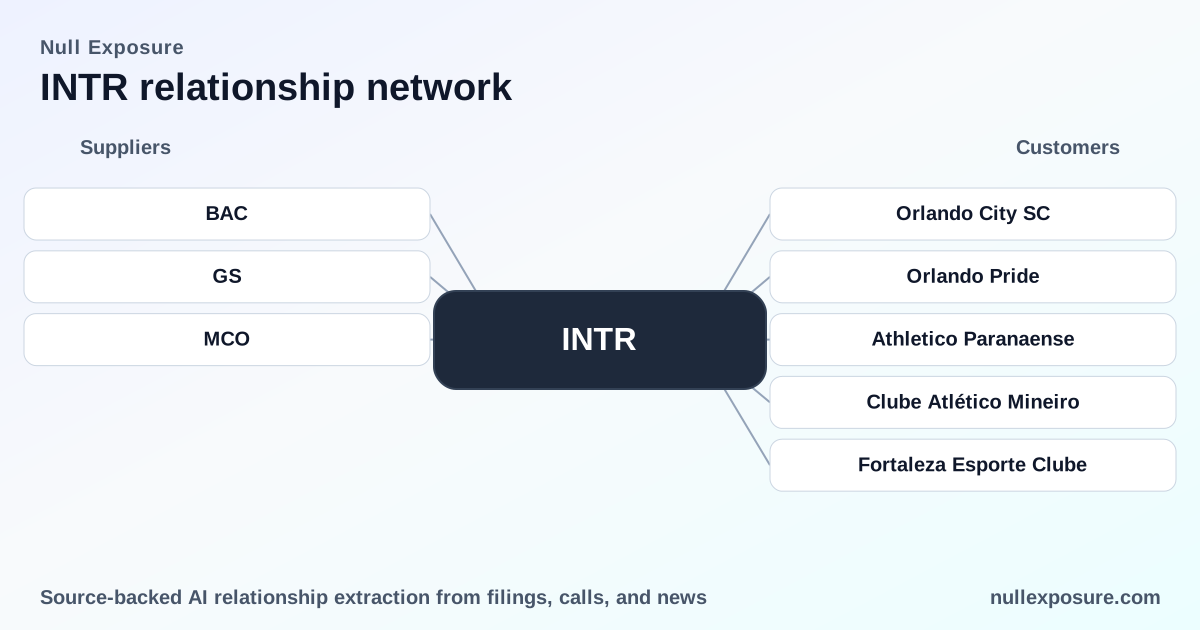
Inter & Co. (INTR) — Supplier and counterparty map for capital markets and credit relationships
Inter & Co. (INTR) is a Brazilian retail bank and wealth-management platform that monetizes through a mix of net interest income, fee-based services, and transaction volumes on its digital platform. The company finances growth and balance-sheet activity through capital-market transactions and benefits from external credit assessments that influence funding costs; understanding its supplier and counterparty set is therefore essential for investors and operators assessing underwriting capacity, refinancing risk, and reputational channels.
Explore additional counterparty intelligence at https://nullexposure.com/.
Where the company generates economics and why suppliers matter
Inter operates as a digital-first regional bank with broad retail distribution and an investment-management arm. Revenue TTM of roughly $5.98 billion and a profit margin near 22% indicate a business that converts scale into earnings, while a return on equity of 14.4% signals effective capital deployment for a regional bank. Inter’s supplier and counterparty footprint is concentrated where it affects capital access and credit standing: global investment banks for equity and debt placements, and credit-rating agencies that shape funding spreads.
From an operating-model standpoint, view these signals at the company level:
- Contracting posture: Transactional and episodic with global banks — relationships are primarily capital-markets engagements rather than long-term operational outsourcing.
- Concentration: Capital-markets activity concentrates exposure to a small set of global coordinators when Inter pursues follow-on offerings, increasing single-event counterparty importance.
- Criticality: Investment banks are critical for rapid equity issuance and market access; credit-rating agencies are critical for ongoing funding-cost dynamics.
- Maturity: These are mature, well-established relationship types (global banks and rating agencies) with standard market documentation, reducing operational novelty but maintaining reputational and execution risk.
If you want a cross-check of counterparties and their business implications, see our platform: https://nullexposure.com/.
Supplier relationships: what the public record shows
Below are every supplier/counterparty identified in public results and what those linkages mean in plain English.
BofA Securities, Inc. — global coordinator on equity issuance
According to a GlobeNewswire press release dated January 16, 2024, BofA Securities acted as a Global Coordinator alongside Goldman Sachs on Inter’s follow-on public offering, indicating direct access to a major U.S. capital-markets desk for equity supply execution. This participation underscores Inter’s ability to engage large, full-service banks when executing market financings. (GlobeNewswire, Jan 16, 2024.)
Takeaway: BofA’s role signals institutional distribution capacity for sizeable equity transactions, reducing execution risk for follow-on offerings.
Goldman Sachs & Co. LLC — partner on capital markets execution
Public coverage on both GlobeNewswire and Yahoo Finance confirms Goldman Sachs served as the other Global Coordinator for the same offering reported January 16, 2024, demonstrating Inter’s reliance on top-tier investment banks for equity placement and syndication. The involvement of Goldman Sachs provides market credibility and access to institutional investors. (GlobeNewswire, Jan 16, 2024; Yahoo Finance, Jan 16, 2024.)
Takeaway: Goldman’s engagement complements distribution, pricing, and book-running capabilities—important for timing-sensitive capital raises.
Moody’s Local BR — domestic credit assessment and outlook revision
A press report published in The Globe and Mail references Inter’s announcement on October 3, 2025 that Moody’s Local BR reaffirmed Banco Inter S.A.’s ‘AA+.br’ rating and upgraded the outlook to Positive, signaling an improved credit profile in the domestic rating scale and potential for tighter funding spreads. This rating action has direct implications for borrowing costs and counterparty confidence in debt markets. (The Globe and Mail referencing Inter announcement, Oct 3, 2025.)
Takeaway: A positive rating outlook from Moody’s Local BR materially supports access to cheaper wholesale funding and enhances investor confidence.
How these relationships influence risk and execution
Inter’s public relationships are concentrated where execution and cost of capital are decided: global bulge-bracket banks and domestic rating agencies. Those ties are transactional but high-impact: a successful follow-on offering reduces equity pressure and funds growth, while an improved local rating shrinks cost-of-funds over time.
Key investment and operational implications:
- Funding optionality: The presence of BofA and Goldman Sachs as coordinators demonstrates the bank’s access to global distribution when it needs equity capital. This lowers execution risk for episodic capital raises but creates single-event dependency on lead managers for pricing and timing.
- Credit and funding costs: Moody’s Local BR’s positive outlook is a direct lever on funding economics; sustained positive credit signals translate to narrower spreads on debt and interbank access.
- Concentration risk is episodic, not structural: These relationships are not core operational suppliers (e.g., IT vendors) but are critical during capital events; operational continuity is not at stake, while market-execution risk is.
- Reputational channel: High-profile banks and rating agencies also function as reputational validators—positive engagements improve investor and counterparty sentiment.
Company-level signals to watch (without attribution to a single supplier)
Because the constraint set for supplier relationships provided no named constraints, treat the following as company-level operating signals:
- Institutional shareholder mix (~39% institutions) and insider stake (~19%) suggest governance alignment between management and significant investors, which influences capital decisions and the propensity to tap markets.
- Forward P/E near 9.7 and trailing P/E at 14.5 indicate market expectations for earnings growth relative to peers; market receptivity to follow-on offerings depends on these valuation dynamics.
- Digital distribution and fee income expansion position Inter to diversify revenue, lowering long-term reliance on capital markets for growth funding versus pure balance-sheet funding.
Actionable recommendations for investors and operators
- For investors: Monitor the cadence and choice of global coordinators on future capital raises, as lead-manager selection signals desired investor targeting and potential pricing discipline. Track rating-agency outlooks for immediate effects on funding costs.
- For operators and risk teams: Institutionalize engagement playbooks with global banks and rating agencies so that capital events run on a repeatable timeline and documentation standard, minimizing execution risk.
- For credit/watchlist analysts: Prioritize updates to funding curve assumptions when rating outlooks change; a positive domestic outlook can reduce near-term cost of debt materially.
If you want a deeper counterparty roadmap and live monitoring for INTR’s supplier relationships, visit https://nullexposure.com/ for full intelligence and alerts.
Conclusion
Inter’s public supplier map is compact and focused on capital-markets and credit relationships: global banks for equity issuance and domestic rating agencies for credit visibility. These links materially affect execution capability and funding costs but are episodic rather than operational. For investors, the practical takeaway is clear: track capital-market activity and rating outlooks as leading indicators of financing flexibility and cost. For operators, standardize engagement with these counterparties to keep execution risk low and timing predictable.