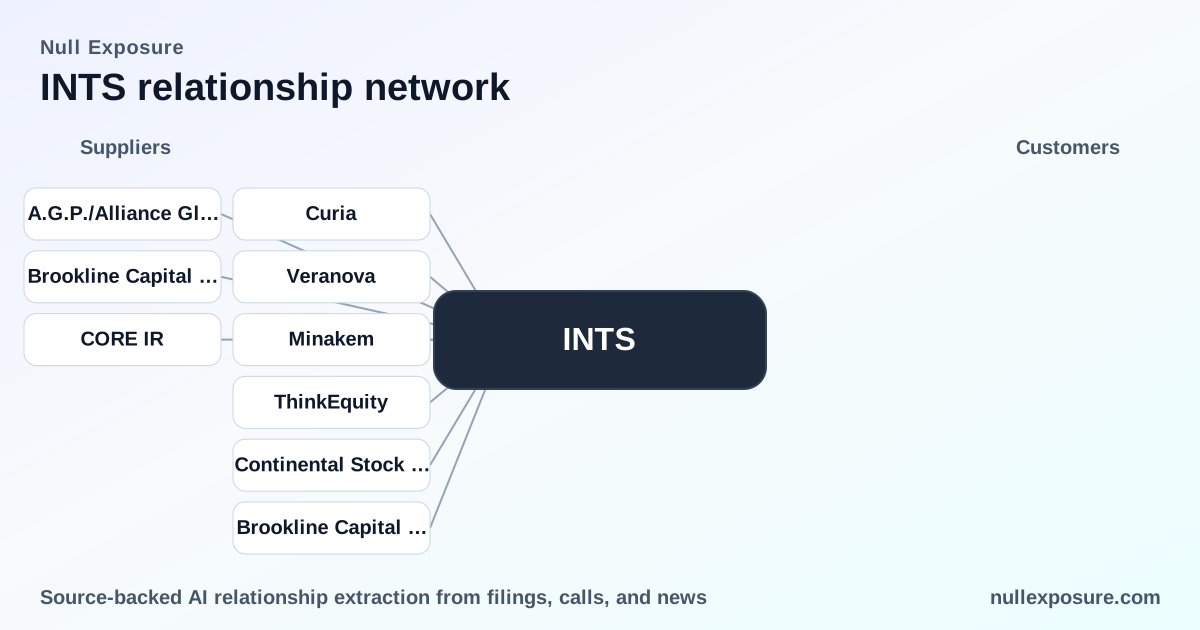
Intensity Therapeutics (INTS): Supplier map and what it means for investors
Intensity Therapeutics operates as a small-cap biotechnology developer that outsources clinical manufacturing and bulk active pharmaceutical ingredients while relying on third-party capital markets partners to fund operations. The company monetizes by advancing its INT230-6 program and related oncology assets through clinical development and then capturing value via licensing, partnerships, or commercial launch—while using registered direct and public equity placements to finance development. For investors, the critical lenses are manufacturing continuity, input sourcing for chemotherapies, and capital markets dependence.
If you want a consolidated view of supplier and capital-market counterparties for INTS, visit https://nullexposure.com/ for the full platform that aggregates these relationships and source documents.
High-level conclusions for an investment or operator due diligence
Intensity runs a lean, outsourced operating model. Clinical manufacturing and bulk API suppliers are mission‑critical for trial continuity; conversely, investor relations, placement agents, and transfer agents drive near-term funding and shareholder mechanics. The company’s contracting posture is outsourced and concentrated, with active long-term leases and reliance on external CROs/CMOs and placement agents to execute financing. Key takeaways:
- Manufacturing is outsourced and geographically distributed (U.S., UK, Belgium) — this reduces fixed capital needs but raises single‑vendor continuity risk.
- Bulk APIs are purchased from specialized suppliers; disruptions in that supply chain would directly affect clinical timelines.
- Capital markets relationships are active and frequent, with multiple placement agents and a sole book‑runner on public offerings in recent periods.
- Investor relations and transfer agent arrangements handle communications and post-offering mechanics, which is critical given recent reverse splits and registered offerings.
Explore the primary source links and relationship documents at https://nullexposure.com/ for deeper document-level evidence.
Who supplies what — every named counterparty and what they do
Below I cover every counterparty referenced in public filings and press releases tied to INTS, with a concise, plain-English line on role and source.
Curia
Curia manufactures INTS’ SHAO product in Albany, New York, and the INT230-6 drug product in Glasgow, Scotland for Intensity’s clinical supply chain. According to Intensity’s 2024 Form 10‑K, Curia is the contract manufacturer for these drug products (FY2024 10‑K).
Veranova
Intensity purchases cisplatin, a chemotherapy active ingredient, from Veranova’s facility in West Deptford, New Jersey — a direct input supplier for protocols that include platinum agents. This relationship is stated in the company’s 2024 Form 10‑K (FY2024 10‑K).
Minakem
Vinblastine sulfate for Intensity’s programs is sourced from Minakem in Mont‑Saint‑Guibert, Belgium, supplying a second critical chemotherapy active ingredient. The 2024 Form 10‑K documents the Minakem purchase (FY2024 10‑K).
ThinkEquity
ThinkEquity acted as the sole book‑running manager on a public offering announced in FY2025, which places them at the center of at least one material equity financing. This role is confirmed in a PR Newswire offering announcement (FY2025 PR Newswire).
Continental Stock Transfer & Trust
Continental Stock Transfer & Trust serves as the transfer agent handling post‑split certificate exchanges and fractional share cash‑outs, a practical operations role after the company’s reverse stock split. That function was described in press coverage of the reverse split (FY2026 Barchart/press).
Brookline Capital Markets (Arcadia Securities division)
Brookline Capital Markets acted as a co‑placement agent on registered direct offerings, supporting distribution to institutional and accredited investors in FY2024‑FY2025 financing activity. This is noted in the company’s offering press releases and market reports (FY2024–FY2025 MarketScreener & PR Newswire).
A.G.P. / Alliance Global Partners
A.G.P. / Alliance Global Partners has been the lead placement agent on multiple offerings, taking the placement lead role on registered and direct offerings during the FY2024‑FY2025 period. That placement lead role is reported in multiple offering announcements (FY2024–FY2025 MarketScreener & PR Newswire).
CORE IR
CORE IR is the retained investor relations and media contact referenced across multiple press releases and company announcements, handling investor communications and press distribution for clinical milestones and financing news in FY2024–FY2026. This is evident in PR Newswire and other press coverage where CORE IR contacts are listed (FY2024–FY2026 PR Newswire, Finviz, Barchart).
What the contract and supplier constraints tell investors
The company-level constraints extracted from filings and public statements form a coherent portrait of Intensity’s operating model:
- Contracting posture — outsourced and long‑dated facility lease. Intensity maintains operations under a 5.5‑year lease for its Shelton, CT address entered in July 2023, indicating stable office/administrative tenure but no owned manufacturing footprint (company 10‑K disclosure).
- Concentration and criticality — third‑party manufacturing and specialized API suppliers. The firm does not own manufacturing capacity and relies on CMOs for clinical supply, making those supplier relationships operationally critical to trial timelines (company 10‑K).
- Relationship roles — manufacturer and service provider predominance. The filing explicitly frames counterparties as contract manufacturers, CROs, and service providers for clinical development and cybersecurity advisors for governance, highlighting a mature outsourcing posture for a clinical‑stage biotech.
- Maturity and stage — active but non‑commercial. The firm has no commercial distribution capability and relies on third‑party distributors if and when commercialization occurs, positioning these supplier relationships as developing and operationally pivotal pre‑commercial arrangements.
- Counterparty type signal — engagement with large enterprise software providers. The company cites security features of third‑party software operated by large corporations such as Microsoft, signaling reliance on enterprise‑grade service providers for IT and security.
These constraints collectively describe a company that is asset‑light on manufacturing but highly dependent on a small set of external suppliers and capital markets intermediaries for both operations and funding.
If you want a deeper, document‑level supplier and counterparty map for Intensity, the aggregated relationships are available at https://nullexposure.com/.
Investment implications and risk checklist
For investors and operators evaluating INTS supplier exposure, focus on three actionable items:
- Validate CMO continuity and redundancy. With Curia handling manufacturing in two jurisdictions, confirm capacity commitments and backup plans to avoid trial delays.
- Audit API supply contracts and lead times. Cisplatin and vinblastine sulfate come from named suppliers; contractual supply guarantees and change‑control processes are material.
- Monitor capital markets partners and liquidity cadence. Frequent use of placement agents and registered offerings, and a sole book‑runner on at least one public deal, make short‑term funding execution a material risk/reward driver.
For a consolidated view of public documents supporting these points and to track new supplier disclosures, visit https://nullexposure.com/ and review the source filings and press releases.
Conclusion: Intensity’s outsourcing model is standard for a clinical‑stage biotech, but the combination of concentrated CMO dependence, specialized API suppliers, and active equity financing partners concentrates operational and funding risk. Investors should treat supplier diligence as part of any investment thesis and verify contractual protections before assuming smooth clinical progression.