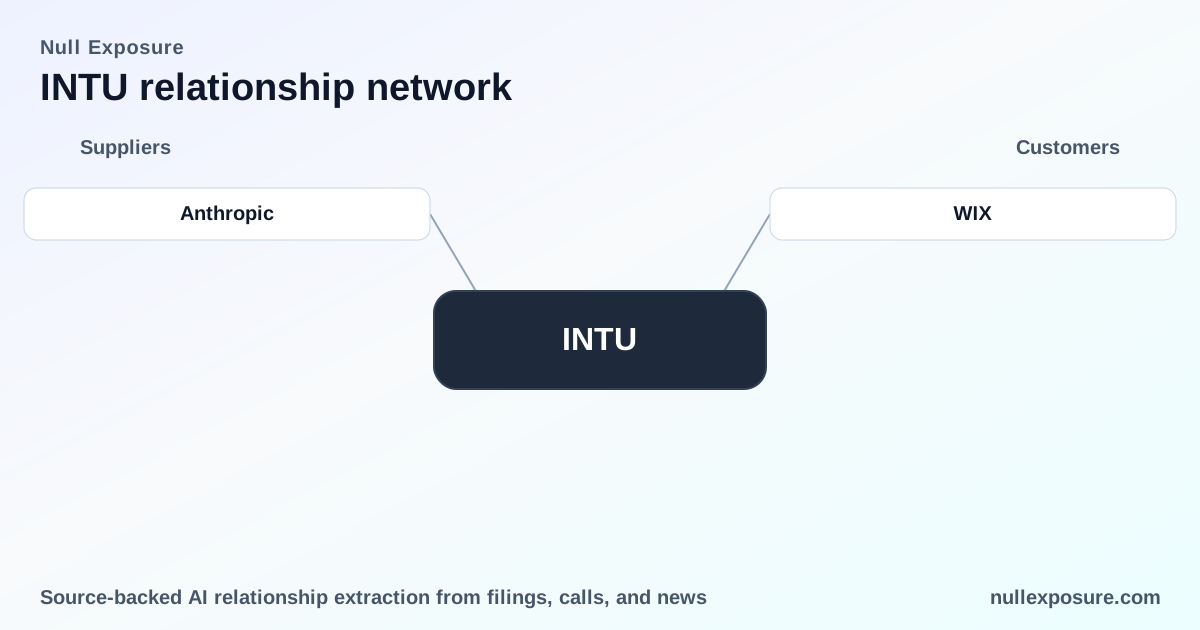
Intuit’s supplier map: what investors need to know about third‑party exposure and the new Anthropic tie-up
Intuit monetizes a diversified portfolio of financial software and services—TurboTax, QuickBooks and Mint—primarily through recurring subscriptions, transactional fees and add‑on business services. Supplier relationships for Intuit are operationally material because they support distribution of packaged software and cloud hosting for core SaaS products; investors should evaluate both concentration risk in physical manufacturing/distribution and cloud dependency and partner‑led AI initiatives as coexisting operational factors. For a concise operational-risk evaluation and supplier monitoring, visit https://nullexposure.com/.
Why supplier relationships matter for a software company that still ships boxes
Intuit is a modern software company with legacy retail footprints. Its core revenue engine is subscription and services economics driven by digital adoption, but the company continues to rely on third parties for physical packaging/distribution for desktop products and on external cloud providers for hosting. That dual posture creates a two‑dimensional supplier risk profile: concentration and criticality for distribution, and operational scale and vendor maturity for cloud services. At the same time, Intuit is pursuing external AI partnerships to accelerate product differentiation and expansion into mid‑market automated financial services.
The Anthropic partnership — a concise investor read
- Intuit announced a strategic, multi‑year partnership with Anthropic to co‑develop customizable AI agents for mid‑market customers, positioning AI as an incremental product driver for automated financial workflows. A March 2026 IBTimes Australia report cited Intuit’s February 24 announcement of the deal and linked the partnership to the company’s better‑than‑expected results and analyst upgrades (https://www.ibtimes.com.au/intuit-shares-surge-6-rebound-ai-fears-strong-fundamentals-analyst-upgrades-1862751).
- TradingKey reported in early March 2026 that the partnership is multi‑year and focused on custom AI agents for businesses, reinforcing Intuit’s strategy to embed generative AI into its small‑ and mid‑market offerings (https://www.tradingkey.com/news/stocks/261636084-market-movers-intu-20260302).
- A subsequent TradingKey mention reiterated that this initiative strengthens Intuit’s position in automated financial services by delivering tailored AI agents to business customers, implying product roadmap and go‑to‑market coordination with Anthropic (https://www.tradingkey.com/news/stocks/261641170-market-movers-intu-20260303).
Takeaway: the Anthropic relationship is a strategic technology partnership intended to accelerate product differentiation and revenue expansion in mid‑market automation.
How the Anthropic tie influences investment calculus
The Anthropic partnership is a strategic enabler rather than a supplier for goods; it communicates Intuit’s willingness to outsource core AI model work to a specialist in order to speed time‑to‑market. For investors, the relevant vectors are product differentiation, potential acceleration of ARPU (average revenue per user) from higher‑value automation features, and the contractual shape of the deal (multi‑year). These factors enhance the revenue runway while leaving execution risk concentrated in partner integration and commercialization execution.
Visit https://nullexposure.com/ for a deeper supplier‑risk briefing tailored to enterprise relationships.
Company‑level constraints and what they signal about Intuit’s operating model
Company filings and excerpts report three supplier‑related constraints that function as company‑level signals:
- Intuit relies primarily on one third‑party vendor for manufacturing and distribution of its retail desktop software products. This is a concentration signal: the contracting posture is dependent, the relationship is operationally critical for any remaining physical distribution, and the maturity of that vendor relationship is entrenched but concentrated—creating single‑point disruption risk if logistics or vendor performance deteriorates.
- The same filing text lists that the third party performs both manufacturing and distribution functions, underscoring operational coupling: the supplier is not only a logistics provider but the physical production gatekeeper for boxed software.
- Intuit primarily uses two third‑party public cloud providers for cloud hosting needs, indicating a deliberate multi‑provider cloud strategy that reduces single‑vendor cloud concentration but retains strategic dependency on those providers for uptime, latency and compliance controls.
From an investor perspective, the manufacturing/distribution concentration is a tangible single‑source risk, while the two‑provider cloud posture is a moderating signal of resilience—it balances vendor lock‑in concerns against the complexity and procurement cost of running multi‑cloud operations.
Operational and contractual implications for investors
- Concentration risk: reliance on one vendor for manufacturing/distribution elevates operational exposure in scenarios such as global logistics disruption, vendor insolvency, or localized regulatory issues. This is materially different from pure SaaS peers that outsource only to cloud vendors.
- Cloud criticality and maturity: using two public cloud providers is an operationally mature posture that signals vendor diversification for hosting, but it requires robust orchestration and adds integration overhead.
- Partnered AI acceleration: the Anthropic multi‑year collaboration is strategic and revenue‑accretive if Intuit executes commercialization; it also shifts some technology execution risk outside the company’s direct control.
What investors should watch next
- Monitor filing updates or earnings commentary that name the manufacturing/distribution vendor or disclose contingency plans; any shift away from single‑vendor dependence will materially reduce operational risk.
- Track product release cadence and go‑to‑market timelines tied to the Anthropic partnership; evidence of early customer trials or ARPU uplift will validate the strategic thesis.
- Watch cloud service incidents and vendor negotiations in Form 10‑Ks/10‑Qs for evidence of service‑level exposure or cost pressure.
For operational monitoring and a supplier‑centric view of Intuit’s counterparties visit https://nullexposure.com/.
Bottom line
Intuit’s supplier map combines a legacy concentration risk in physical manufacturing/distribution with a modern multi‑cloud hosting stance and an ambitious AI partnership with Anthropic that targets mid‑market automation. Investors should value the Anthropic tie as strategic upside while discounting the asymmetric operational risk posed by a single manufacturing/distribution vendor. Balance the growth story against these supplier exposures when assessing valuation and scenario risk.