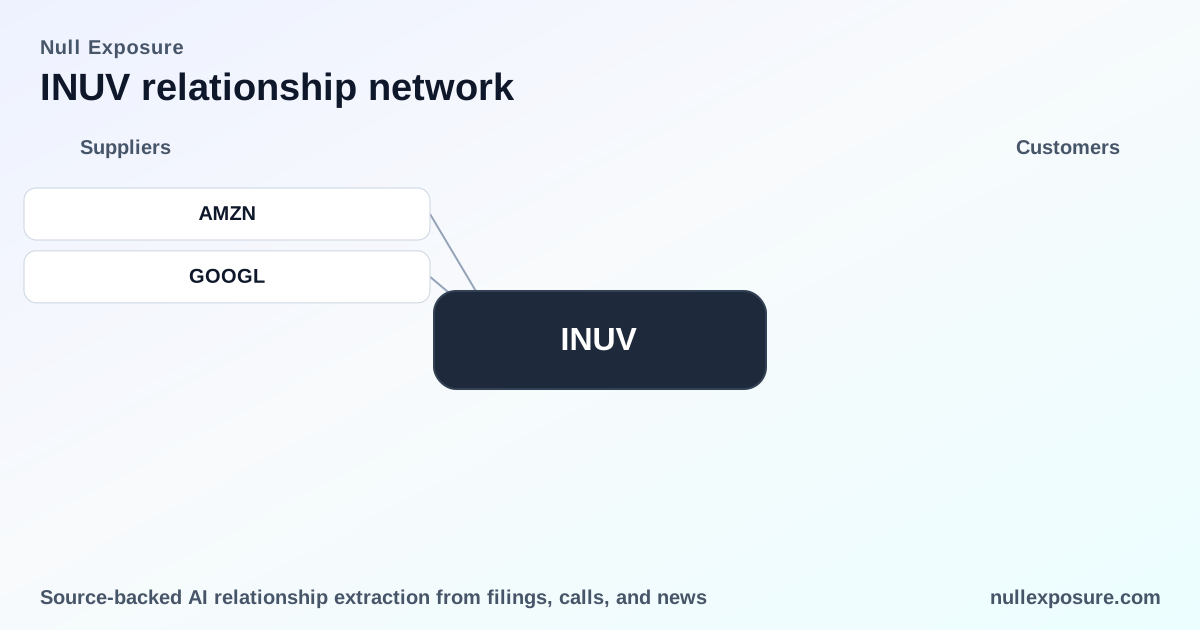
Inuvo (INUV) — supplier map, commercial posture, and what Google + AWS relationships mean for investors
Inuvo operates and monetizes as a small-cap technology company that sells information-technology and platform services through operating units (including the Vertro subsidiary). Revenue is generated from platform-based services and vendor-enabled delivery, with FY2025 revenue roughly $86.2 million and margins under pressure; supplier relationships with large cloud and platform providers therefore materially affect unit economics and resilience. Investors should treat Inuvo as a vendor-dependent technology operator where platform access and cloud migration choices drive near-term cost structure and scale economics. For a quick navigation of supplier risk and concentration analytics, visit https://nullexposure.com/.
The short take: how Inuvo runs its business and pays the bills
Inuvo builds and sells application-level software and platform services out of Little Rock, Arkansas, and operates with a small-cap capitalization ($37.5M market cap) and negative trailing profitability. The company uses a mix of long-term property and equipment leases and third‑party platform vendors to deliver services; vendor relationships are therefore both operationally critical and materially concentrated, which compresses negotiation leverage and raises single-vendor risk for an operator of this size.
Supplier relationships investors need to know about
AWS (Amazon Web Services)
- Inuvo is actively migrating its data centers to the AWS Cloud to capture cost savings, greater scalability, and improved resiliency as it scales platform operations, according to remarks reported from the company’s FY2026 commentary. Source: InsiderMonkey transcript of Inuvo’s Q4 2025 / FY2026 commentary (published March 2026) — https://www.insidermonkey.com/blog/inuvo-inc-amexinuv-q4-2025-earnings-call-transcript-1711381/.
Google (via Vertro subsidiary)
- Vertro, a subsidiary of Inuvo, executed an Extension Amendment to its Google Services Agreement to preserve the existing commercial relationship, indicating continuity of platform access that is central to the company’s operations. Source: MarketScreener report on the extension effective March 1, 2026 — https://www.marketscreener.com/news/inuvo-inc-says-unit-vertro-extends-google-services-agreement-effective-march-1-ce7e5dd9de8bf027.
- Management described Google as a long-standing and larger platform customer that has contributed materially to the business and referenced a recent cash award tied to that relationship, reinforcing the strategic importance and historical dependence on Google platform services. Source: InsiderMonkey earnings call transcript (Q4 2025 / FY2026 discussion) — https://www.insidermonkey.com/blog/inuvo-inc-amexinuv-q4-2025-earnings-call-transcript-1711381/.
- Reuters/TradingView also covered the extension amendment filing for Vertro and its Google Services Agreement in early 2026, corroborating the public disclosure of the contractual extension. Source: TradingView/Reuters summary (January 26, 2026 reporting) — https://www.tradingview.com/news/reuters.com,2026:newsml_FWN3YT1C3:0-inuvo-inc-on-jan-26-vertro-unit-of-co-got-into-extension-amendment-to-google-services-agreement/.
What the supplier map implies about contracting posture and commercial constraints
- Contracting posture — long-term orientation. Inuvo’s filings disclose operating and finance leases with multi-year terms (three to six years) and renewal/purchase options; this signals an operational preference for longer-term commitments and a measured, capital-managed posture rather than purely short-term vendor switching.
- Concentration and criticality — high single-vendor impact. The company reported that, in 2024, three vendors accounted for 59.6%, 25.6% and 10.3% of cost of revenue respectively, and constraints flag these relationships as critical. That concentration means vendor actions (pricing, replatforming, access changes) will transmit directly to gross margin and service continuity.
- Spend profile — mid-single-digit millions. Evidence places typical spend bands in the $1M–$10M range for materially impactful vendors, which is consistent with a scale that is meaningful to operations but small relative to hyperscalers’ overall revenue — a posture that reduces bargaining leverage versus platform providers.
- Maturity and strategic posture. The mix of legacy data centers transitioning to AWS and an extended Google services agreement suggests management is consolidating platform dependency while outsourcing scale-critical infrastructure to hyperscalers — a strategy that benefits variable cost flexibility but locks in platform dependency.
Risk / reward implications for investors and operators
- Upside: Migrating to AWS should reduce fixed hosting costs and deliver scalability benefits that support growth without commensurate capital expenditure, improving operating leverage if revenue stabilizes and user acquisition costs are controlled.
- Downside: High vendor concentration and the company's small scale create material counterparty risk — a change in Google or AWS commercial terms, a lost certification, or an access restriction could disproportionately damage revenue and margin. Management’s ability to renegotiate terms is constrained by spend scale and market position.
- Execution sensitivity: Given negative EBITDA and low margins, successful cloud migration and sustained platform continuity with Google are operational levers that materially influence near-term profitability.
For deeper supplier intelligence and to map contract-level exposures against revenue lines, check the platform at https://nullexposure.com/.
Practical diligence checklist for investors evaluating INUV supplier exposure
- Validate the length and termination rights of the Google Services Agreement extension (SLAs, revenue share, penalty clauses).
- Quantify migrated workload run-rate on AWS and short-term one-time migration costs versus expected run-rate savings.
- Model sensitivity of gross margin to a 10–20% change in key vendor pricing or a loss of preferential access to platform features.
- Confirm the identities and dollar exposure of the three vendors that together comprised >95% of concentrated cost buckets in 2024.
Bottom line and recommended next steps
Inuvo is a small-cap tech operator where vendor relationships are a core driver of cost structure, scale, and execution risk. The extension of the Google Services Agreement (Vertro) and the explicit migration to AWS are two corporate choices that reduce operating friction but simultaneously concentrate counterparty exposure. Investors should prioritize contract-level diligence and scenario modeling around vendor pricing and access; operators should pursue redundancy, clear SLAs, and a migration roadmap that converts one-time costs into sustainable operating savings.
For a tailored supplier-risk assessment and benchmarking against peers, visit https://nullexposure.com/ for more detailed supplier intelligence and dashboards.