Invitation Homes (INVH): Supplier Relationships and What They Mean for Investors
Invitation Homes operates and monetizes as the largest single-family rental REIT in the U.S., acquiring, renovating, and leasing suburban homes to generate recurring rental income, ancillary fees, and capital appreciation on a large owned-and-operated portfolio. The company supplements organic portfolio growth with strategic acquisitions and in-house development capabilities, converting construction and renovation activity into leased cash flow and balance-sheet assets. For investors evaluating INVH supplier exposure, the critical questions are how INVH sources homes, how it contracts for construction and repair services, and how dependent ongoing operations are on third-party vendors. Learn more at https://nullexposure.com/.
Why supplier relationships matter to INVH's business model
INVH’s operating model is vertically integrated around three cash-generating flows: rental income from a scale portfolio, fee income from property services, and value capture through homebuilding and renovation. That integration depends on two supplier axes: homebuilders who deliver inventory and service vendors who maintain livability and lease velocity.
- Homebuilder and development relationships control the pace and cost of adding new, lease-ready units and therefore influence capex timing and portfolio yield.
- Maintenance and technical service providers control operating continuity and resident experience, and problems here directly depress occupancy and lease pricing.
These supplier dynamics are business-critical: they influence near-term cash flows and long-term asset returns in a capital-intensive model where INVH’s market capitalization ($15.4B) and EBITDA ($1.49B) reflect scale but not immunity to operational disruption.
The reported relationship: ResiBuilt — one line, big implications
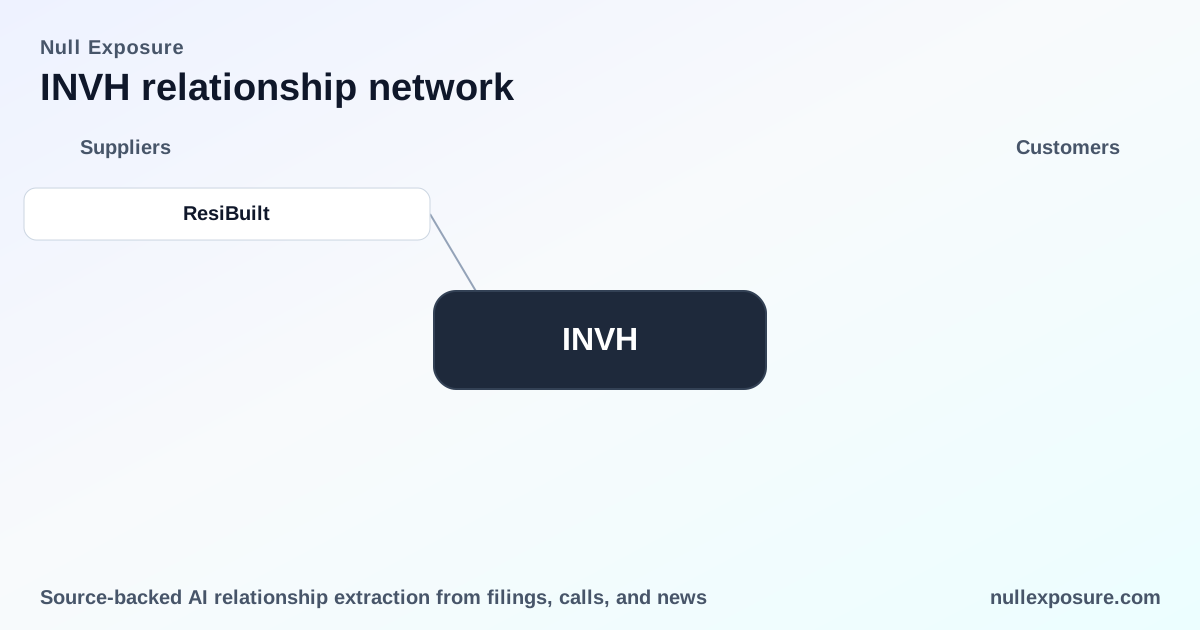
ResiBuilt: In January 2026 INVH acquired ResiBuilt, a fee homebuilder focused on single-family rental communities, integrating homebuilding capability into Invitation Homes’ platform and accelerating the company’s ability to deliver lease-ready homes on a scheduled basis. This was reported in TradingView’s summary of INVH’s SEC filings in March 2026 (FY2026 disclosure). Source: TradingView (news summary of INVH SEC 10‑K, March 2026) — https://www.tradingview.com/news/tradingview:4ca27fbeb1122:0-invitation-homes-inc-sec-10-k-report/.
What the documented constraints say about INVH’s supplier posture
Several company-level signals in INVH’s filings describe the nature of supplier engagements and operational dependencies:
- Long-term contracting posture: The company describes arrangements with homebuilders that “generally provide for periodic deposits from us to the homebuilders and scheduled delivery of homes over a specified period of time,” signaling a forward-committed procurement model that stabilizes supply cadence but locks in capital and timing exposures. This is a company-level operating signal rather than an attribute tied to any single named supplier.
- Critical materiality of third-party services: INVH states that “certain critical components of our platform are dependent upon third‑party service providers,” and that a significant portion of operations are conducted online or through mobile applications. This elevates vendor risk into a business-critical category for the entire enterprise.
- Service-provider relationship role for repairs and technical work: INVH uses in-house maintenance for routine tasks but outsources complex repairs — roofing, HVAC, plumbing, electrical — to “vetted, pre-approved third‑party vendor partners.” This signals a hybrid model where vendor quality directly affects operating margin and resident retention.
Each of these excerpts is drawn from the company filing language and should be treated as a company-level indicator of contracting style, dependency, and operational criticality.
Operational and financial implications for investors
INVH’s supplier choices translate directly into measurable investment outcomes:
- Capital timing and portfolio growth control. Long-term delivery schedules with builders (as noted in the filing language) let INVH plan inventory rollouts and amortize capital, but they also create exposure to construction cycle risk and deposit-financing needs.
- Operational continuity risk. Outsourced technical services for critical systems (HVAC, roofing) are essential to preserving occupancy and limiting repair capex spikes; vendor failures or capacity constraints translate into leasing downtime and higher turnover costs.
- Margin leverage and scale economics. Owning homebuilding capabilities through acquisitions like ResiBuilt shifts cost structure toward internally managed development, potentially improving margin capture on new units and reducing per-unit acquisition costs over time.
INVH’s valuation multiples (EV/EBITDA ~13.9, Price/Book ~1.61) and steady revenue/EBITDA base make supplier execution a key differentiator for returns — operational efficiency wins translate directly to both cash yield and equity returns.
Explore supplier mapping and risk scoring at https://nullexposure.com/ to see how these dynamics compare across peers.
Key risks investors should track
- Potential supplier concentration risk if a small set of builders or vendor networks account for the majority of deliveries in a given market.
- Delivery timing and capex lock-in from long-term builder contracts that could misalign with market demand or financing conditions.
- Service quality and capacity of third-party vendors for complex repairs; poor vendor performance increases turnover and can depress rent relets.
- Technology and platform dependence: outages or third-party SaaS interruptions affect resident-facing processes and revenue collection.
Relationship-by-relationship inventory (complete)
ResiBuilt — Invitation Homes acquired ResiBuilt in January 2026 to add fee homebuilding capability and accelerate delivery of single-family rental communities; this expands INVH’s ability to control construction and timing of new inventory (FY2026). Source: TradingView’s March 2026 coverage of INVH’s SEC 10‑K — https://www.tradingview.com/news/tradingview:4ca27fbeb1122:0-invitation-homes-inc-sec-10-k-report/.
(There are no additional named supplier relationships in the provided results; the company-level excerpts cited above describe INVH’s broader contracting and vendor posture.)
Concrete investor actions
- Monitor delivery cadence and capex guidance tied to homebuilder contracts and acquisitions such as ResiBuilt; deviations are early warnings of execution risk.
- Require disclosure of vendor concentration and geographic vendor networks in future filings or quarterly commentary to assess operational resilience.
- Watch service-level metrics (maintenance backlog, turn-time, lease-up speed) as primary leading indicators of margin pressure.
For a structured supplier risk summary and ongoing monitoring tools visit https://nullexposure.com/.
Bottom line
Invitation Homes is scaling both by buying homes and by building them, and the ResiBuilt acquisition converts a vendor relationship into an owned capability that changes both execution risk and margin dynamics. INVH’s long-term contracting posture, reliance on third‑party service providers for critical repairs, and the integration of homebuilding capacity are the primary supplier-related levers that will determine near-term cash flow stability and long-term return capture. For investors and operators, the focus should be on execution timelines, vendor capacity, and disclosure of supplier concentration — those are the variables that move the stock and the business. Explore more supplier intelligence at https://nullexposure.com/.