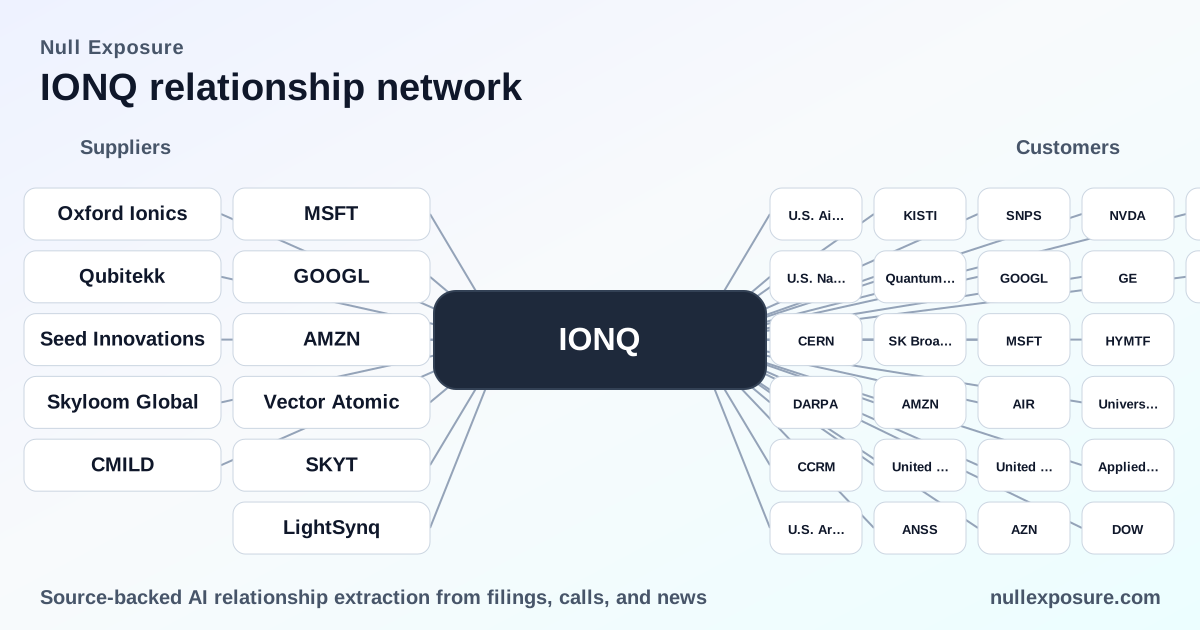
IONQ supplier map: who powers the quantum stack and why it matters to investors
IonQ builds and sells access to trapped‑ion quantum processors and related software, monetizing through cloud access (channel partnerships and its own cloud service), intellectual‑property licensing, and strategic M&A to vertically integrate sensing, networking and fabrication. Revenue flows from cloud access fees, enterprise/custom engagements, and the long‑term value of owned IP and acquired technology platforms. For investors evaluating supplier and partner risk, the combination of cloud distribution agreements, critical IP licenses, and recent acquisitive behavior defines both growth optionality and balance‑sheet exposure. Learn more and track supplier signals at https://nullexposure.com/.
Why supplier relationships are a first‑order investment variable for IonQ
IonQ’s commercial model is distribution‑heavy: its quantum processors are primarily monetized through third‑party cloud marketplaces (Microsoft Azure, Google Cloud, Amazon Braket) and direct enterprise contracts. That distribution posture reduces customer acquisition friction but increases strategic dependence on a small number of hyperscale cloud channels for reach and billing. At the same time, IP licensing and specialized supply lines (isotopes, foundry services) are material and strategically critical to operations, which pushes the company toward vertical integration via acquisitions.
Key operating model signals:
- Contracting posture: mix of long‑term leases and exclusive IP licenses creates durable, predictable fixed costs and legal protections for core technology.
- Concentration: cloud channel concentration across the three major cloud providers creates both scaling leverage and single‑point‑of‑channel risk.
- Criticality: licensing of foundational patents and reliance on specialized materials (sourced via government programs) are critical to manufacturing and product delivery.
- Maturity and spend: operating leases and other obligations sit in a medium spend band consistent with capital‑intensive hardware development.
If you want a supplier‑focused monitoring dashboard for quantum and adjacent tech suppliers, start here: https://nullexposure.com/.
Supplier and partner map — the relationships investors should know
Below I review every relationship returned in the supplier results. Each entry is a concise, plain‑English description with source attribution.
Microsoft Azure
IonQ’s systems are available through Microsoft Azure’s quantum marketplace, making Azure a primary distribution channel for customer access to IonQ hardware (FY2026 reporting). According to The Quantum Insider (referenced FY2026), IonQ is the only vendor with systems live on Azure alongside other clouds.
Source: The Quantum Insider article cited in FY2026 (thequantuminsider.com, first seen March 2026).
Google Cloud
IonQ lists Google Cloud as a cloud distribution partner, with its machines accessible via Google’s cloud marketplace (FY2026). The Quantum Insider’s coverage (referenced FY2026) confirms IonQ’s multi‑cloud availability, including Google Cloud.
Source: The Quantum Insider article (referenced FY2026).
Amazon Braket
IonQ’s Aria system is commercially available on Amazon Braket, giving enterprise customers access through AWS’s quantum service (FY2026). An IonQ press release announced Aria’s availability on Amazon Braket in FY2026.
Source: IonQ press release on ionq.com (FY2026).
Amazon Web Services (AWS) — broader listing and filings
MarketBeat and other filings reiterate that IonQ distributes via AWS (Amazon Braket) and calls out AWS specifically as a broad cloud partner for access and billing (FY2026). This duplicates the Braket channel but highlights AWS’s strategic importance.
Source: MarketBeat filing summary (FY2026).
Amazon Web Services (AWS) / Amazon Braket (combined mention)
A MarketBeat instant alert also references IonQ’s general cloud distribution through AWS/Amazon Braket, confirming the company’s multi‑channel cloud strategy and repeated market messaging around AWS (FY2026).
Source: MarketBeat instant alert (FY2026).
Vector Atomic
IonQ acquired Vector Atomic to add quantum sensing and satellite distribution capabilities, signaling a move beyond pure compute into positioning, navigation and timing (PNT) applications (FY2026). TelecomTV and Finviz reported on the Vector Atomic deal and its integration into IonQ’s product roadmap.
Source: TelecomTV and Finviz coverage (reported FY2026).
SkyWater / SkyWater Technology Foundry
IonQ announced the planned acquisition of SkyWater Technology (a US semiconductor foundry) as a path to secure supply, accelerate iteration and improve unit economics—an explicitly strategic move to internalize fabrication (announced in FY2026). IonQ’s 2025 Q4 earnings call and multiple news reports described SkyWater as a leading quantum foundry and a material M&A target.
Source: IonQ earnings call (2025 Q4) and press coverage (FY2026).
LightSynq
The acquisition of LightSynq provided IonQ with photonic interconnect technology intended to support scale‑out of systems, per sector reporting (FY2026). Finviz and related press noted this deal as part of IonQ’s scaling toolkit.
Source: Finviz article (FY2026).
Oxford Ionics
IonQ completed the purchase of Oxford Ionics to reduce system footprint and accelerate engineering integration; the deal was reported as a major acquisition of a University of Oxford spin‑out in FY2026. TelecomTV and other outlets covered the acquisition price and strategic rationale.
Source: TelecomTV coverage (FY2026).
Qubitekk (asset purchase)
IonQ completed an asset purchase from Qubitekk, acquiring quantum networking assets to strengthen its networking roadmap, according to press reporting in FY2026. The Quantum Insider and related reports referenced the transaction.
Source: The Quantum Insider (FY2026).
Seed Innovations
IonQ acquired Seed Innovations, a Colorado software and R&D firm focused on government and enterprise challenge solving, to boost systems engineering and government‑facing capabilities (FY2026). TelecomTV reported this as part of IonQ’s acquisition wave.
Source: TelecomTV coverage (FY2026).
Skyloom Global
IonQ completed the purchase of Skyloom Global, a lightwave‑optics developer for secure high‑performance communications, to add networking and secure comms capabilities to its portfolio (FY2026). TelecomTV documented the transaction.
Source: TelecomTV coverage (FY2026).
Capella
IonQ’s deals with Capella were reported to provide satellite‑based distribution channels, reflecting a push into space‑enabled delivery for sensing and networks (FY2026). Finviz referenced the Capella relationship in a broader comparison of quantum firms.
Source: Finviz article (FY2026).
What the constraints reveal about operational risk and upside
The constraint evidence in IonQ’s filings and disclosures shapes a clear operating profile:
- Long‑term commitments: leases in College Park, Bothell and Arlesheim run to 2029–2030, indicating multi‑year fixed occupancy costs and a capital‑intensive footprint.
- Licensing is strategic and exclusive: IonQ discloses exclusive IP licenses with the University of Maryland and Duke University, which are foundational to product commercialization and therefore materially important to value capture.
- Government supply channels: IonQ sources certain specialized materials through the U.S. Department of Energy’s isotope program, indicating dependence on government‑managed supply lines.
- Geographic footprint: active operations in North America and EMEA support global customer reach but also require compliance and logistics capabilities in multiple regulatory regimes.
- Materiality and spend posture: procurement statements and lease maturities place key supplier spend in the $10m–$100m band, and company language treats some suppliers as critical to continuing operations.
These constraints point to a hybrid risk profile: upside from vertical integration and owned IP, counterbalanced by fixed obligations and supplier concentration that increase execution risk during aggressive M&A and scale‑up.
Investment takeaway and monitoring actions
- Bull case: IonQ’s cloud distribution across Azure, Google Cloud and AWS plus targeted acquisitions (SkyWater, Vector Atomic, Oxford Ionics, LightSynq, Skyloom, Seed Innovations) create a scalable enterprise stack spanning compute, sensing and networking—potentially enabling higher‑margin service and product bundles.
- Key risks: channel concentration, long‑term fixed costs, and dependence on specialized materials and IP licensors create execution risk if integration or customer adoption lags.
- Action: monitor cloud distribution metrics, SkyWater integration milestones, and government supply notifications. For a supplier‑centric monitoring solution and alerts, visit https://nullexposure.com/.
If you want bespoke supplier intelligence and event monitoring for IonQ and its ecosystem, start a watchlist at https://nullexposure.com/.