IonQ-WS: supplier relationships that shape commercialization and risk
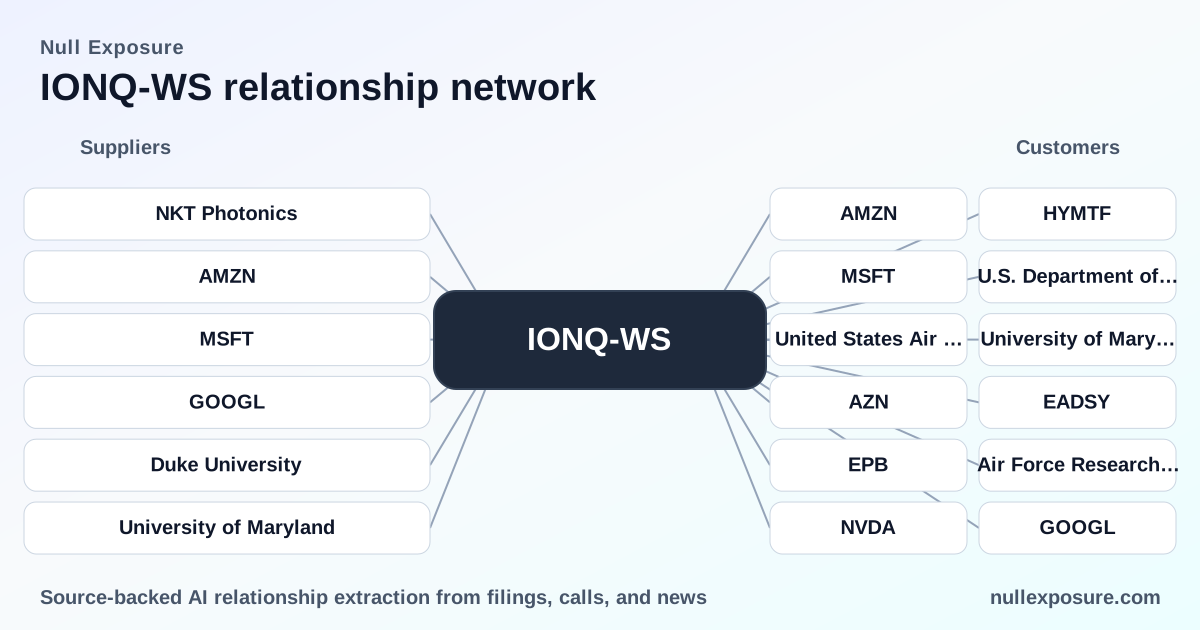
IonQ builds and monetizes quantum computing through a dual model: hardware sales and cloud-access services integrated with major cloud platforms, underpinned by foundational academic licenses. The company sells trapped‑ion quantum systems and captures recurring revenue by offering access to those systems through third‑party cloud marketplaces and direct enterprise engagements. For an investor, the critical read is that distribution and technical performance are jointly driven by cloud partnerships and a small set of specialized hardware suppliers, which determine time-to-market and revenue scale. For a deeper look at supplier and partner dynamics, visit https://nullexposure.com/.
How IonQ’s supplier map influences value creation
IonQ’s commercial pathway depends on three linked elements: advanced hardware components, global cloud distribution, and licensed intellectual property from academic institutions. Cloud partnerships extend market reach and reduce sales friction, while specialized suppliers provide components that are functionally critical to system performance. The company’s academic origins give it proprietary IP and a research moat that supports product differentiation.
This structural read yields a few clear operating-model characteristics as company-level signals:
- Contracting posture: IonQ leverages both product sales and channel relationships rather than long-term captive procurement contracts; the company routes customer access through cloud partners as well as direct engagements.
- Concentration: Component sourcing is inherently concentrated because trapped‑ion systems require specialist optics and lasers; limited supplier alternatives increase supplier leverage.
- Criticality: Suppliers for optical and laser subsystems are functionally critical — failures or delays in that supply chain have immediate impact on delivery and uptime.
- Maturity: Commercialization is early-to-growth: cloud distribution is established, but broad enterprise adoption is still developing, so supplier and partnership execution are central to scaling.
These signals should frame any diligence on counterparty exposure, margin sensitivity, and operational continuity. Learn more about mapping supplier risk at https://nullexposure.com/.
What IonQ’s reported relationships actually are
NKT Photonics — laser systems partner
IonQ announced a partnership with NKT Photonics (a Hamamatsu Photonics subsidiary) to procure next‑generation laser systems for its trapped‑ion quantum computers and networking equipment, a direct supplier relationship tied to hardware performance. According to IonQ’s press release dated March 10, 2026, the agreement targets laser subsystems critical to IonQ’s trapped‑ion architecture.
AWS Braket — cloud distribution and marketplace channel
IonQ systems are available on AWS Braket, providing cloud-based access and monetization through Amazon’s quantum services channel. A Benzinga market commentary covering IonQ’s go‑to‑market noted that IonQ runs on AWS Braket as part of its multi‑cloud distribution strategy (FY2025 reporting context).
Azure Quantum — enterprise cloud channel with Microsoft
IonQ also lists Azure Quantum as a distribution channel, enabling enterprise customers to access IonQ hardware through Microsoft’s quantum cloud offerings and broadening commercial reach. A July 2025 Benzinga piece referenced IonQ’s presence on Azure Quantum as part of its platform strategy.
Google Quantum AI Cloud — additional cloud access point
Google Quantum AI Cloud is a third cloud channel where IonQ systems are available, reinforcing the company’s multi‑cloud strategy and reducing single‑cloud dependency for customer access. Benzinga coverage from FY2025 reiterated that IonQ runs on Google’s quantum cloud alongside other major providers.
Duke University — foundational IP and research lineage
IonQ’s technology traces back to foundational trapped‑ion breakthroughs licensed from Duke University, which form part of the company’s intellectual property base and scientific credibility. IonQ’s corporate materials (company page) describe emergence from decades of academic research tied to Duke University (FY2025 context).
University of Maryland — original research and licensed inventions
The University of Maryland is another explicit origin for the trapped‑ion techniques licensed to IonQ and embedded in the company’s foundational IP portfolio. IonQ’s company page documents licensing and research lineage from the University of Maryland (FY2025 context).
What these relationships mean for investors
- Distribution strength is tangible: Presence on AWS Braket, Azure Quantum, and Google Quantum AI Cloud is a direct lever for recurring revenue; these channels convert hardware capability into customer hours and enterprise trials. Cloud availability materially accelerates monetization versus hardware‑sales-only models.
- Supplier dependency is a core operational risk: Specialized optical and laser suppliers are critical inputs for trapped‑ion machines; procurement disruptions have direct implications for backlog, margins, and commercialization pace.
- IP origins underpin the moat: Licenses from Duke and the University of Maryland supply defensible science and a barrier to entry that supports long‑term product differentiation.
Key risk factors to monitor:
- High supplier concentration for critical subsystems and single‑sourced components.
- Execution dependence on cloud partners for customer acquisition and revenue growth.
- Transition from research‑led credibility to predictable commercial margins as scale increases.
Tactical takeaways for portfolio managers and operators
- Prioritize operational diligence on component lead times and alternate sourcing plans for optics and lasers. Confirm second‑source options and inventory strategies.
- Model revenue sensitivity to cloud‑access pricing and channel economics; cloud hours and marketplace terms drive near‑term monetization.
- Treat IP licensing and academic relationships as strategic assets; document exclusivity windows, ongoing collaboration terms, and any royalty or sublicensing clauses.
For a structured view of supplier exposure and to map counterparties across the quantum stack, see our analysis hub: https://nullexposure.com/.
Final perspective and next steps
IonQ’s commercial trajectory is defined by a hybrid model: cutting‑edge hardware that depends on specialized suppliers, distributed through major cloud platforms and anchored by academic IP. That combination creates compelling upside if supply execution and cloud economics scale in tandem, and it creates concentrated operational risks if either pillar falters.
If you are evaluating IonQ as an investment or a supplier partner, focus diligence on the supplier contracts for critical optical components and the terms governing cloud marketplace access. For ongoing monitoring and supplier‑risk intelligence, return to https://nullexposure.com/ for supplier‑centric research and alerts.