Income Opportunity Realty Investors (IOR): Supplier relationships, tender-agent exposure, and what operators should price in
Income Opportunity Realty Investors operates as a Dallas-based real estate investment concern concentrating on Texas properties, including undeveloped land; it monetizes through property-level cash flows and active asset management and capital allocation across its portfolio. For investors and operators evaluating IOR as a counterparty or platform, the company’s external supplier posture is notable for heavy outsourcing of advisory and cash management functions and episodic reliance on third parties for corporate actions such as tender offers. That combination creates operational leverage but also supplier concentration and single-event exposure that investors should price into valuation and counterparty diligence. Learn more about supplier intelligence and monitoring at https://nullexposure.com/.
Quick company snapshot that matters to supplier risk
Income Opportunity Realty Investors is a small-cap, Texas-focused real estate firm with a market capitalization roughly $76 million and a controlling insider share position (over 90% insiders). The firm reports no employees on its payroll: advisory and cash management are outsourced, and fee disclosures show advisory payments listed in recent years (notably quoted as $108, $970 and $1,175 for 2024, 2023 and 2022 in the filing excerpt). Those features drive the supplier profile: high reliance on a small set of service providers, long-tenor contracts, and concentrated counterparty risk.
Tender-offer parties: who handled the shareholder process
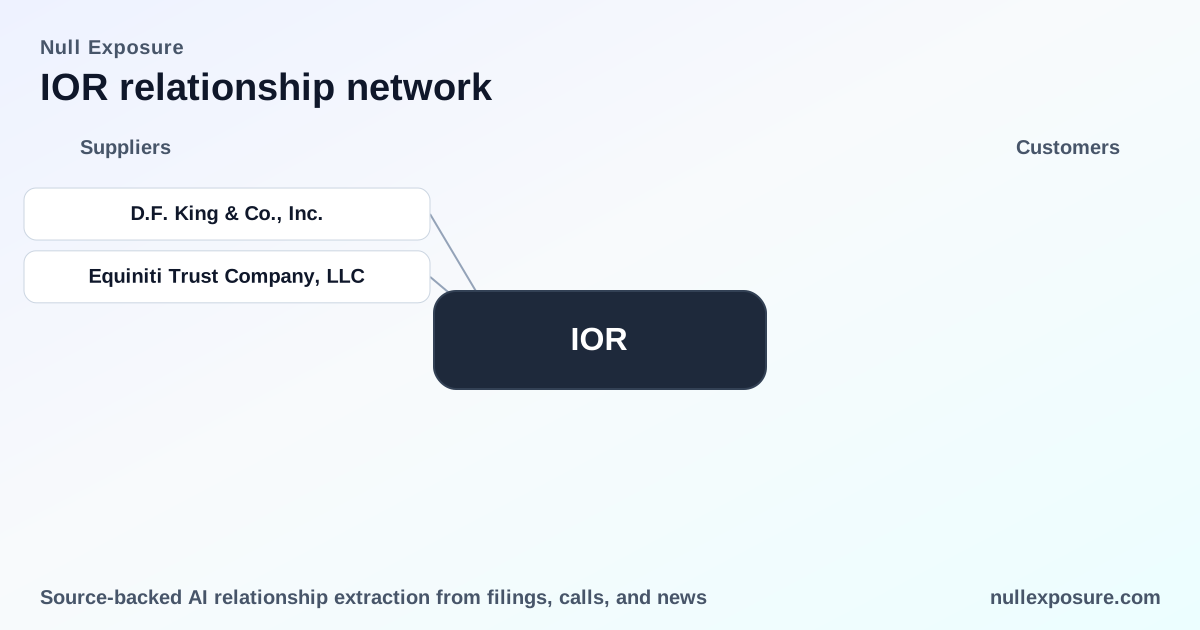
IOR’s recent public activity around a limited tender offer is useful for understanding which external providers the company turns to for shareholder-facing events. The filings and press release name two external firms involved in the tender-offer execution:
D.F. King & Co., Inc.
D.F. King acted as the information agent for the limited tender offer, providing shareholder communications and contact support for IOR stockholders (including an information-line and email address for tender materials). According to a BizWire press release dated January 14, 2025, D.F. King was listed as the information agent for the transaction and the designated contact for shareholders. (BizWire via FinancialContent, Jan 14, 2025).
Equiniti Trust Company, LLC
Equiniti Trust Company served as the depositary for the tender offer and reported tender activity: as of 5:00 p.m. NY time on January 13, 2025, two record stockholders had tendered shares and additional shares were tendered through CEDE. This operational role places Equiniti at the center of settlement and share custody for the transaction. (BizWire via FinancialContent, Jan 14, 2025).
What these relationships mean for counterparties and investors
Both named parties are transactional service firms retained for a discrete corporate action rather than ongoing asset management. That makes them critical for short-duration liquidity and shareholder processing but not for day-to-day asset management. For investors evaluating IOR:
- Event risk is centralized: using recognized, market-standard agents (D.F. King, Equiniti) reduces execution risk for tender offers, but the company’s dependence on a few external providers for corporate actions concentrates operational counterparty exposure.
- Operational continuity is outsourced: because IOR reports no employees, the firm’s ability to execute even routine functions is dependent on retained advisors and service providers. Loss or disruption of a primary vendor would be operationally significant.
Contracting posture and supplier maturity — company-level signals
IOR’s own filing language provides strong signals about contracting, concentration, and cost scale:
- Long-term advisory relationship: a filing states Pillar has been the Advisor and Cash Manager since April 30, 2011, with the cash management agreement coterminous with the advisory agreement and automatically renewing unless terminated with the Advisory Agreement. This is a long-tenor, auto-renewal contracting posture that increases dependency on a single advisor.
- Service-provider model with no in-house staff: the company explicitly notes “We have no employees. Employees of Pillar render services to us in accordance with the terms of the Advisory Agreement,” which makes Pillar effectively the operating backbone of IOR.
- Mature relationship and scope: the advisory engagement is mature (relationship in place since 2011) and covers locating, evaluating and recommending investments plus arranging external financing — i.e., critical, high-complexity functions are outsourced.
- Spend signal: the filing reports advisory fees as $108, $970 and $1,175 for 2024, 2023 and 2022 respectively; categorization in the system flags this within a $100k–$1m spend band. These fee figures suggest a small absolute spend but a high strategic dependence, given the absence of employees.
These excerpts come from IOR’s public filings that disclose the advisory and cash-management arrangements and historical fees.
Risk framework for investors and operators
Translate these facts into action-oriented risk categories:
- Concentration risk: a single advisor/cash manager is functionally the company’s operating arm. That increases negotiation asymmetry and creates regime risk if the advisor relationship shifts.
- Operational criticality: with no employees, the firm’s continuity, financing arrangements, and asset sourcing are dependent on external providers; counterparties should require evidence of redundancy, SLAs, and successor arrangements.
- Event exposure: for discrete corporate actions such as tender offers, IOR leans on recognized third-party agents; that lowers execution risk for the specific event but does not mitigate persistent day-to-day vendor concentration.
- Governance signal: insider ownership exceeding 90% signals tight control and limited institutional oversight, which elevates governance and liquidity considerations for external counterparties.
Practical recommendations for counterparties and buy-side managers
- Require written continuity plans and substitution clauses for Pillar-level services given the single-provider operating model.
- For transaction-level exposure (tender offers, share settlements), validate counterparty confirmations from named agents (D.F. King, Equiniti) and retain proof of settlement instructions.
- Monitor advisory fee disclosures and any material amendments to the advisory/cash management agreements as early-warning signals for shifting operational risk.
For a deeper supplier-risk scorecard and continuous monitoring of names like IOR and its service providers, visit https://nullexposure.com/ to see how we surface supplier concentration and event-execution exposure.
Bottom line and investor action points
Income Opportunity Realty Investors runs a highly outsourced operating model with a long-tenor advisory relationship and episodic use of recognized agents for shareholder events. That structure lowers fixed payroll but concentrates operational, governance, and continuity risk in a very small number of external providers. For investors and operators, the immediate deliverables are proof of backup arrangements for the advisor, confirmation of event-settlement controls with D.F. King and Equiniti, and ongoing monitoring of any changes to the advisor agreement or advisory fees. For an operational diligence package and supplier monitoring tied to IOR, go to https://nullexposure.com/.
Key takeaway: IOR’s low internal staffing plus long-standing external advisory arrangements create operational leverage but also single-vendor exposure that should be priced into credit, counterparty, and transaction risk assessments.