Innospec (IOSP) — Supplier Relationships, Contracting Posture, and Supply-Chain Risk for Investors
Innospec monetizes specialty-chemical formulations and additives through a global manufacturing and distribution platform: it sells engineered chemical products to industrial and consumer markets while locking raw-material exposures behind long-term purchase commitments and formula-based pricing that stabilize margins. The company’s financial profile — roughly $1.78bn revenue and $200m EBITDA on a $1.69bn market capitalization — makes supply continuity and input-cost management strategic drivers of near-term operating performance. For investors evaluating supplier counterparty risk, the 2024 disclosures highlight a conservative contracting posture and a small number of economically significant sourcing relationships that deserve active monitoring.
For a deeper view of supplier risk and disclosure tracking visit https://nullexposure.com/.
How Innospec runs procurement and why that matters to returns
Innospec explicitly uses long-term contracts and advance bulk purchases to secure feedstocks and manage cost volatility; those contracts are described as fixed or formula-based and are part of the firm’s standard approach to supply continuity. This contracting posture reduces spot-price exposure for margins but increases counterparty and concentration risk if a long-term supplier fails or a logistics route is disrupted. The company also flags that certain purchases account for a substantial portion of variable manufacturing costs, which makes supplier performance an operational lever for earnings stability.
Financial context matters: Innospec’s trailing operating margin is around 10.3% and profit margins near 6.6%, making input-cost shocks potentially material to near-term profitability. The firm’s capital-light specialty-chemicals model means procurement execution — not heavy capex — is often the primary source of margin upside or downside over a fiscal year.
Documented supplier relationships in the filings
Below is every supplier relationship reported in the source material for the supplier scope.
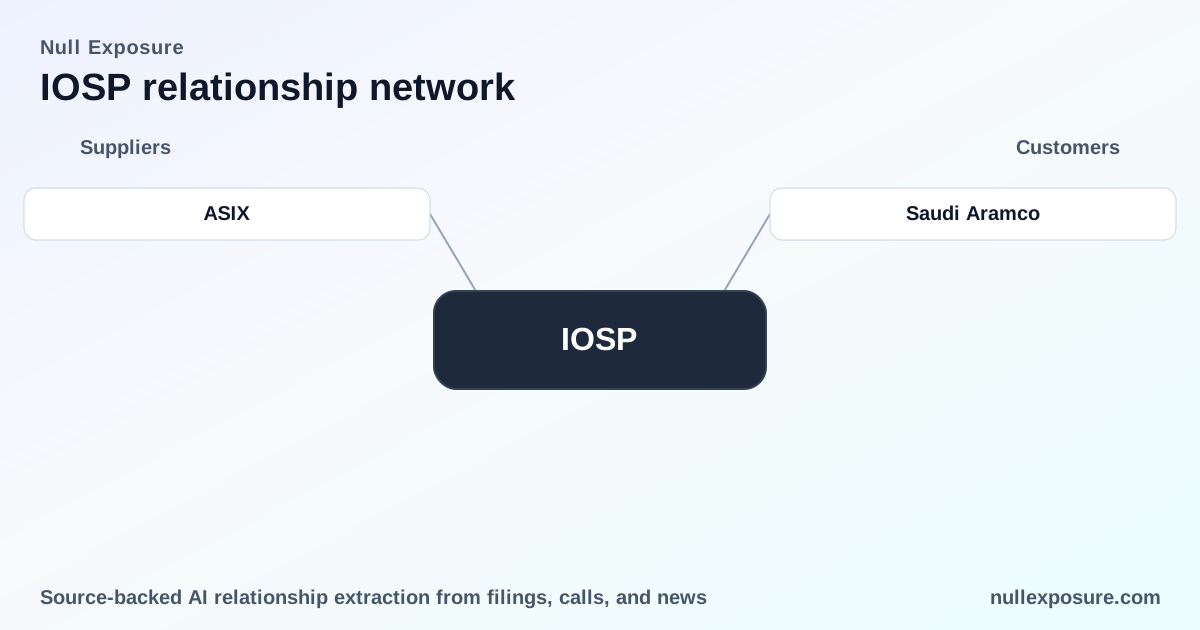
- AdvanSix (ASIX): Innospec reports that it did not purchase any product from AdvanSix in 2024, compared with $0.4 million in 2023 and $0.5 million in 2022, indicating a de minimis procurement relationship in the most recent fiscal year. This disclosure appears in the company’s 2024 Form 10-K filing. (Source: Innospec Form 10-K, FY2024)
What the filing-level constraints tell us about Innospec’s operating model
The company disclosures contain several clear operational constraints that shape supplier risk and negotiating leverage:
-
Long-term contracting is the default: Innospec states it uses long-term contracts (often fixed or formula-based) and advance bulk purchases to ensure availability and to manage cost increases, indicating a preference for predictability over opportunistic spot procurement. (Source: Innospec Form 10-K excerpts)
-
Buyer role and purchase concentration: The filing frames Innospec as a buyer with numerous long-term sales and purchase commitments, and calls out that purchases represent a substantial portion of variable manufacturing costs. This is a company-level signal that input suppliers are economically critical to gross-margin stability. (Source: Innospec Form 10-K excerpts)
-
Geographic single-source exposure in EMEA: The company specifically discloses that it sources ethylene for its German operations via a direct pipeline, making that supply effectively single-source and regionally concentrated — a geographic concentration risk for production continuity in EMEA. (Source: Innospec Form 10-K excerpts)
Collectively these constraints imply Innospec trades lower price volatility for higher counterparty and concentration risk, and that disruptions in a few inputs or routes could move margins faster than the firm can adjust volumes or prices.
Why each signal matters for investors and operators
-
Long-term contracts reduce margin volatility but increase counterparty risk. For shareholders, consistent contract coverage underpins the company’s EBITDA conversion but concentrates risk on counterparties and logistics. Credit investors should weigh whether counterparties are investment-grade or hedged in contract language. (Source: Innospec Form 10-K)
-
Materiality of purchases makes suppliers operationally critical. When a line item in procurement drives a large share of variable costs, any sustained price shock or shortage translates into near-term margin pressure that management must address via pricing, hedges, or product mix. (Source: Innospec Form 10-K)
-
Single-source infrastructure in EMEA is a point risk. The direct pipeline for ethylene into German operations is a tangible single-point-of-failure; operational disruption there could force short-term plant curtailments and inventory drawdowns while contract repricing lags. (Source: Innospec Form 10-K)
If you want ongoing monitoring of supplier disclosures and concentration signals, see how we track counterparty exposures at https://nullexposure.com/.
Practical implications for supplier diligence and portfolio risk
-
For equity investors: monitor quarterly filings and management commentary for any change in volumes purchased from named suppliers and for renegotiations of formula-based cost clauses that could change input pass-through dynamics.
-
For credit and M&A teams: Evaluate contract tenure, termination provisions, and the financial health of key suppliers; long-term contracts help revenue predictability but increase recovery risk if a supplier defaults.
-
For operations and procurement: Prioritize redundancy where the filings show single-source feedstock routes (the German ethylene pipeline), and stress-test contingency plans for logistics or regulatory interruptions in EMEA.
Closing recommendations and next steps
- Maintain a watch on supplier disclosure lines in the next quarterly and annual filings for movements from de minimis purchases (as with AdvanSix) to larger volumes, which would signal a shift in concentration. (Source: Innospec Form 10-K, FY2024)
- For active investors, request management commentary on counterparty credit metrics, hedging coverage, and contingency capacity in EMEA when conducting diligence calls.
- For hands-on operators, develop mitigation playbooks for pipeline or single-route failures and quantify EBITDA sensitivity to key feedstock price moves.
For timely supplier-risk intelligence and to integrate supplier disclosures into investment models, visit https://nullexposure.com/.
Innospec’s filings paint a company that prioritizes supply continuity through long-term contracting while accepting concentration risk in a small number of critical inputs and routes; that trade-off defines the primary supplier-risk profile investors and operators must manage.