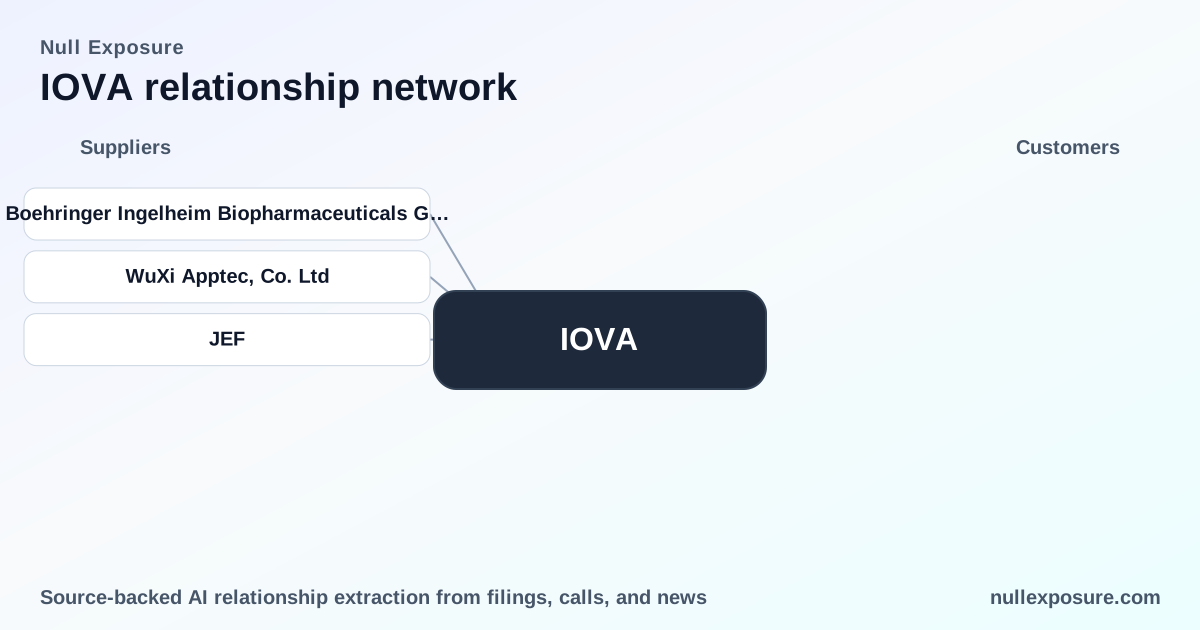
Iovance Biotherapeutics (IOVA): the supplier relationships that drive production and capital
Iovance Biotherapeutics commercializes cell‑based cancer immunotherapies (notably Amtagvi) by combining an internal manufacturing hub (the Iovance Cell Therapy Center, iCTC) with contract manufacturing organizations and outsourced logistics; it monetizes through product sales while preserving operational flexibility with third‑party CMOs and occasional equity financing. Key revenue drivers are commercial manufacturing throughput and the company's ability to secure reliable CMO capacity, while financing programs such as at‑the‑market equity sales underwrite working capital and commercial scale‑up.
For a concise vendor risk brief and monitoring checklist, visit the Nillexposure homepage: https://nullexposure.com/.
How Iovance structures suppliers to match a cell‑therapy business model
Iovance operates a hybrid manufacturing posture: centralized, proprietary processes at an owned iCTC combined with CMOs for scale and geographic reach. That hybrid approach lowers single‑point production risk while enabling faster regional rollouts, but it creates dependences that are both operationally and contractually significant. The company also supplements operating cash via equity programs that rely on investment banks acting as sales agents, which directly impacts capital flexibility and dilution.
Supplier map — the contractual relationships investors should know
Boehringer Ingelheim Biopharmaceuticals GmbH
Iovance inherited a manufacturing and supply agreement with Boehringer Ingelheim as part of the Clinigen acquisition; under that contract BI handles processing, manufacturing and supply of Proleukin in unlabeled vials. According to Iovance’s FY2024 Form 10‑K, the agreement was a transferred obligation following the May 2023 acquisition and remains part of the company’s outsourced manufacturing footprint.
WuXi AppTec, Co. Ltd
WuXi has an established manufacturing services relationship with Iovance, providing services for two cGMP manufacturing suites and related testing, and the company recorded material costs with WuXi across recent years (roughly $25.0 million in 2024). Iovance’s FY2024 disclosure references the original WuXi manufacturing services agreement and the company’s consolidated statements show multi‑year spend and purchase obligations tied to that relationship.
Jefferies (ATM sales agent)
Iovance established an at‑the‑market equity program with Jefferies acting as sales agent for up to $350 million of common stock, with compensation capped at roughly 3% of gross proceeds. The ATM and agent terms were disclosed in an SEC‑filed prospectus supplement (Aug. 22, 2025) and reported in market coverage in late 2025.
What these relationships reveal about Iovance’s operating constraints and posture
-
Contracting posture — mixed maturity: Iovance combines long‑term facility commitments (including multi‑decade lease extension options) with shorter term leases for corporate headquarters; the company’s disclosures show both durable real‑estate commitments and tactical short‑term arrangements. These lease characteristics signal a business balancing long‑cycle manufacturing needs with flexible corporate footprints.
-
Concentration and criticality — supplier dependence is real: The 10‑K explicitly states dependence on a limited number of vendors for cGMP manufacturing and critical materials, making those suppliers operationally critical. That concentration elevates execution risk if a key vendor faces capacity constraints or quality interruptions.
-
Geographic reach — North America, Europe and APAC coverage: Iovance’s manufacturing and logistics plan is explicitly regional, with the iCTC and CMOs covering North America, Europe and Australia (APAC), indicating a regionalized supply footprint that supports clinical and commercial distribution across major markets.
-
Relationship roles and maturity: The company relies on CMOs for commercial manufacturing while operating the iCTC internally; WuXi’s manufacturing services date back to a 2016 master services agreement, indicating a mature external manufacturing relationship. The WuXi relationship is both a manufacturer and a service provider in practice, per historical agreements.
-
Spend and purchase obligations — material but manageable: Iovance recorded tens of millions of dollars of costs with WuXi (about $25.0M in 2024) and disclosed purchase obligations of approximately $13.6M for 2025 under certain agreements, with additional commitments in 2026–2027. Those figures place major CMOs in the $10–100M spend band, a material line item for a company at Iovance’s revenue scale.
-
Financing relationships affect operating flexibility: The Jefferies ATM provides an open channel for equity capital up to $350M, increasing liquidity and enabling scale‑up, but it also represents a dilution vector that investors should track against cash burn and commercialization milestones.
For a vendor exposure dashboard and ongoing alerts on supplier changes, check Nillexposure: https://nullexposure.com/.
Risk framework for investors and operators
Iovance’s supplier posture creates several investment‑grade risk vectors:
- Manufacturing concentration risk: dependence on a limited number of CMOs and the iCTC elevates operational risk if a single supplier suffers a shutdown or fails audits.
- Capacity and scalability risk: commercial ramp requires predictable CMO throughput and validation timelines; failure to expand manufacturing capacity constrains revenue growth.
- Contractual lock‑in and lease obligations: long‑dated facility lease options increase fixed costs during downturns.
- Capital availability and dilution: use of ATMs is a flexible financing tool but increases share count when deployed.
Mitigants include Iovance’s owned iCTC, multiple CMOs across regions, and documented multi‑year supplier relationships (notably WuXi). Investors should monitor: CMO audit outcomes, purchase obligation schedules, ATM utilization, and regional logistics performance.
Quick checklist for due diligence:
- Track quarterly spend and disclosed purchase obligations with CMOs.
- Review CMO inspection and quality disclosures.
- Monitor ATM sales and dilution metrics in SEC filings.
- Confirm geographic logistics coverage for targeted approvals.
Actionable takeaways and monitoring priorities
- Prioritize supplier continuity: negotiate capacity and redundancy clauses in CMO contracts and monitor contract expiration windows to avoid single‑point failures.
- Watch capital execution: ATM usage is a lever for growth but affects equity value; tie ATM drawdowns to predefined milestones.
- Measure supplier spend vs. revenue: WuXi’s multi‑year spend profile is material; investors should benchmark CMO costs relative to commercial gross margin.
For a tailored supplier risk assessment and live tracking, visit Nillexposure: https://nullexposure.com/.
Bottom line
Iovance operates a hybrid internal/CMO manufacturing model that provides both scalability and vendor concentration risk. The company’s major supplier relationships — Boehringer Ingelheim (manufacturing inherited via acquisition), WuXi AppTec (established cGMP manufacturing partner with multi‑million dollar spend and purchase obligations), and Jefferies (equity sales agent under an ATM program) — together define the critical operational and financing seams investors must monitor. Diligent tracking of CMO capacity, contractual obligations, and ATM utilization will drive the most predictive signals for Iovance’s commercial trajectory.