International Paper (IP): Legal advisors, cybersecurity vendors, and what that means for investors
International Paper operates and monetizes as the global leader in pulp and paper and a major supplier of packaging and containerboard to consumer-goods and industrial customers. The company generates revenue through the production and sale of packaging, pulp and fiber-based products, with trailing revenue of roughly $23.6 billion and EBITDA of $3.95 billion (TTM). Its current strategic path includes a material corporate separation that will split North American operations from the EMEA packaging business — a move that reorders supplier and advisory needs and has direct implications for counterparty risk and transition costs. Investors should view supplier relationships and retained advisors as levers that shape execution risk and the pace of value realization.
Explore NullExposure’s supplier coverage for more context.
Why the legal advisory roster matters for a corporate split
International Paper has announced a plan to create two independent, publicly traded companies: a North American International Paper and an EMEA Packaging business. That structural change transforms the company’s contracting universe: commercial suppliers, regional logistics partners, and shared service vendors will need new contractual terms or transitional service agreements, and advisory counsel will choreograph the legal and governance elements of the separation.
Key implication: the selection of boutique and elite law firms for transaction work signals IP’s intention to execute a complex cross-jurisdictional separation with heavy legal and regulatory coordination. The roster of advisors is therefore an execution-risk signal as much as a vendor list.
At-a-glance: the advisor and counsel relationships disclosed
-
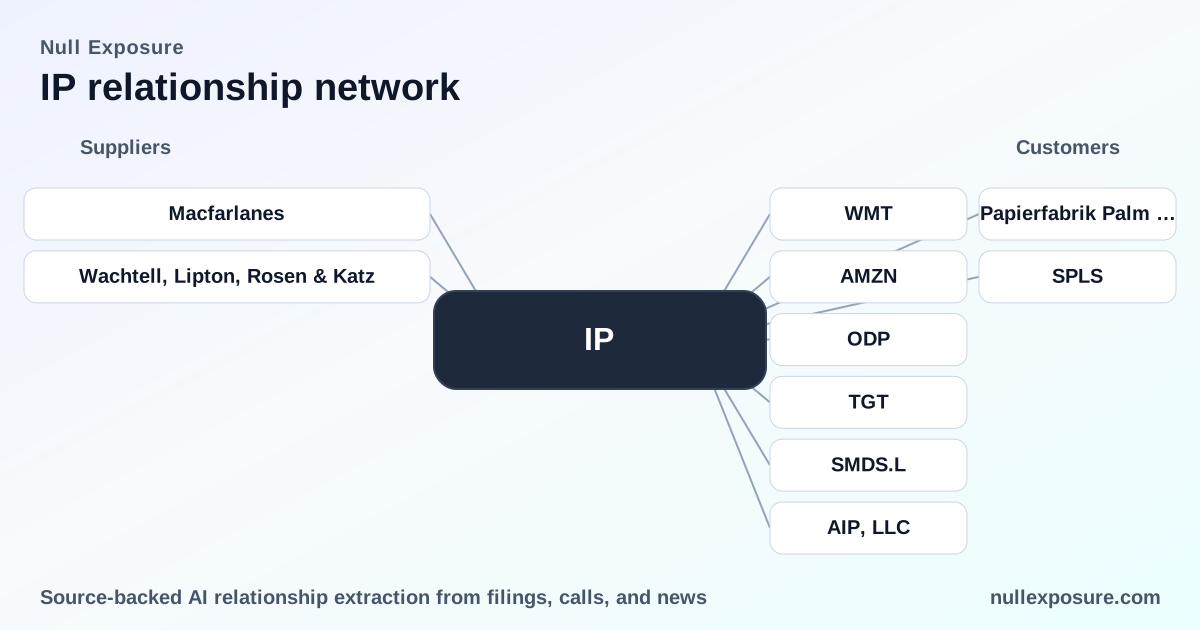
Macfarlanes — Macfarlanes is advising International Paper on its proposal to split the business into two publicly traded companies, specifically supporting the creation of a standalone North American company and an EMEA Packaging entity. This engagement is reported in a March 2026 Macfarlanes insight note describing the advisory role for the transaction.
Source: Macfarlanes insight on the IP proposed separation (March 10, 2026). -
Wachtell, Lipton, Rosen & Katz — Wachtell is acting as International Paper’s US counsel and is working closely with Macfarlanes on the transaction, indicating parallel UK/EMEA counsel coordination with elite US legal support for domestic regulatory and governance issues. The involvement of Wachtell was noted within the same March 2026 Macfarlanes advisory announcement.
Source: Macfarlanes insight noting collaboration with Wachtell (March 10, 2026).
What those relationships mean operationally and financially
Engaging Macfarlanes and Wachtell for a strategic split signals a high-touch, high-cost legal pathway: expect elevated advisory fees, tightly negotiated separation agreements, and significant legal oversight of asset transfers, employee matters, and cross-border contracts. That increases near-term SG&A and one-time separation costs, but also reduces execution uncertainty if counsel successfully limits post-close disputes.
From an operational standpoint, the separation will require re-contracting or novation of supplier arrangements across geographies. Suppliers that historically served consolidated IP may face contract renegotiation, new credit terms, and potential consolidation of third-party service providers. Contract churn during separation creates concentration risk for strategically important suppliers and potential service continuity issues for buyers.
Company-level supplier constraints and what they signal
According to company disclosures in FY2026, International Paper actively engages third parties to assess, identify and manage cybersecurity risk and has contracted independent incident response expertise to prepare for, prevent, investigate and remediate incidents that affect on-premise, cloud and critical infrastructure environments. These statements should be interpreted as company-level signals about their contracting posture and operational maturity:
- Contracting posture: IP uses specialized external service providers for critical security functions rather than relying solely on internal teams, indicating a preference for vendorized expertise for high-consequence capabilities.
- Concentration and breadth: The language indicates multiple third-party cybersecurity relationships rather than a single-provider dependency, which distributes operational risk but increases vendor governance complexity.
- Criticality: Cybersecurity is treated as mission-critical, with dedicated incident response arrangements — a necessary posture for a manufacturing and logistics-heavy business with extensive OT/IT exposure.
- Maturity: Contracting independent incident response capability reflects a mature approach to cyber risk management and a recognition that external expertise accelerates detection and remediation.
These constraints are company-level signals and are not assigned to any specific law firm or advisor unless explicitly stated by a disclosure.
Operational and investor risks to watch during the split
- Transition-service risk: Expect transitional service agreements and temporary shared services; failures in those arrangements can disrupt packaging supply to major consumer brands and affect revenue recognition timing.
- Supplier reallocation: Regional suppliers and logistics providers will be evaluated anew; small, single-source vendors could face replacement or consolidation, raising short-term disruption risk.
- Legal and regulatory cost: Using elite legal counsel reduces regulatory friction but increases near-term cash outlays; monitor SG&A and one-time separation charges in updated filings.
- Cyber resilience: The company’s explicit use of third-party incident response indicates preparedness, but separation activities can expand attack surfaces — continued disclosure on vendor oversight and security testing will be an important signal.
Actionable takeaways for investors and operators
-
Monitor separation milestones and advisor disclosures. Legal counsel announcements are not ceremonial — they map to the transaction timeline and the likely complexity of regulatory clearance and asset transfers. Revisit filings and counsel updates each quarter.
Check supplier intelligence and timelines at NullExposure. -
Assess supplier concentration in the regions being carved out. EMEA customers and suppliers could be subject to new contractual counterparty credit terms; evaluate counterparties for concentration and migration risk.
-
Insist on cyber vendor governance disclosures. Given the company-level statement about active cybersecurity third-party engagements, investors should prioritize evidence of vendor oversight, tabletop exercises, and contractual SLAs in forthcoming filings.
Final read: how this shapes the investment case
International Paper is executing a structural separation that elevates both near-term expense and strategic clarity. The appointment of Macfarlanes and Wachtell signals a deliberate, high-governance approach to the split, which reduces legal execution risk at the cost of advisory fees. Concurrent company-level cybersecurity vendor commitments reflect a mature operational posture that reduces operational risk but adds vendor governance responsibilities during the transition. For investors, the key ledger items to track are separation-related charges, supplier re-contracting outcomes, and continued transparency on cyber vendor management. These dynamics will determine whether the corporate reorganization delivers the promised value uplift or simply defers execution risk into the post-close operating model.
Return to NullExposure for ongoing supplier relationship updates.