Innate Pharma (IPHA): Partnership-driven biotech with alliance revenue and milestone exposure
Innate Pharma discovers and develops therapeutic antibodies and monetizes primarily through collaborations, licensing agreements, and milestone-driven payments from larger biopharma partners, while retaining clinical programs that can be progressed independently. For an investor or operator assessing supplier relationships, the practical takeaway is that Innate’s cash flow and program cadence are highly correlated with the timing and terms of partnership agreements, not product sales from marketed drugs. For deeper supplier and partner risk analysis, visit https://nullexposure.com/.
How Innate’s operating model translates into supplier and partner risk
Innate runs a partnership-first commercialization model: it leverages its antibody discovery and early clinical capabilities to enter cost- and risk-sharing agreements with global pharma companies. That model produces three operating characteristics that matter for vendor and supplier diligence:
- Contracting posture: Innate negotiates licenses, co-development and transition agreements that allocate manufacturing and development costs back and forth with partners, creating contingent liabilities and receivables tied to milestones and terminations.
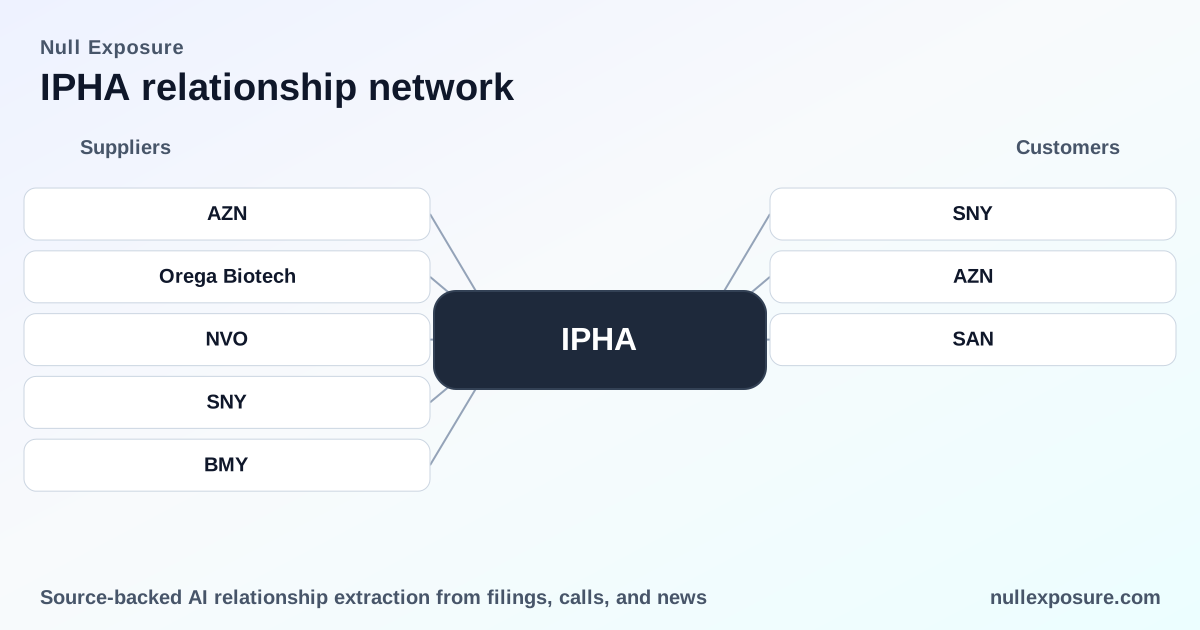
- Concentration and counterparty importance: The company’s operational runway is influenced by a handful of large-cap partners (AstraZeneca, Novo Nordisk, Sanofi, BMS), so counterparty credit, strategic alignment, and contract exit provisions are material to cash flow and program continuity.
- Maturity and criticality: Programs range from preclinical to Phase II; manufacturing and transition clauses (e.g., cost splitting after program terminations) create near-term operational obligations even when a partner steps back.
No explicit contractual constraints were captured in the source feed for IPHA supplier relationships; as a company-level signal, this dataset did not flag discrete, named supplier contract restrictions or covenants. That absence should be treated as a neutral datapoint — it is not confirmation of clean contract status, but it does mean no flagged supplier constraints were surfaced in the referenced public communications.
The partner map: every listed relationship and what it means for operators and investors
AstraZeneca — multi-product and transactional history
Innate has a recurring, multifaceted relationship with AstraZeneca that includes licensing transactions and a post-termination cost-sharing arrangement. According to a FierceBiotech report referencing activity in FY2018, Innate paid $50 million upfront for U.S. and EU rights to AstraZeneca’s Lumoxiti, a licensed oncology asset. A GlobeNewswire business update (H1 2021) documents a termination and transition agreement with AstraZeneca effective June 30, 2021, under which the companies agreed to split manufacturing costs and Innate committed to a $6.2 million payment due April 30, 2022. These items illustrate both active licensing behavior and downstream operational obligations tied to partner exits. (Sources: FierceBiotech, FY2018; Innate Pharma press release via GlobeNewswire, H1 2021.)
Orega Biotech — milestone payment tied to clinical progress
Innate recorded an additional €2.7 million payment to Orega Biotech in April 2020 linked to IPH5201 following dosing of the first patient in a Phase I trial, as disclosed in Innate’s H1 2021 financial update. This is a direct example of milestone-triggered supplier/subcontractor payments that increase cash burn when internal programs advance through clinical inflection points. (Source: Innate Pharma H1 2021 financial results release via GlobeNewswire.)
Novo Nordisk A/S — antibody program collaboration
Innate’s work for an anti-NKG2A antibody program originated through collaboration with Novo Nordisk, with program activity described as ready for Phase II development; this is noted in an FY2026 preview of Innate’s Q2 2025 earnings. The relationship signals strategic technical partnerships that extend Innate’s clinical pipeline capacity and place program advancement under partner-linked timelines. (Source: Intellectia preview article, FY2026.)
Sanofi — strategic collaboration mention
Industry commentary in a FY2026 earnings preview highlights Innate’s partnership footprint including Sanofi among “leading biopharmaceutical firms” collaborating on immuno-oncology initiatives, indicating industry-recognized alliances that support Innate’s competitive positioning in therapeutic antibodies. This listing signals the company’s ability to secure blue-chip partners for platform leverage. (Source: Intellectia preview article, FY2026.)
Bristol-Myers Squibb — program-level collaboration in oncology and inflammation
A FY2026 preview of Innate’s Q2 2025 results referenced a collaboration with Bristol-Myers Squibb on a Phase I cancer antibody program and additional antibody programs with Novo Nordisk in inflammation. The BMS tie demonstrates Innate’s role as a co-development partner on early-stage oncology assets, creating shared development responsibilities and shared technical suppliers or CROs linked to those programs. (Source: Intellectia preview article, FY2026.)
What these relationships imply for supplier diligence
- Cash-flow sensitivity to milestone timing: Multiple partner-triggered payments (upfronts, milestone payouts, and termination-related obligations) mean treasury forecasting must be scenario-driven and partner-specific. The AstraZeneca cost-splitting and Orega milestone payment are concrete examples of how program events convert into supplier cash flow.
- Operational handoffs create supplier concentration risk: When large partners control rights or step away (as with the AstraZeneca transition agreement), Innate inherits or shares manufacturing and transition responsibilities that can shift vendor relationships and increase short-term procurement complexity.
- Counterparty risk is material: Partnerships with global pharmas provide validation but also concentrate business risk on a small number of counterparties; investors should track partner credit, termination clauses, and milestone schedules closely.
For operators, the immediate actions are to map contract clauses that drive cash obligations (manufacturing cost allocation, termination payments, milestone triggers) and to stress-test supplier delivery timelines against partner-driven clinical milestones.
If you want a concise supplier-risk briefing tailored to IPHA’s partner contracts and milestone schedule, get an actionable report at https://nullexposure.com/.
Bottom line and investment implications
Innate Pharma’s business model is partnership-centric with milestone-dependent economics. That structure delivers upside when partners advance programs but also generates lumpy liabilities and concentrated counterparty exposure that require active contract and treasury management. For investors, the stock is best evaluated as a play on successful alliance execution and timing of partner-funded milestones rather than as a pure product-revenue biotech.
For immediate next steps—whether you are conducting due diligence or building a vendor risk scorecard—start with a partner clause inventory and a cash-flow waterfall that isolates partner-funded versus Innate-funded obligations. You can commission a focused partner-contract review via https://nullexposure.com/ to convert these relationship signals into operational priorities.