Intelligent Protection Management (IPM): supplier relationships and what they mean for investors
Intelligent Protection Management Corp (IPM) operates a blended security and secure-cloud services business that monetizes through recurring managed-security contracts, cloud licensing arrangements and targeted tuck‑in acquisitions to expand capability. Revenue generation comes from security services and private-cloud hosting, amplified by partnerships with enterprise vendors such as Hewlett Packard Enterprise and by acquisitions (notably Newtek Technology Solutions) that shift IPM toward higher-margin infrastructure offerings. For investors evaluating supplier and partner risk, the company shows a combination of strategic vendor accreditation, modest scale (Revenue TTM $17.76M; Market Cap ~$28.46M) and concentrated ownership that materially influences contracting posture. Learn more at https://nullexposure.com/.
Quick read: how IPM actually makes money and where suppliers fit in
IPM sells protective services and secure-cloud solutions to corporate clients, operating private suites in Tier‑3 data centers (leased under license agreements) and layering software and managed services on top. Monetization is a mix of recurring service fees for security and cloud hosting, one‑time consideration tied to acquisitions, and vendor-sourced revenue via partner programs (e.g., HPE Private Cloud AI accreditation). The business is small but growing (Quarterly revenue growth YoY 21.65%) with negative profitability today (Profit Margin -38.4%, EBITDA negative), which makes supplier and partner arrangements critical levers for margin improvement and scale.
Visit https://nullexposure.com/ for vendor due-diligence resources and supplier risk scoring.
Supplier and partner relationships that matter
Below are the supplier/partner relationships surfaced in public reporting and press coverage. Each relationship note is concise and sourced.
-
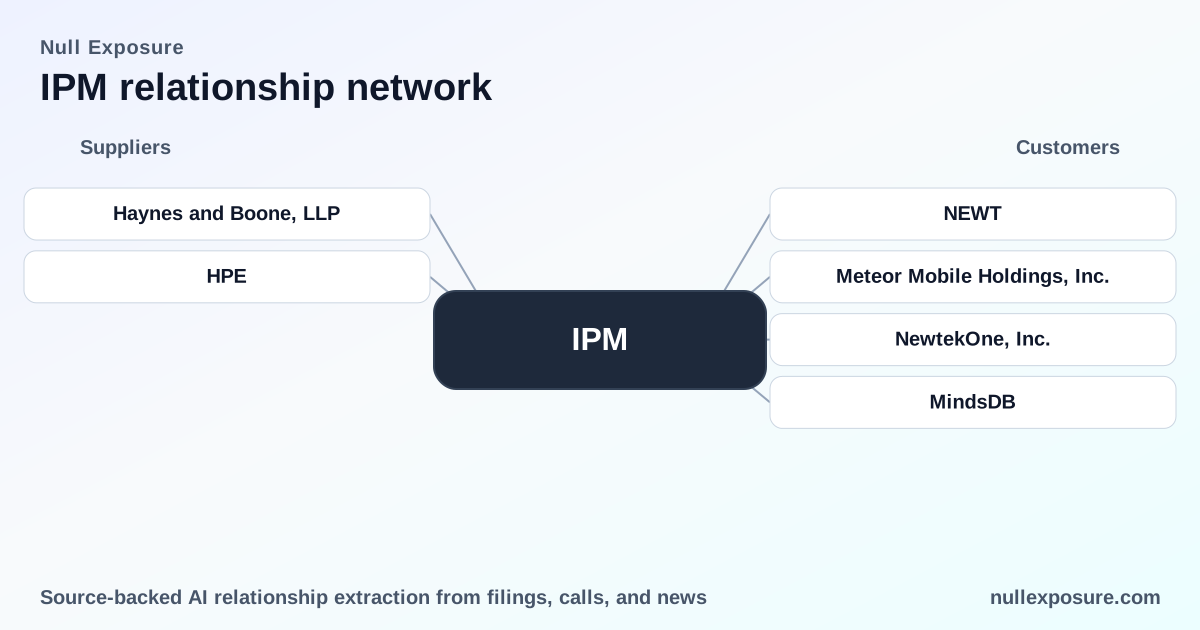
Hewlett Packard Enterprise (HPE) — IPM was selected as an accredited partner for HPE’s Private Cloud AI solution and initiated a collaboration with IT Ally during Q2 2025, signaling vendor-level endorsement of IPM’s cloud capabilities and a likely channel for enterprise sales and technical enablement (FY2025 press release reported on The Globe and Mail). Source: IPM Q2 2025 press release as reported on The Globe and Mail (FY2025).
-
Haynes and Boone, LLP — A news item noted Haynes and Boone served as legal counsel to Paltalk in a transaction that also involved Newtek Technology Solutions; the mention highlights Haynes and Boone's role in M&A/legal work in IPM’s transaction ecosystem rather than as a direct product supplier to IPM (StorageNewsletter report, Jan 6, 2025). Source: StorageNewsletter coverage of the Newtek/Paltalk transaction (Jan 6, 2025).
What the disclosed constraints reveal about IPM’s operating model
IPM’s disclosures and public excerpts point to several company-level signals that shape supplier risk and opportunity.
-
Contracting posture: evidence of multi‑year obligations and contingent earn‑outs. The acquisition of Newtek (Newtek Technology Solutions, Inc.) included an earn‑out provision up to $5.0M tied to adjusted EBITDA thresholds for 2025–2026, indicating IPM structures deals with performance‑based contingent payments rather than only fixed cash consideration. That earn‑out creates medium-term contingent liability and aligns seller incentives with integration performance. (Acquisition Agreement language, FY2025.)
-
Geographic footprint concentrated in North America with leased data‑center suites. IPM operates secure private cloud suites in two Tier‑3 facilities located in Phoenix, AZ and Edison, NJ under license agreements; IPM does not own the data centers but leverages their operations and standards through contractual licenses. This structure reduces capital intensity but increases dependence on data‑center landlords and service-level frameworks. (Company disclosure on Data Centers.)
-
Transaction role and M&A posture: buyer and consolidator. Disclosures show IPM completed the acquisition of Newtek, delivering $4.0M in cash plus 4,000,000 shares of preferred/common‑equivalent stock at closing and structuring additional earn‑outs—an active M&A posture that expands service scope but also introduces integration and funding risk. (Acquisition Closing consideration, Jan 2, 2025.)
-
Supplier/service model: reliance on third‑party facilities and vendor partnerships. While IPM provides cloud services to customers, the company explicitly states it does not own the underlying data centers, positioning itself as a service provider that layers security and managed services atop third‑party infrastructure via license agreements. This creates operational dependency on facility standards and contractual SLAs. (Data Centers license disclosure.)
-
Spend and financial commitment on acquisitions is material but moderate. The disclosed cash consideration of $4.0M (plus equity and earn‑out potential) for Newtek places that single transaction in the roughly $1M–$10M spend band, indicating IPM is deploying mid‑single‑digit millions to buy capability rather than funding large-scale greenfield builds. (Acquisition Closing consideration.)
What these signals mean for investors and sourcing teams
IPM’s supplier picture is a mix of strategic vendor endorsements and contractual dependencies that investors must weigh against a small capitalization and current unprofitable status.
-
Vendor accreditation (HPE) is a positive customer‑facing credential and a commercial distribution vector; it reduces go‑to‑market friction when selling cloud offerings to enterprise buyers. HPE partnership increases credibility and potential for higher‑value contracts.
-
Dependence on leased Tier‑3 suites reduces capital expenditure but creates concentration and counterparty risk—if license terms or facility SLAs shift, IPM’s delivery capability could be impaired quickly. Operational criticality is concentrated in two locations (Phoenix, Edison).
-
Acquisition‑driven growth (Newtek transaction) is an explicit strategy to add capability and revenue, but the structure—cash plus equity and contingent earn‑outs—creates both integration execution risk and contingent liabilities that will affect cash flow and possibly dilution. M&A is a primary growth lever and a material use of capital.
-
Scale and balance‑sheet limitations (Market Cap ~$28M, negative EBITDA) mean supplier negotiations and partner revenue are central to margin improvement. IPM’s concentrated insider ownership (≈39% insiders) and low institutional ownership (~11%) suggest strategic decisions will be closely held and may be influenced by internal stakeholders.
Explore supplier risk profiles and acquisition analytics at https://nullexposure.com/ to support your vendor diligence.
Actionable takeaways for investors and operators
- Prioritize due diligence on the two Tier‑3 data centers and the terms of IPM’s license agreements: service levels, termination rights, and change‑of‑control provisions are potential inflection points for delivery risk.
- Monitor HPE partner activity and any announced joint deals; vendor endorsements are leading indicators of channel traction that can be monetized without large capital outlays.
- Treat acquisition-related earn‑outs and share consideration as part of the company’s capital structure story—these instruments impact both cash burn and potential dilution.
For deeper supplier and transaction intelligence on IPM and comparable small-cap technology suppliers, visit https://nullexposure.com/.
Intelligent Protection Management is at an inflection where vendor partnerships and strategic acquisitions can materially alter growth trajectory, but execution risk and facility dependency are the primary hazards for investors. Focus diligence on contractual counterparty risk, the cadence of partner-generated revenue, and the integration progress of acquired assets.