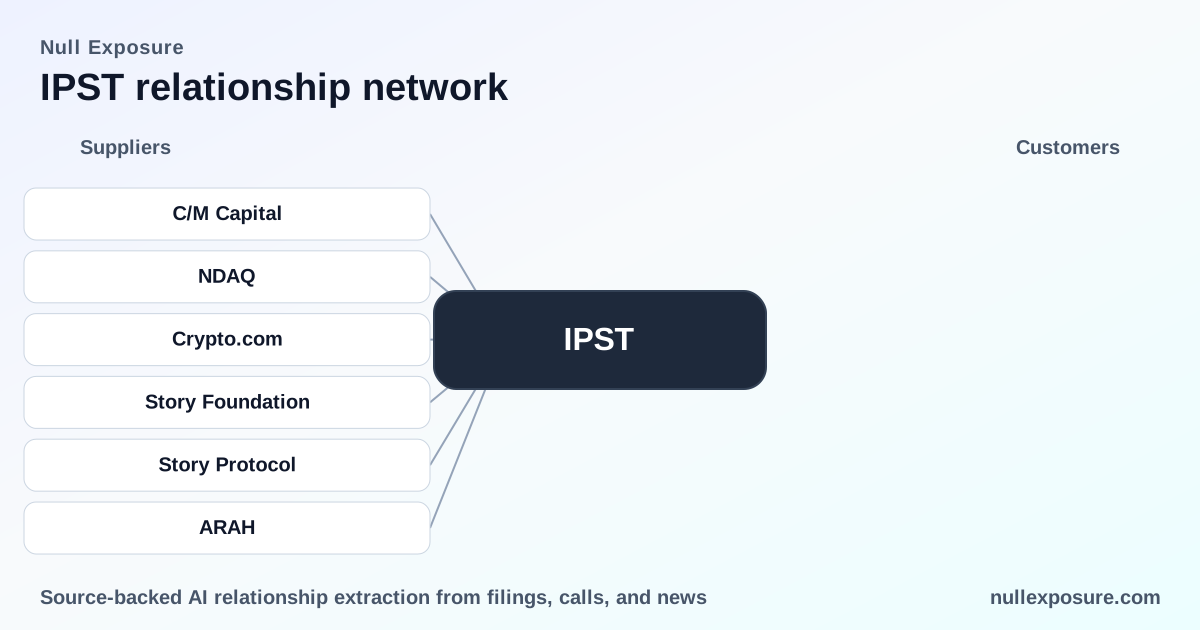
Heritage Distilling / IP Strategy (IPST): supplier exposures and counterparty map
Heritage Distilling Holding Company, trading as IPST, runs a classic craft spirits business—producing, marketing and selling spirits domestically and internationally—while increasingly monetizing non-core treasury and digital initiatives such as token purchases, staking and strategic digital-asset partnerships. For investors and operators, the company’s supplier posture combines traditional manufacturing and three‑tier retail channels with an expanding set of service and finance counterparties that materially change counterparty risk profiles.
If you want a consolidated view of counterparty risk and supplier dynamics for IPST, visit the Null Exposure homepage for deeper supplier-targeted research: https://nullexposure.com/
How IPST makes money and where supplier risk lives
Heritage Distilling’s cash flow is still derived from physical product sales through a three‑tier compliant reseller network and direct distribution, while the balance sheet is being used to pursue digital treasury strategies and token-backed initiatives that generate staking or participation income. That hybridization means investors must evaluate two parallel ecosystems: the manufacturing and fulfillment supply chain (raw materials, glass, label, third‑party retailer) and a suite of financial and platform relationships (equity lines, crypto partners, blockchain infrastructure providers). Each category drives different contracting and liquidity sensitivities.
Company-level operating constraints and what they imply
The company disclosures show several supplier and operational constraints that are material to counterparty assessment:
- Geographic sourcing mix: IPST historically sourced glass bottles from China and recently migrated production to Taiwan (APAC exposure), while grain is sourced domestically (North America). This creates a geographically bifurcated vendor base with different geopolitical and logistic risk profiles.
- Contracting posture and channel structure: IPST uses a three‑tier reseller to resell and fulfill direct‑to‑consumer orders in 45 states plus D.C., signaling delegated fulfillment and regulatory-compliant retail routing rather than direct-control retail.
- Service dependency: The company relies on third‑party IT and hosting services for operations, indicating outsourced critical infrastructure and attendant cyber/availability dependencies.
- Materiality and liquidity stress: As of December 31, 2024, aged payables aggregated to approximately $5.0 million, creating a real short‑term creditor risk that could require prioritization of cash and affect supplier relationships or litigation exposure.
- Contract maturity stage: Several sports marketing contracts completed by end‑2024 were not renewed, indicating a transition from legacy, contracted marketing obligations to a leaner cost base.
These are company‑level signals—none are attributed to a named counterparty unless the source explicitly did so—so treat them as structural characteristics that shape how every supplier relationship behaves.
Detailed counterparty relationships you need to know
Below I cover every relationship recorded in the public results and provide a plain-English summary with the cited source.
C/M Capital — termination of equity line
IPST terminated its Securities Purchase Agreement (equity line of credit) with C/M Capital effective December 22, 2025, which removes a previously available financing source and alters the company’s short-term liquidity and funding options. This action was documented in market reporting on TradingView in March 2026 referencing the December 2025 notice. (TradingView report on the agreement termination.)
Nasdaq — continued listing
IPST’s common stock continues to be listed and traded on Nasdaq, preserving market liquidity and reporting visibility for investors, as noted in the company’s ticker‑change announcement published via GlobeNewswire in September 2025. (GlobeNewswire press release, Sept 19, 2025.)
Crypto.com — digital asset treasury partner
IPST announced a partnership with Crypto.com to support a digital asset treasury strategy, signaling active engagement with a centralized crypto services provider for custody, trading or treasury operations; the relationship was covered in aggregated market listings that cited GlobeNewswire. (Finviz aggregation referencing GlobeNewswire announcement.)
Story Foundation — infrastructure for IPST’s AI/blockchain initiative
IPST highlighted the Story Foundation as the blockchain infrastructure underpinning its Poseidon AI data initiative, indicating a platform-level relationship for IPST’s hybrid data/blockchain efforts; this was disclosed in IPST’s press coverage referenced via Finviz and GlobeNewswire. (Finviz/GlobeNewswire mention of Story Foundation.)
Story Protocol — validator operation and staking revenue
IPST operates a validator for the Story Protocol, which the company cites as a driver of staking-driven revenue, introducing protocol-runner counterparty and technical operational risk tied to blockchain uptime and token economics; a press release accessible on The Globe and Mail site summarized this activity in FY2026. (Press release on The Globe and Mail with FY2026 timing.)
Aria — strategic token purchase
IPST announced the strategic purchase of Aria ecosystem tokens ($ARIAIP and $APL), reflecting a direct token-holding exposure that ties part of the company’s treasury to Aria’s ecosystem performance; this was reported through Finviz referencing the company’s GlobeNewswire disclosure. (Finviz aggregation of GlobeNewswire announcement.)
Middle-ground operational and counterparty analysis is important; if you want a vendor-focused risk map and remediation playbook, review our supplier intelligence and exposure services at Null Exposure: https://nullexposure.com/
What these relationships mean for investors and operators
- Liquidity and financing posture has shifted. The termination of the C/M Capital equity line is a clear financing change: reduced standby capital increases reliance on operational cash flow and digital‑asset arrangements for liquidity.
- Supplier concentration is directional. Domestic sourcing of grain reduces agricultural supply risk; conversely, APAC dependence for glass (now Taiwan) creates concentrated international procurement exposure.
- Counterparty complexity has increased. Crypto.com, Story Protocol/Foundation and Aria introduce new operational risk vectors—custody, validator uptime, token valuation—that are structurally different from traditional vendor risk and require specialized oversight.
- Material payable backlog is a tangible constraint. The reported ~$5.0M of aged payables is material to near‑term liquidity and can influence supplier negotiation leverage and contract enforcement.
- Outsourced fulfillment and IT raise different criticalities. Using a three‑tier reseller and third‑party IT providers offloads day‑to‑day operational burdens but increases dependency on counterparty service levels and compliance.
Investor takeaways and recommended monitoring
- Prioritize monitoring of liquidity sources and aged payable remediation; the company’s ability to amortize or restructure the $5M of payables affects supplier stability.
- Track the operational performance and custody arrangements with Crypto.com and Story Protocol—validator downtime, token lockups or crypto market shocks directly affect non‑core revenue streams.
- Review supply chain status for glass (APAC → Taiwan) and confirm contingency plans for any geopolitical or logistics disruptions.
For a tailored supplier-risk brief, vendor concentration heat map, or counterparty scoring for IPST, see our engagement options at Null Exposure: https://nullexposure.com/
Final judgment
Heritage Distilling (IPST) is evolving from a pure craft‑spirits manufacturer into a hybrid operating model that blends traditional manufacturing and distribution with speculative and operational digital‑asset activities. That transition amplifies both opportunity (new revenue lines from staking and token strategies) and complex counterparty risk that investors must monitor across financing partners, crypto service providers and international suppliers. Assess positions with an emphasis on liquidity, vendor concentration, and the governance controls that surround digital‑asset counterparties.