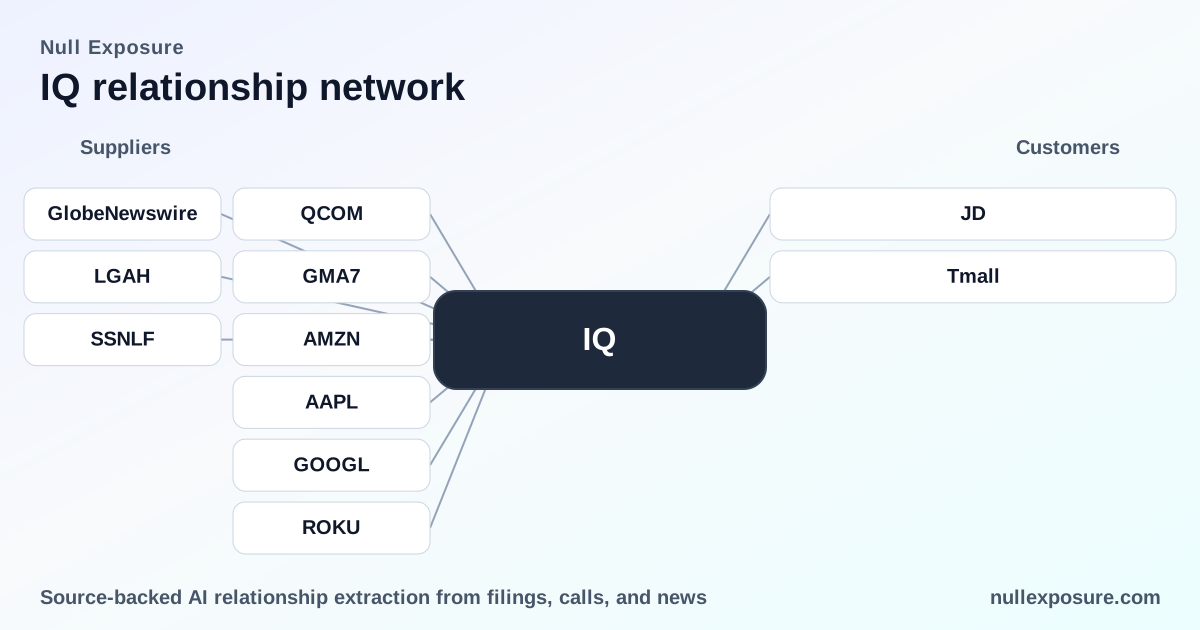
iQIYI: Distribution Partnerships as the Backbone of Streaming Monetization
iQIYI operates a China-focused streaming platform that monetizes through a mix of subscription fees, advertising, and licensed content distribution. The company's commercial strategy relies on broad distribution across device ecosystems and selective content licensing partnerships to drive scale and ad inventory — a model that demands stable supplier and platform relationships to protect reach and monetization. For investors and operators evaluating iQIYI as a supplier partner, the company’s network of device OEMs, platform aggregators, and content licensors is the primary engine for user acquisition and revenue diversification. For a concise vendor-focused risk profile and relationship map, visit the NullExposure homepage: https://nullexposure.com/.
Why these supplier ties matter to investors
iQIYI’s economics hinge on two interdependent channels: audience scale through distribution partners and content that retains paying users and advertisers. Device and platform deals unlock incremental addressable markets outside mainland China; content partnerships both supply catalog depth and seed new regional growth. Consequently, supplier concentration, contractual terms with platform partners, and the maturity of these distribution agreements are critical corporate risk factors that affect churn, ARPU, and advertising yield.
Explore a vendor risk snapshot and supplier intelligence at https://nullexposure.com/ to benchmark iQIYI against peers.
Distribution and device partnerships: the practical landscape
The relationship set in the available reporting shows iQIYI taking a multi-pronged approach to distribution: direct apps on smart TVs and streaming boxes, tie-ups with regional content owners, and hardware platform integrations for new formats like VR. These agreements function as reach multipliers rather than primary revenue drivers, but they are operationally critical because they determine where the app is discoverable and which monetization features are supported.
Relationship-by-relationship review (plain English, sourced)
-
Qualcomm Technologies (QCOM) — iQIYI’s Qiyu 3 VR headset is built on Qualcomm’s Snapdragon XR2 platform, tying iQIYI to a modern XR silicon stack that enables immersive content distribution and hardware feature parity. Source: Auganix coverage of iQIYI Qiyu 3 launch (FY2021), https://www.auganix.org/china-based-online-entertainment-platform-iqiyi-launches-new-qiyu-3-virtual-reality-headset/
-
GMA Network (GMA7) — iQIYI International secured a multi-year pact with GMA Network to bring Filipino dramas to its OTT platform, representing a content licensing route to regional audience growth. Source: GMA Network press coverage (FY2021), https://www.gmanetwork.com/entertainment/showbiznews/gma-network-and-iqiyi-international-enter-into-multi-year-deal/76505/
-
Amazon (Amazon Fire TV) (AMZN) — iQIYI announced availability on Amazon Fire TV devices, expanding access to North American subscribers via a major streaming device ecosystem. Source: PR Newswire release (FY2022), https://www.prnewswire.com/news-releases/iqiyi-launches-on-roku-streaming-players-and-roku-tv-models-bringing-variety-of-entertainment-from-across-asia-to-fans-in-canada-and-us-301512414.html
-
Apple (Apple TV) (AAPL) — iQIYI listed Apple TV among supported platforms, ensuring presence in the premium living-room app environment favored by higher-engagement users. Source: PR Newswire release (FY2022), https://www.prnewswire.com/news-releases/iqiyi-launches-on-roku-streaming-players-and-roku-tv-models-bringing-variety-of-entertainment-from-across-asia-to-fans-in-canada-and-us-301512414.html
-
Google (Chromecast) (GOOGL) — Chromecast and Android TV support are part of iQIYI’s cross-device distribution strategy for Android ecosystems, widening utility across mobile and TV form factors. Source: PR Newswire release (FY2022), https://www.prnewswire.com/news-releases/iqiyi-launches-on-roku-streaming-players-and-roku-tv-models-bringing-variety-of-entertainment-from-across-asia-to-fans-in-canada-and-us-301512414.html
-
Roku, Inc. (ROKU) — iQIYI launched a channel on Roku devices in Canada and the U.S., signaling a targeted push into Western viewing markets via a leading streaming-platform aggregator. Source: PR Newswire release (FY2022), https://www.prnewswire.com/news-releases/iqiyi-launches-on-roku-streaming-players-and-roku-tv-models-bringing-variety-of-entertainment-from-across-asia-to-fans-in-canada-and-us-301512414.html
-
LG (LGAH) — LG Smart TVs are listed among supported hardware platforms, providing access to a segment of living-room users and reinforcing the multi-manufacturer TV strategy. Source: PR Newswire release (FY2022), https://www.prnewswire.com/news-releases/iqiyi-launches-on-roku-streaming-players-and-roku-tv-models-bringing-variety-of-entertainment-from-across-asia-to-fans-in-canada-and-us-301512414.html
-
Samsung (SSNLF) — Samsung Smart TV support extends iQIYI’s distribution to the largest global smart-TV install base, an important channel for ad-supported viewership and subscriber acquisition. Source: PR Newswire release (FY2022), https://www.prnewswire.com/news-releases/iqiyi-launches-on-roku-streaming-players-and-roku-tv-models-bringing-variety-of-entertainment-from-across-asia-to-fans-in-canada-and-us-301512414.html
-
GlobeNewswire — a press distribution notice of iQIYI’s FY2025 results is reflected in the coverage set; the item includes a note that an AI-generated summary was used to summarize the release. This is a marketing and disclosure channel rather than an operational supplier, and it frames how earnings and PR reach are propagated. Source: Quiver Quant summary referencing GlobeNewswire (FY2026), https://www.quiverquant.com/news/iQIYI%2C+Inc.+to+Release+Fourth+Quarter+and+Fiscal+Year+2025+Financial+Results+on+February+26%2C+2026
Operating model constraints and company-level signals
There are no explicit contractual constraints surfaced in the available records for supplier relationships. This absence is itself a signal: public reporting for these partnerships emphasizes distribution breadth rather than restrictive exclusivity clauses, which implies a contracting posture focused on openness and scale. Company-level model characteristics:
- Contracting posture: Broad, ecosystem-friendly agreements to maximize app availability across devices and platforms.
- Concentration: Distribution is diversified across multiple global platforms and OEMs, reducing single-partner concentration risk on the device side.
- Criticality: Platform and OEM partnerships are operationally critical for reach and therefore for ad inventory and subscription growth.
- Maturity: Several relationships (major smart-TV and streaming-device integrations) reflect mature go-to-market mechanics; XR/VR integration with Qualcomm indicates experimentation in newer formats.
These company-level signals inform vendor risk models: while no single supplier appears dominant, the operational importance of device and platform partners makes their availability a systemic dependency.
Investment implications and risk checklist
- Upside: Broad device coverage supports audience scale and diversified ad inventory. Content licensing deals like the GMA Network partnership create regional growth catalysts. Presence on Roku, Apple TV, Amazon Fire TV, Google Chromecast, Samsung and LG ensures discoverability across major western and Asian viewers.
- Risks: Distribution is a necessary condition for monetization but not sufficient — content success, regulatory context in China, and advertising demand cycles remain primary revenue drivers. Device-ecosystem dependencies are operationally critical; any platform-level changes to app-store economics or feature access could materially affect reach and ARPU.
- Operational priority for operators: Negotiate non-discriminatory placement, robust analytics access, and standardized streaming capabilities across device partners to protect engagement metrics.
If you want a structured vendor risk scorecard or bespoke supplier due diligence on iQIYI, start here: https://nullexposure.com/.
Bottom line and next steps for partners and investors
iQIYI’s supplier map shows intentional breadth: major smart-TV OEMs, streaming-platform aggregators, and targeted content licensors underpin an approach designed to maximize reach and convert it into subscriptions and ad revenue. For investors, the critical questions are whether content investment and ad monetization will scale proportionally and whether platform relationships remain stable under shifting app-economy rules. For operators evaluating iQIYI as a supplier, prioritize contractual terms that preserve distribution, analytics transparency, and product parity across devices.
For further supplier intelligence and to commission a tailored relationship risk assessment, visit https://nullexposure.com/ and request a briefing.