Opus Genetics (IRD) — supplier relationships, contracts, and what they mean for investors
Opus Genetics monetizes by developing proprietary gene therapies for rare retinal diseases and extracting value through exclusive licenses, strategic asset transactions, and partnership-driven commercialization. The company’s economics are driven by clinical progress and IP control: it licenses foundational patents from academic and third-party holders, acquires or sells program assets, and relies on third-party manufacturers and collaborators to move candidates from clinic to market. For investors evaluating IRD as a supplier to the broader ophthalmic ecosystem, the combination of licensing posture and reliance on external manufacturing is the single most important operational axis to monitor. Learn more at https://nullexposure.com/.
How Opus’s operating model converts science into commercial optionality
Opus operates as a clinical-stage biotech whose primary revenue pathways are license fees, milestone and royalty streams from partnered programs, and eventual product sales or asset monetization. The company’s most visible balance-sheet signals: market capitalization roughly $362.8M, trailing revenue of $14.2M and a negative EBITDA of about $38.5M, indicate a capital-intensive R&D profile typical of gene-therapy developers. Analyst coverage is constructive: the street consensus target sits near $9.50 with a majority of buy ratings (11 buys and 1 strong buy).
Key operating characteristics:
- IP-centric model: Opus formalizes exclusive and sublicensed rights to gene targets and builds clinical programs around those rights. That grants high optionality but also concentrates value on a few licensed assets.
- Partner-dependent execution: The company routinely acquires or transfers program rights and relies on third parties for manufacturing and certain development steps, increasing dependence on counterparty execution.
- Low fixed-property exposure: A short-term leased facility profile reduces long-term fixed-cost burden but does not substitute for robust manufacturing capacity when scaling clinical or commercial supply.
If you are modeling counterparty risk across ophthalmic supply chains, put Opus on your shortlist and see additional supplier intelligence at https://nullexposure.com/.
Notable supplier and partner relationships (what the record shows)
Below I cover every named relationship surfaced in the supplier results and provide a concise summary with source context.
-
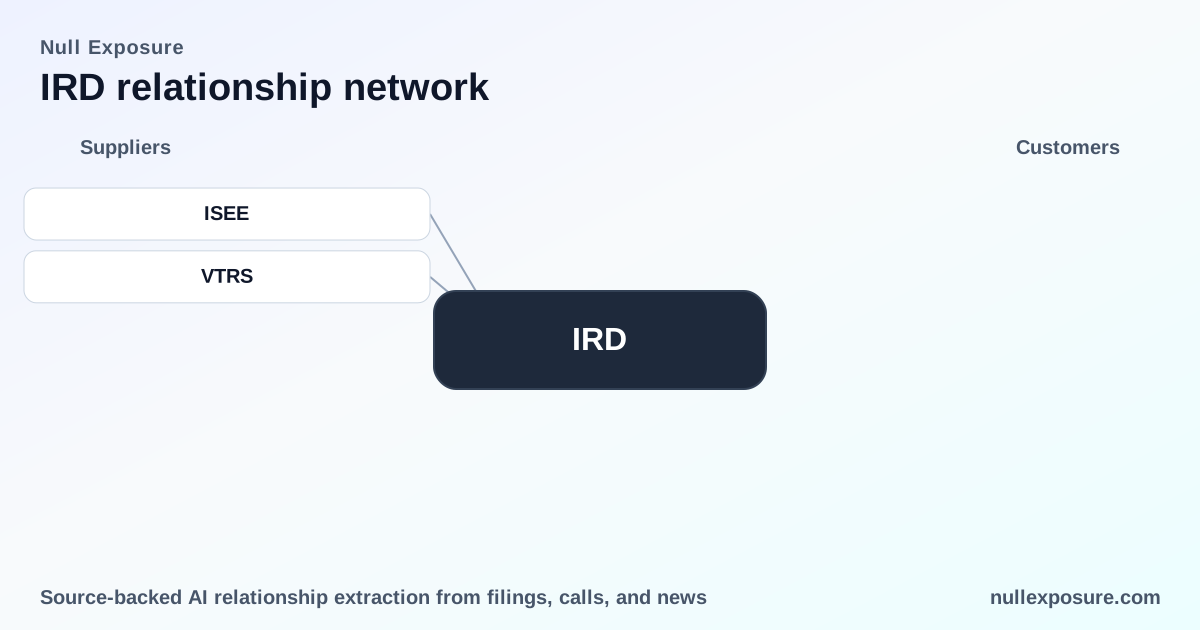
Iveric (ISEE) — Opus acquired assets from Iveric on December 23, 2022, including the BEST1 License and programs tied to BEST1 and RHO, reflecting Opus’s strategy to consolidate ocular IP and move assets into its clinical pipeline; the transaction is documented in company filings and was referenced in press coverage. According to the company’s asset purchase disclosure and press reporting, Opus closed that purchase to expand its retinal portfolio (company filings; The Pharma Letter coverage noted the acquisition and subsequent program developments).
-
Viatris (VTRS) — A trade press piece covering Ocuphire’s purchase of Opus referenced Ocuphire’s prior work with Viatris on RYZUMVI and ties to the broader ophthalmic product ecosystem; this is an indirect linkage that situates Opus within a network of companies engaged in ophthalmic commercialization. EyesOnEyecare reported on Ocuphire’s acquisition activities and noted past partnering between Ocuphire and Viatris on the RYZUMVI product (EyesOnEyecare, Oct 23, 2024).
Constraints and what they imply for supply-side risk
Opus’s disclosures reveal several operational constraints that shape its supplier and counterparty risk profile. Presenting these as company-level signals (unless the excerpt explicitly names a counterparty):
-
Short-term contracting posture: Opus leases a facility under a short-term, non-cancellable agreement that expires September 30, 2025, with modest base rent ($1,300/month). This implies a deliberate strategy to keep fixed costs low and maintain flexibility, but it also signals potential relocation or scaling costs if larger manufacturing capacity is required beyond 2025 (company lease disclosure).
-
IP licensing is central and concentrated: Filings confirm an exclusive, royalty-bearing license with the Trustees of the University of Pennsylvania (LCA5/RDH12 Agreement) and a sublicense with Apexian for a Ref-1 Inhibitor program, demonstrating Opus’s reliance on third-party academic and commercial IP to build its pipeline. These licensor relationships are critical to Opus’s product definition and future revenue capture (company license agreements).
-
Asset acquisition and seller activity: Opus has executed asset purchase agreements such as the December 2022 transaction with Iveric for BEST1/RHO rights, indicating the company both acquires and consolidates program assets as a core growth tactic and can act as a buyer or seller in the ophthalmic IP market (company asset purchase disclosure).
-
Manufacturing reliance risk: Filings highlight potential delays from third-party contractors in testing, validation, manufacturing and delivery of product candidates, flagging a dependency on external CMOs and testing providers that can bottleneck clinical timelines and commercial launches (company risk disclosures).
Together these constraints paint a picture of a lean, IP-driven developer that intentionally limits long-term fixed commitments but accepts concentration of value in a small number of licensed programs and outsources manufacturing — a profile that accelerates de-risking through partnerships but introduces counterparty and supply continuity risk.
Operational and investment implications for suppliers and buyers
For supply-chain managers and investors evaluating Opus as a supplier or partner, the practical takeaways are clear:
-
IP control is the fulcrum: Any supplier or investor evaluating a partnership should prioritize contractual visibility into licensed patents and sublicenses; loss or limitation of those rights would meaningfully change program economics.
-
Manufacturing capability is the gating factor: Given stated exposure to third‑party manufacturing delays, counterparties should demand robust validation timelines, contingency plans and clear supply agreements to protect trial and launch schedules.
-
Flexibility traded for concentration: Short-term facilities and an acquisitive posture keep Opus nimble but concentrate value risk on a handful of programs; counterparties should price for that concentration and demand milestone-aligned protections.
If you need a structured diligence brief or counterparty risk scoring for Opus and its suppliers, start your inquiry at https://nullexposure.com/ — we aggregate filings, press mentions, and operational constraints into actionable supplier intelligence.
Bottom line
Opus Genetics runs a classic small-cap gene-therapy playbook: license-driven asset assembly, selective asset transactions, and outsourced execution. That combination creates high upside if clinical milestones are met, but it also centralizes risk in IP agreements and third-party manufacturing performance. For investors and operators, prioritize contract-level clarity on licenses and supply agreements, and price in the operational risk implied by short-term facilities and CMO dependence.