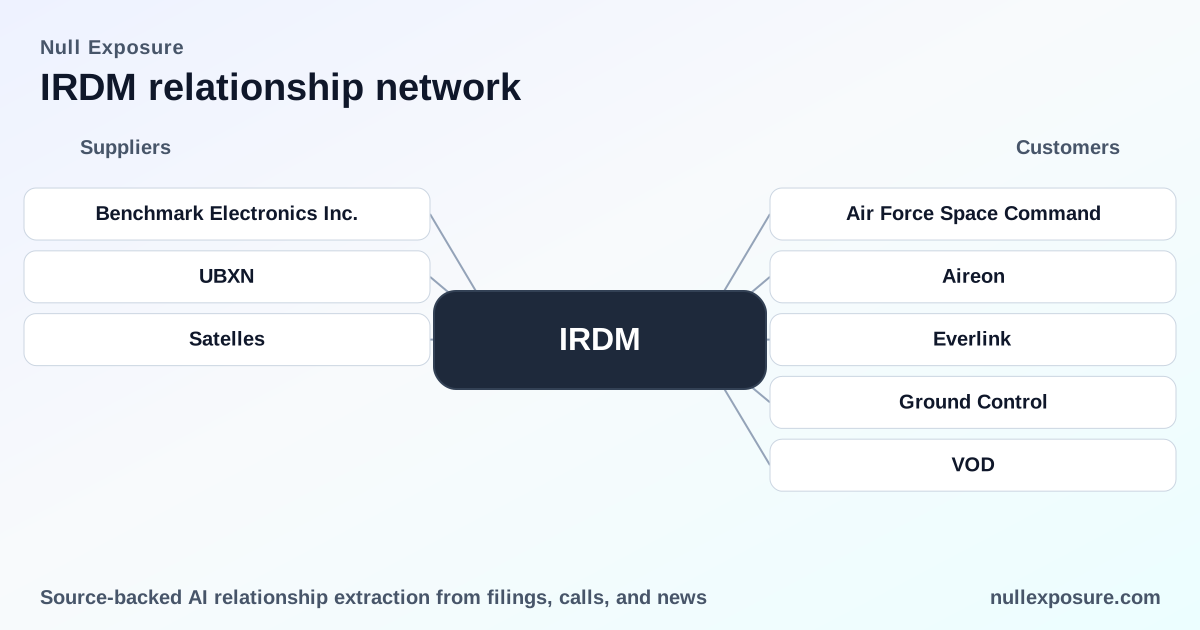
Iridium Communications (IRDM): supplier relationships that shape product delivery and operational risk
Iridium monetizes a global satellite-network and device ecosystem by selling voice and data connectivity, recurring subscription services, and certified subscriber devices to commercial, government and consumer customers. The business depends on sold hardware (subscriber equipment) manufactured under contract and a constellation-based service layer that drives recurring revenue through connectivity plans and value-added services. For investors, the supplier relationships that produce Iridium’s subscriber devices are as important as spectrum and orbital assets because device supply constrains revenue growth and customer acquisition economics. For a practical supplier map and ongoing tracking, visit https://nullexposure.com/.
How Iridium’s business model links to its supplier posture
Iridium’s revenue profile combines durable, subscription-like service income with hardware sales that have lumpy margins. Services generate predictable cash flow; devices enable distribution and lock-in. That dichotomy makes manufacturing contracts strategically critical: shortages or single-source failures translate directly into lost activations and slower service ARPU growth.
- Contracting posture: Iridium outsources manufacturing of most of its subscriber equipment to third parties under explicit manufacturing agreements.
- Concentration: The company contracts with a limited number of manufacturers and relies on sole-source suppliers for certain components — a concentrated supply base rather than a distributed, multi-sourced model.
- Criticality and maturity: Device manufacturing is a mission-critical operational activity that is mature (established manufacturing partners with defined agreements) but remains exposed to single-event disruptions and component shortages.
These company-level signals come from Iridium’s public filings and disclosures. The FY2025 10‑K explicitly states the use of a limited set of manufacturers and reliance on single-source components, framing supplier risk as a persistent operational constraint.
The supplier relationships that matter today
Below I cover every identified supplier relationship in Iridium’s public results and reporting. Each entry includes a concise, plain-English summary and a source reference.
Benchmark Electronics — the primary contract manufacturer for subscriber equipment
Iridium has a manufacturing agreement with Benchmark Electronics Inc. to produce most of its subscriber equipment, positioning Benchmark as a primary contract manufacturer in Iridium’s supply chain. According to Iridium’s FY2025 10‑K, Benchmark manufactures the majority of subscriber devices under an explicit contract, making it central to device throughput and fulfillment timelines (Iridium FY2025 10‑K filing).
u‑blox — module platform for the compact Iridium 9604 IoT device
The Iridium 9604 module is built on the u‑blox SARA‑R5 platform, enabling a very small form factor that targets industrial and mobility IoT use cases where dual-mode connectivity was previously cost-prohibitive. A March 2026 article in SatellitePro described the technical partnership and the role of u‑blox silicon in the 9604 design, highlighting u‑blox as a component platform supplier for Iridium’s next-generation IoT modules (SatellitePro, March 10, 2026).
Satelles — an acquisition to extend PNT services and GPS protection
Iridium agreed to acquire Satelles, a satellite-based provider of positioning, navigation and timing (PNT) services, to broaden Iridium’s PNT and GPS-protection capabilities and expand addressable markets for critical infrastructure and security applications. The transaction and strategic rationale were reported in media coverage in March 2026, noting Iridium’s objective to accelerate growth in IoT and PNT services through the Satelles purchase (Simply Wall St coverage, March 2026).
What the supplier map means for risk and upside
The relationships above reveal a pragmatic supplier strategy: partner with established contract manufacturers for scale, integrate proven module platforms for product design efficiency, and acquire specialized service providers to expand capabilities. That structure supports predictable device output and faster product rollout, but it also concentrates risk.
- Single-source exposure: Iridium’s filings identify single-source suppliers for certain components and a limited roster of manufacturers for devices. This is a company-level constraint that increases operational vulnerability to supplier disruptions, lead-time spikes, and component shortages.
- Operational criticality: Manufacturing partners like Benchmark are functionally indispensable — delays at these firms translate to lower device shipments and subsequent subscription growth drag.
- Mitigants and strategic moves: The use of established module vendors such as u‑blox reduces engineering risk and accelerates time-to-market, while acquisitions like Satelles shift Iridium’s revenue mix toward higher-value services, lowering sole dependence on device volume for growth.
For portfolio managers concerned with supply-side continuity and contract concentration, these are actionable risk signals. For a live view of supplier concentrations and contract intelligence, explore https://nullexposure.com/ for supplier dashboards and alerts.
Investment implications and operational monitoring checklist
For investors and operators evaluating IRDM supplier relationships, prioritize these monitoring items:
- Track manufacturing throughput and any public statements from Benchmark (order volumes, lead times, capacity expansions).
- Monitor component market dynamics for u‑blox modules and the SARA‑R5 supply cadence; module shortages would have an immediate impact on Iridium 9604 availability.
- Assess integration progress and revenue contribution from the Satelles acquisition as a leading indicator of PNT monetization and higher-margin service growth.
Key takeaway: supplier concentration elevates operational risk but is balanced by strategic partner selection and capability-accretive M&A.
Final read: what to watch and next steps
Iridium’s supplier relationships are integral to both its near-term delivery capacity and its medium-term strategy to push into IoT and PNT services. Benchmark’s manufacturing agreement anchors device supply, u‑blox supplies the module architecture for compact IoT endpoints, and the Satelles deal expands service capabilities — together these relationships determine the speed at which device-enabled subscriptions convert into recurring revenue.
If your investment decision depends on supply continuity, covenant risk, or realized service monetization, use supplier-focused intelligence to supplement traditional financial analysis. Visit https://nullexposure.com/ for tools and reporting that map these exact relationships and provide ongoing monitoring.
Closing recommendation: treat Iridium’s supplier base as a leading operational metric — watch manufacturing cadence and component availability as bellwethers for revenue momentum and margin sustainability.