IREG supplier relationships: what investors need to know
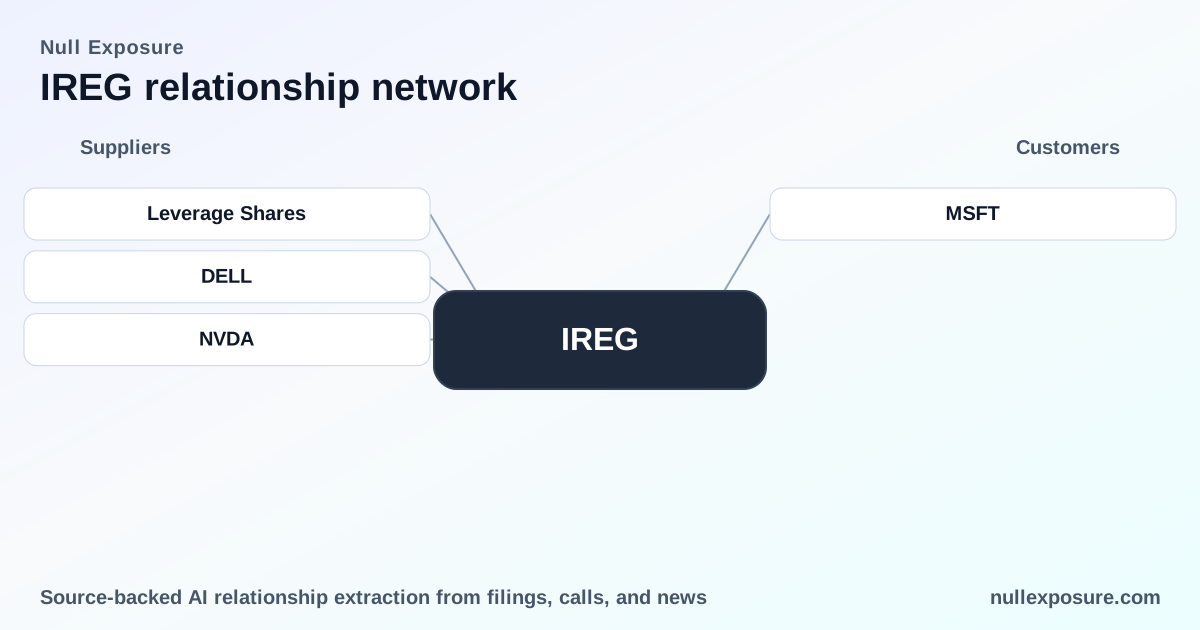
IREG operates as a publicly traded supplier whose market relevance is driven by two channels: financial market exposure via exchange-traded products that reference its listing and operational linkages to large technology vendors that shape demand for its services or output. The company monetizes through its underlying commercial contracts and the capitalization that flows from market instruments tied to its equity or operational footprint. Investors should evaluate IREG on both supplier concentration and the market-sentiment dynamics that can amplify short-term liquidity and valuation moves.
Explore further company and supply-chain signals at https://nullexposure.com/.
Market snapshot: short-term liquidity and narrative risk matter
Media coverage in 2025–2026 shows IREG is exposed to volatile sentiment channels: an ETF product using the IREG ticker recorded a sharp single-day move in March 2026, while December 2025 coverage linked IREG’s narrative to large-scale AI hardware procurement reported through Dell and Nvidia. This mix of retail/ETF volatility and enterprise-supply narratives increases the sensitivity of IREG’s market value to both trading flows and supply-chain news.
Supplier relationships you must review (all relationships in the record)
Below are every supplier relationship mentioned in the available records, with plain-English summaries and source notes.
-
Leverage Shares
Leverage Shares operates a 2x leveraged ETF that references IREN/IREG (listed as IREG.US) and recorded a 28.67% intraday rise on March 10, 2026 with $1.47 million traded, demonstrating material short-term volatility tied to the IREG listing. According to a Futunn news post (Mar 10, 2026), the ETF’s price and volume spikes are a direct market signal that trading products referencing IREG can drive meaningful liquidity events. (Futunn, Mar 10, 2026) -
Dell
Dell is cited in December 2025 reporting as the conduit for large-scale AI hardware deployments involving Nvidia chips; that reporting was included in a broader piece about IREN Limited’s market outlook. A TS2.Tech article (Dec 16, 2025) noted an agreement that routed $5.8 billion of Nvidia GB300 chips and related equipment through Dell, linking IREN’s market narrative to enterprise AI supply chains. (TS2.Tech, Dec 16, 2025) -
Nvidia
Nvidia’s GB300 chips are referenced in the same December 2025 coverage and represent the high-end compute hardware at the center of a $5.8 billion procurement flow discussed in the article that mentioned IREN Limited. The presence of Nvidia in the coverage ties IREG’s public narrative to AI infrastructure demand and downstream OEM distribution via Dell. (TS2.Tech, Dec 16, 2025)
How to read these relationships: commercial vs. narrative weight
The relationships above fall into two distinct types of influence on IREG:
-
Market-channel influence (Leverage Shares): The Leverage Shares ETF is a trading vehicle that creates market amplification. The ETF’s outsized single-day move and nontrivial volume show that instrument-level flows can produce volatility that is independent of operating cash flows, but highly relevant for investors focused on liquidity, share-based financing, or short-term valuation swings.
-
Supply-chain narrative influence (Dell and Nvidia): Mentions of Dell and Nvidia connect IREG to the enterprise AI procurement cycle, which is a demand-side driver for many suppliers and partners. Coverage that ties IREG to a $5.8 billion hardware routing through Dell suggests that investor perception of IREG’s exposure to AI infrastructure can materially affect sentiment and, therefore, market price.
Operating model constraints and what the silence implies
The records include no explicit contractual constraints or flagged limitations on IREG’s supplier relationships. That absence is itself a signal: there are no disclosed supplier constraints in the reviewed data set, which suggests either straightforward contracting posture or simply lack of public contract-level disclosure.
Company-level signals derived from that absence:
- Contracting posture: No published constraints indicate standard commercial terms rather than restrictive concessionary clauses; investors should still seek the underlying agreements for confirmation.
- Concentration: Media linkage to a small set of high-profile vendors and a leveraged ETF indicates concentration risk at the narrative level—market moves can be dominated by a handful of visible relationships.
- Criticality: Dell and Nvidia are material industry suppliers at scale, so any true operational dependency on them would be highly critical for downstream performance; absence of contract detail prevents definitive quantification.
- Maturity: The relationships reported are current to FY2025–FY2026, indicating active, contemporary exposure rather than legacy ties.
For deeper supplier contract intelligence and to monitor new disclosures, visit https://nullexposure.com/.
Investment implications and risk checklist
Investors and operators should prioritize the following:
- Liquidity management: Given the ETF-driven volatility observed, maintain sufficient liquidity buffers and monitor derivative/ETF positions referencing IREG to avoid forced selling or margin stress.
- Disclosure diligence: The lack of public contractual constraints requires active diligence—request contract-level visibility for any supplier identified as operationally critical.
- Narrative risk monitoring: Coverage linking IREG to large AI procurement cycles can drive rapid sentiment changes; set alerts on vendor announcements from Dell and Nvidia to anticipate second-order effects.
- Concentration mitigation: If contracts or revenue streams are concentrated around relationships referenced in media, consider contingency planning and supplier diversification.
Bottom line and next steps
IREG’s investor profile combines market-channel volatility with exposure to high-profile technology vendors; both elements are equally important for valuation and operational risk. The Leverage Shares ETF shows how trading instruments can amplify price moves, while Dell and Nvidia mentions connect IREG to the broader AI hardware supply chain narrative. Investors should demand supplier contract transparency and continuously monitor both trading flows and vendor announcements.
For a structured supplier-risk review and ongoing alerts, see https://nullexposure.com/. If you need a tailored briefing on IREG’s supplier risk and disclosure gaps, start at https://nullexposure.com/ and request the supplier deep-dive.