IRIDEX (IRIX): Supplier Relationships and operational signals investors need to know
IRIDEX is an ophthalmic medical-technology company that designs, assembles and sells therapeutic laser systems, delivery devices and consumable instrumentation for the treatment of retinal and glaucoma conditions. The company monetizes through capital equipment sales combined with recurring consumables and procedure-related disposables, plus aftermarket service and consumable replacements that generate higher-margin recurring revenue. For a focused view of supplier exposures and partner linkages that drive this business model, visit https://nullexposure.com/.
How IRIDEX captures value and where supplier relationships fit in
IRIDEX captures value through a dual model: one-time device sales that establish clinical footprints and recurring revenue from consumables and proprietary delivery consumables. Fiscal results show a small enterprise with FY‑TTM revenue of $50.6 million and gross profit of $19.3 million, but negative operating and net margins that reflect early-stage margin recovery and investment in commercialization. The company discloses that it relies on third parties to manufacture substantially all components while assembling critical subassemblies and final products in Mountain View, California, which concentrates operational criticality on the company’s facility and on its contract-manufacturing network. Company disclosures also state: "We have some long-term or volume purchase agreements with our suppliers but currently purchase most components on a purchase order basis." That contracting posture is a company-level signal that investors must treat as a driver of both flexibility and supply risk.
- Business-model implication: recurring consumables provide margin leverage once installed base grows; device sales create the installed base.
- Supply implication: spot/PO-driven purchasing increases exposure to price and availability volatility but reduces long-term fixed commitments to suppliers.
- Operational criticality: in-house assembly in Mountain View is a single-site point of operational concentration for final assembly and quality control.
Supplier and partner relationships investors should track
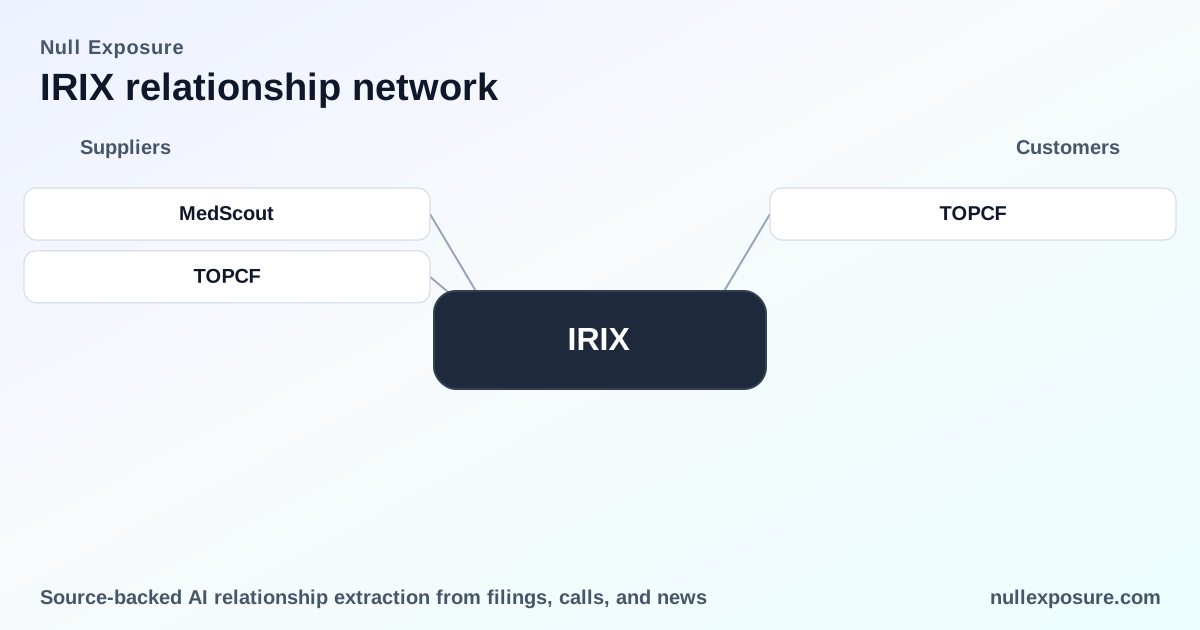
MedScout — tactical sales enablement to increase utilization
IRIDEX uses MedScout as a sales enablement platform to identify mid‑range utilization accounts and push clinical and consumable utilization. According to an IRIDEX Q3 FY2025 earnings call transcript published on InsiderMonkey in March 2026, management described active use of MedScout to uplift utilization in targeted accounts to drive consumable demand and procedure volume. This is a low-capital, high-leverage commercial partnership that directly targets the recurring-revenue leg of IRIDEX’s model. (Source: InsiderMonkey, IRIDEX Q3 FY2025 earnings call transcript, first reported March 2026.)
Topcon — product-line acquisition to broaden retinal offerings
IRIDEX integrated Topcon’s Pascal laser product line into its portfolio and combined that IP with IRIDEX’s MicroPulse technology to expand its retinal scanning laser products. A MassDevice report referencing IRIDEX’s FY2021 activity documents the acquisition and strategic product consolidation, which strengthens the company’s commercial proposition in retinal therapy by expanding product breadth and OEM footprint. This represents a strategic product-supply relationship that enhances addressable market and device-to-consumable conversion opportunities. (Source: MassDevice report on IRIDEX–Topcon activity, referencing FY2021.)
What the contract posture and manufacturing signals mean for investors
The company-level constraints point to a mixed operational profile:
- Contracting posture — predominantly spot purchase: IRIDEX currently purchases most components on a purchase-order basis while maintaining some long-term or volume agreements. That posture gives procurement flexibility and reduces committed fixed costs, but it increases exposure to near-term supply shocks, price spikes and lead-time variability if demand normalizes or trade conditions tighten.
- Manufacturer role — third-party production with in-house assembly: IRIDEX relies on third-party manufacturers for substantially all components while retaining assembly of critical subassemblies and final products in Mountain View. That structure reduces capital intensity and shortens time-to-market for product updates while concentrating quality and continuity risk at the Mountain View facility and at the small set of contract manufacturers.
- Maturity and concentration: the company’s small market capitalization (roughly $15.1 million) and limited institutional ownership (about 15%) reflect early-stage market penetration and concentrated insider ownership (~27.5% insiders), which amplifies governance attention and execution risk.
These are company-level signals; none of these constraints are tied to a single supplier unless explicitly stated by the company.
Commercial and operational implications for valuation and risk
IRIDEX’s current financial profile — negative operating margins, diluted EPS of -$0.32, price-to-sales around 0.45 and EV/Revenue near 0.54 — indicates a small, commercially active medical-device company that is investing in topline growth and commercialization efficiency. The supplier and partnership signals translate into the following investment implications:
- Upside drivers: product-line acquisitions like Topcon’s Pascal and tactical sales enablement via MedScout are direct levers to increase device penetration and convert equipment installations into recurring consumable revenue, which is the path to margin expansion.
- Key risks: the spot-heavy procurement posture and reliance on third-party component manufacturing increase supply volatility risk, which could compress gross margins if component prices rise or supply lead times lengthen. The single-site final assembly role elevates operational concentration risk.
- Monitoring priorities: track gross margin trends, inventory days, disclosure of long-term supply agreements, any expansion of contract-manufacturer footprint, and revenue mix between device sales and consumables.
For a consolidated view of IRIDEX supplier exposures and to compare counterparties across your coverage set, visit https://nullexposure.com/.
Actionable takeaways for investors and operators
- Topcon integration is strategically important: the addition of the Pascal line broadens IRIDEX’s retinal product set and increases the scope for consumable sales, improving the company’s addressable market. (Source: MassDevice, FY2021 reporting.)
- Commercial enablement is pragmatic and revenue-accretive: MedScout is a deliberate, low-capital tool management is using to extract incremental utilization from existing accounts and lift consumable sell-through. (Source: InsiderMonkey, IRIDEX FY2025 earnings call.)
- Supply structure requires active monitoring: the spot-based procurement approach and reliance on third-party manufacturers make supplier continuity, contract diversification and lead-time management critical operational KPIs for any credible investment thesis.
- Corporate-scale limits near term upside: small market cap and negative profitability make IRIDEX a high-execution-risk investment where operational wins (higher utilization, improved margins) will materially re-rate valuation.
If your diligence requires a side-by-side review of IRIDEX’s supplier relationships and constraints, view the full supplier mapping at https://nullexposure.com/.
Bottom line
IRIDEX operates a clinically focused medical-device business with recurring-consumable economics and a small but strategic product portfolio boosted by the Topcon Pascal line and commercial tactics such as MedScout. The company’s spot-oriented purchasing and third-party manufacturing model deliver procurement flexibility but introduce supply and concentration risks that investors must monitor against margin and utilization progress. For investors and operators, the trade is clear: execution on utilization and consumable conversion drives upside; supply-chain and assembly concentration are the primary operational hazards. For ongoing supplier-intelligence and comparative coverage, start with https://nullexposure.com/.