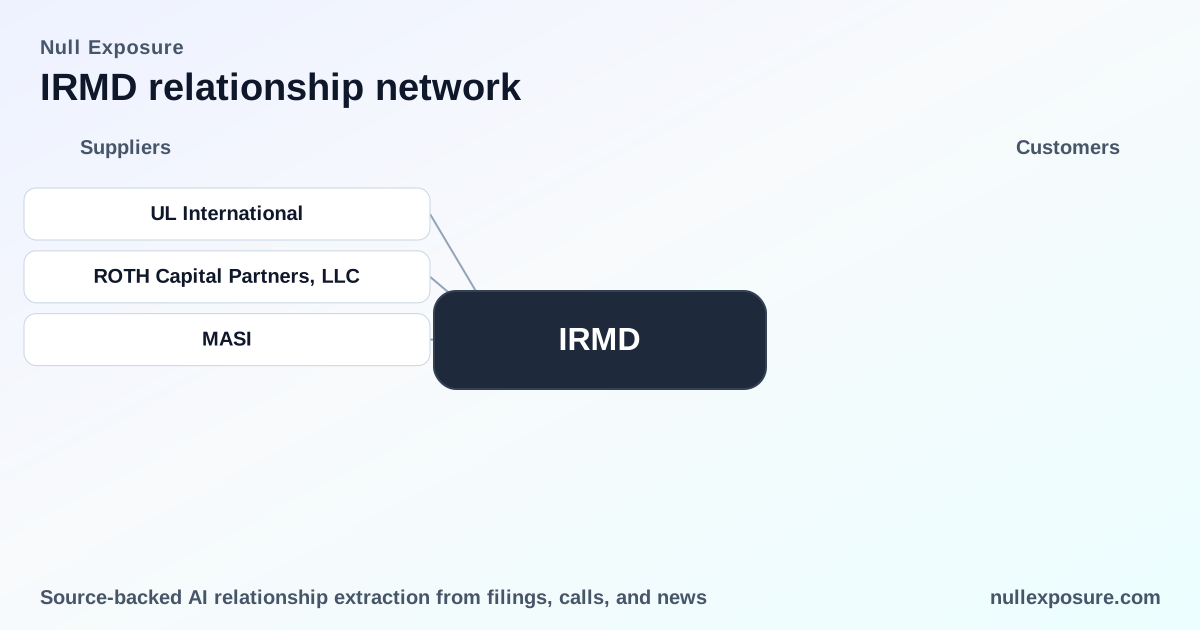
IRadimed (IRMD) — supplier map and what it means for investors
Iradimed manufactures MRI‑compatible patient monitoring and infusion devices and monetizes through direct product sales, recurring accessory and service revenue, and a modest cash dividend. The company assembles products in Florida from globally sourced components, licenses certain technologies, and integrates third‑party algorithms and certifications into its devices to access hospital buying cycles and international markets. Investors should treat IRadimed as a niche medical‑device OEM whose margin profile and growth depend on supplier continuity, regulatory confirmations, and a handful of technology partnerships.
For a concise vendor-focused risk profile and ongoing supplier monitoring, visit the NullExposure homepage: https://nullexposure.com/
How IRadimed’s operating model drives supplier priorities
Iradimed’s business model is a classic medical‑device OEM playbook: design and assemble proprietary hardware at a single U.S. site, source critical subcomponents from overseas suppliers, incorporate third‑party algorithms and components, and sell into hospitals worldwide where regulatory clearance is essential. Financials show a compact but profitable enterprise: Revenue TTM ~$83.8M, Gross Profit TTM ~$64.3M, Market Cap ~$1.3B, illustrating a premium multiple reflective of specialty product positioning rather than scale.
This operating posture creates specific supplier constraints that shape strategic risk:
- Contracting posture: The company relies on a mix of sole‑sourced critical parts (historically) and in‑house manufacturing following technology transfer. This implies higher near‑term operational leverage to a small set of vendors but a growing ability to internalize production for strategic components.
- Concentration and criticality: Key components are single‑sourced and described as essential to product functionality; any disruption carries material operational impact.
- Geographic exposure: Components originate from APAC countries, including Chinese, Taiwanese, and Japanese suppliers, producing currency and geopolitical risks.
- Maturity of relationships: There is evidence of evolving arrangements — for example, a technology transfer that shifted production capacity to IRadimed — indicating movement from supplier dependency toward internal control.
The supplier and advisor relationships you need on your radar
Below I cover every relationship found in the reviewed results and what each implies for investors.
UL International — regulatory reviewer / notified body
UL International acted as the notified body that reviewed Iradimed’s technical file and, according to reporting, found the company out of compliance with new EU clinical evaluation rules, prompting a product withdrawal tied to an expiration date in January (reported in the context of FY2019). This is a regulatory dependency that materially affects market access in Europe. (MassDevice article, reporting on the 2019 regulatory action; massdevice.com)
ROTH Capital Partners, LLC — financial services / compensated advisor
ROTH Capital received compensation for non‑investment banking securities‑related services from Iradimed within the prior twelve months, indicating an active advisory or investor relations engagement rather than an operational supplier role. This is a capital‑markets relationship that supports investor communications and coverage. (Streetwise Reports, August 2023 coverage noting ROTH’s engagement; streetwisereports.com)
Masimo — algorithm and physiologic monitoring partner
Masimo’s pulse oximetry algorithms and monitoring technology are integrated into IRadimed products; IRadimed product descriptions and press releases explicitly list “wireless SpO2 using Masimo® algorithms” and related monitoring features in device specifications. This is a technology licensing/integration relationship that enhances product functionality and hospital acceptance but ties part of the product’s value proposition to a third‑party IP provider. (Orlando regional news on product features, FY2024; GlobeNewswire press release, Feb 2026 financial release)
What these relationships imply for valuation and operations
The combination of a regulatory notified‑body relationship, a financial advisor, and a technology partner yields a clear set of investor takeaways:
- Regulatory certification is an operational lever. The UL incident demonstrates that notified‑body rulings can force product withdrawals and impact revenue recognition and market access. Investors should monitor regulatory filings and notified‑body statuses as value drivers.
- Technology partners underpin product differentiation. Masimo’s algorithms add clinical credibility and are likely a competitive moat for some product lines; losing those integrations would degrade product comparability with peers.
- Supply concentration is a real earnings risk. Company disclosures describe single‑supplier sourcing for critical components and recent internalization of at least one ultrasonic motor via a technology transfer completed December 2024; this reduces dependency but does not eliminate exposure to other single‑source parts. Sole‑source history elevates disruption risk.
- Regional sourcing and FX exposure exist. Procurement from Chinese/Taiwanese and Japanese vendors creates APAC supply chain and currency risk, which is relevant to gross margin stability and timing of deliveries.
- Capital‑markets relationships support share liquidity and communication. Engagements with boutique firms like ROTH reflect ongoing coverage and support for secondary market interest, not operational dependency.
For additional supplier risk signals and tailored monitoring, check NullExposure’s supply‑chain intelligence at https://nullexposure.com/
Practical monitoring checklist for operators and investors
- Track regulatory notices and notified‑body interactions (UL or equivalent) for any product or technical‑file actions.
- Confirm the current supplier list for all previously sole‑sourced components and whether internal manufacturing replaces external supply.
- Monitor license agreements and renewal terms with technology partners such as Masimo.
- Review foreign currency exposure and APAC vendor concentration in quarterly filings.
- Watch investor relations activity and advisor disclosures for signs of impending capital actions.
Bottom line and next steps
IRadimed is a specialty OEM whose value depends on a small number of high‑impact supplier and partner relationships, regulated market access, and the company’s success in reducing single‑supplier dependency. The company’s move to internalize at least one formerly sole‑sourced motor is a constructive operational development, while the UL regulatory action and continued reliance on Masimo algorithms highlight both regulatory and technology dependencies that directly affect revenue and competitive positioning.
For ongoing monitoring, supplier mapping, and alerts tied to regulatory or vendor events that influence valuation, visit NullExposure: https://nullexposure.com/
If you need a bespoke supplier risk briefing on IRadimed or comparable med‑device suppliers, the team at NullExposure can prepare a focused report tailored to investors and operators; start at https://nullexposure.com/ and request a supplier intelligence brief.