Disc Medicine (IRON): Supply relationships, operational constraints, and what investors need to know
Disc Medicine is a clinical-stage biotech focused on novel therapies for serious hematologic disorders. The company generates value through discovery and clinical development, monetizing via licensing arrangements, milestone and royalty receipts from partnered programs, and eventual product sales following regulatory approvals; near-term financing and underwritings fund development. Key operating characteristics are heavy reliance on third-party CDMOs and CROs, short-term/spot purchasing posture, and geographically distributed clinical execution across North America, Europe and APAC. For a quick review of supplier exposures and sourcing signals, visit https://nullexposure.com/.
How Disc runs its supply chain and why it matters for investors
Disc Medicine operates without owned manufacturing capacity and outsources production and clinical execution. Company filings state the organization obtains product supplies from single-source CDMOs on a purchase-order basis and does not have long-term supply arrangements, while clinical trials are run by CROs and medical institutions. This creates a high operational dependence on a small number of external vendors, and a contracting posture that is predominantly spot and short-term — contracts typically lack minimum purchase commitments and are cancelable on notice.
The practical consequences:
- Concentration risk is elevated: a limited vendor set produces active pharmaceutical ingredient (API) and drug product for clinical programs.
- Supply criticality is high: clinical timelines and regulatory milestones depend on timely manufacturing and stable inventory management.
- Flexibility and cost control favor the company in the near term, but long-term commercialization will require renegotiated or expanded manufacturing commitments.
Company filings further document that Disc holds an exclusive license from AbbVie for certain intellectual property, establishing a strategic IP foundation and potential commercial pathways tied to that agreement. This license is a material company-level signal about where IP rights and commercialization levers sit.
Every relationship surfaced in the search results
Disc’s surfaced relationships are limited in number but strategically relevant.
-
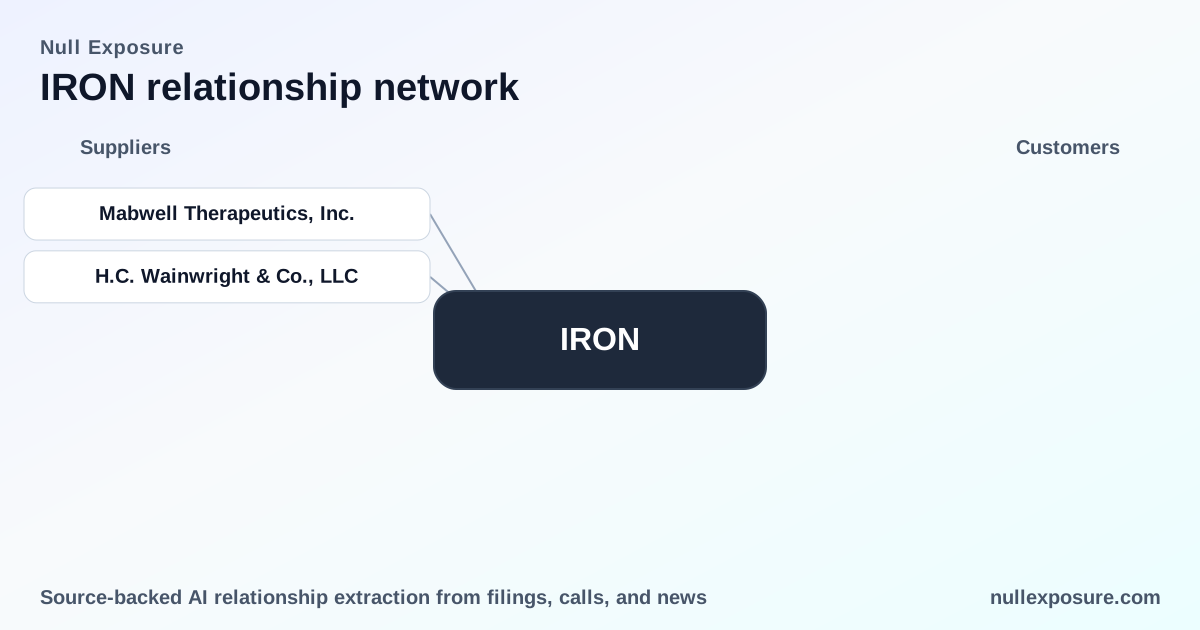
Mabwell Therapeutics, Inc. — Disc licensed DISC-3405 from Mabwell; DISC-3405 is a monoclonal antibody against TMPRSS6 that Disc is developing under that license. This linkage positions Mabwell as a licensor origin for a late-stage development asset. According to an Intellectia news report (March 10, 2026), DISC-3405 was licensed from Mabwell Therapeutics. (Intellectia, 2026)
-
H.C. Wainwright & Co., LLC — H.C. Wainwright acted as manager or co-manager on a public offering for Disc during the prior 12 months, signaling active capital markets access and underwriter support for financing needs. Streetwise Reports noted this underwriting relationship in a January 27, 2026 item discussing an FDA delay narrative. (Streetwise Reports, Jan 27, 2026)
Reading the constraints: operating model signals investors should track
Company disclosures and extracted constraints show a consistent operating profile:
-
Contracting posture: spot and short-term. Filings indicate supplies are obtained on purchase-order terms with no long-term supply contracts; contracts typically lack minimum purchase commitments and are cancelable by Disc on written notice. This gives the company tactical flexibility but increases supplier negotiation risk and exposure to market capacity constraints.
-
Manufacturing and service roles. Disc does not own manufacturing facilities and relies on CDMOs to produce clinical material for bitopertin, DISC-0974, DISC-0998, DISC-3405 and other candidates. The company also depends on CROs, clinical investigators, and contract laboratories to run trials and process samples. This outsourcing profile is consistent with a clinical-stage biotech that prioritizes R&D capital allocation over fixed assets.
-
Geographic footprint of trials. Clinical programs are active in APAC (Australia) and North America, with planned trials in Canada, Europe and the United States; this implies multi-jurisdictional regulatory logistics and the need for suppliers with international quality systems and distribution capability.
-
Relationship stage and segment. Contracts and programs are active and service-oriented, not commercial product supply, reflecting the current development stage rather than commercialization maturity.
Taken together, these constraints pinpoint where operational diligence should focus: vendor concentration metrics, inventory aging, CDMO capacity commitments, and supplier quality systems across jurisdictions.
What this means for investors and operating teams
For investors evaluating Disc Medicine from a supplier-risk perspective, and for operators negotiating or managing relationships, the following actions align with the firm’s profile:
- Perform focused diligence on primary CDMOs: confirm capacity allocations, existing slot agreements, and contingency plans for scale-up or supply chain disruption.
- Track inventory and expiration risk for clinical supplies; short-term contracts increase the chance that pre-produced material could expire or require repackaging.
- Monitor capital markets activity and underwriter relationships. The recent H.C. Wainwright underwriting demonstrates ongoing access to equity capital for program funding, which reduces immediate liquidity stress but does not eliminate mid-term funding needs. (Streetwise Reports, Jan 27, 2026)
- Validate IP rights and sublicense controls tied to the AbbVie license to understand freedom-to-operate and commercialization levers.
These are practical steps that operators can implement immediately and that investors should watch as leading indicators of operational resilience.
For consolidated tracking and supplier exposure maps tailored to biopharma firms like Disc Medicine, check out https://nullexposure.com/ for vendor-level analytics and risk scoring.
Risk checklist and portfolio implications
- High vendor concentration increases single-point-of-failure risk during critical clinical windows.
- Short-term purchasing preserves cash but raises supply certainty and scale-up cost risk at commercialization.
- Geographic trial dispersion demands CDMOs and CROs with global quality and distribution capabilities.
- Capital markets support via underwriters reduces near-term funding risk but investors should model dilution and milestone financing under multiple development outcomes.
Bottom line
Disc Medicine is a classic clinical-stage biotechnology company that monetizes through licensing, development milestones and eventual product sales, while outsourcing manufacturing and trial execution. The dominant supplier risks are vendor concentration and a short-term, spot contracting posture, offset in part by IP licensed from AbbVie and access to underwritten capital. Investors should prioritize diligence on CDMO commitments, inventory management, and clinical supply contingency planning as the company progresses its pipeline.
Learn more about supplier exposure and risk scoring at https://nullexposure.com/ — the platform offers targeted views for investors and operators assessing CDMO and CRO dependencies.