IROQ (IF Bancorp): Funding partners, contract posture, and what investors should know
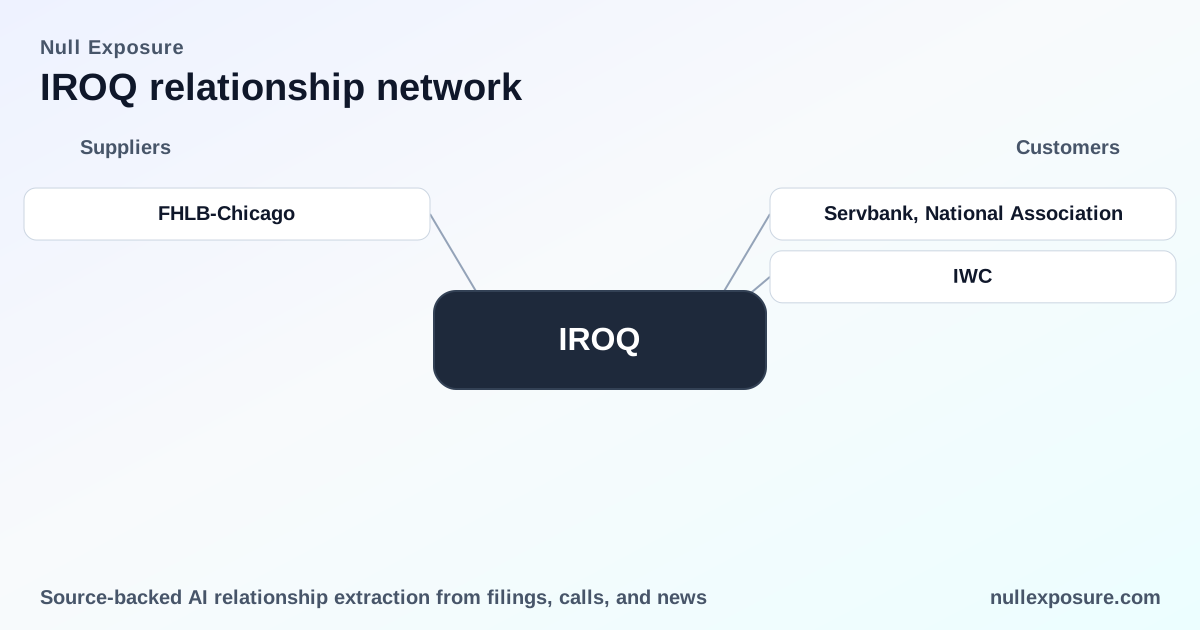
IF Bancorp, Inc. (IROQ) is a small regional savings-and-loan holding company that monetizes primarily through net interest income and fee income from retail and commercial banking; balance-sheet funding is a core operational input. The company manages liquidity with a mix of wholesale funding — notably advances from the Federal Home Loan Bank system and short-term repurchase agreements — and uses the Federal Reserve facilities opportunistically to smooth cash flow and manage interest-rate risk. For investors and counterparties, the supplier footprint is narrowly focused and funding-driven, not product-distribution driven.
Interested in tracking counterparties like IROQ in real time? Visit https://nullexposure.com/ for supplier risk monitoring and alerts.
How IROQ sources funding and why it matters for returns
IF Bancorp’s operating model is balance-sheet centric: it collects deposits and extends loans while actively managing the cost and maturity profile of liabilities. The company explicitly discloses borrowing from three wholesale channels — FHLB-Chicago, the Federal Reserve Discount Window, and the BTFP — with repurchase agreements used for very short-term liquidity. According to the company’s FY2025 10‑K filing, these channels are used “to supplement cash flow needs, to lengthen the maturities of liabilities for interest rate risk management purposes and to manage our cost of funds.” That language makes plain that supplier relationships are tactical funding partnerships, not strategic suppliers of services or technology.
This funding posture affects profitability and risk: net interest margin and interest-rate sensitivity are directly tied to the availability and pricing of these wholesale lines, and short-term repo exposure increases rollover risk if market liquidity tightens. For an investor, these are not theoretical exposures — they are operational levers that affect returns every quarter.
Relationship breakdown: FHLB‑Chicago
FHLB‑Chicago provides advances to IF Bancorp and functions as a primary wholesale lender. The company reported Federal Home Loan Bank advances of $54,124,000 as of June 30, 2025, up from $32,999,000 a year earlier, confirming a material reliance on this source for term funding. This borrowing is described in the FY2025 10‑K as part of the bank’s strategy to lengthen liability maturities and manage cost of funds (FY2025 10‑K).
Source: According to IF Bancorp’s FY2025 10‑K filing, the Federal Home Loan Bank advances totaled $54,124,000 as of June 30, 2025.
Short-term repo usage: company-level signal and contract posture
Separately from the FHLB relationship, IF Bancorp discloses concentrated use of overnight repurchase agreements for liquidity. At June 30, 2025, all $18,795,000 of the company’s repurchase agreements had an overnight maturity, which signals a deliberately short-term contractual posture for a portion of the funding book. That exact figure and maturity profile are stated in the company’s FY2025 disclosure.
Source: FY2025 filing notes all $18,795,000 of repurchase agreements were overnight as of June 30, 2025.
What these relationships and constraints say about concentration and criticality
-
Concentration: The FHLB advances are material in absolute terms relative to IF Bancorp’s balance-sheet scale; a single-system counterparty (FHLB) supplies tens of millions of dollars of liquidity. The FHLB relationship falls into the $10m–$100m spend band, confirming that advances are a meaningful single-counterparty exposure.
Source: The company’s FY2025 disclosure showing FHLB advances of $54,124,000. -
Contracting posture and maturity profile: The mix of overnight repurchase agreements and larger FHLB advances indicates a hybrid funding strategy: short-term tactical liquidity overlaid with larger, likely longer-dated advances intended to manage interest-rate risk. The filing explicitly says these instruments are used “to lengthen the maturities of liabilities,” which confirms the intention behind the supplier choices.
Source: FY2025 10‑K language on funding purposes. -
Criticality: Wholesale lenders are operationally critical for IF Bancorp; they are not peripheral vendors. Loss or restriction of these channels would materially impair liquidity management and could force higher-cost deposit gathering or asset sales.
Practical risks for investors and operators
-
Rollover and liquidity risk: The overnight repo book is exposed to daily funding markets; a sudden repricing or collateral shock could force rapid balance-sheet adjustments. The FY2025 disclosure on overnight repos quantifies that exposure.
Source: FY2025 repurchase agreement disclosure. -
Counterparty concentration risk: A meaningful share of non‑deposit funding comes from the Federal Home Loan Bank system, which concentrates counterparty risk; monitoring advance pricing and collateral requirements is essential. The FY2025 advance totals provide a baseline for that assessment.
Source: FY2025 FHLB advance totals. -
Rate-risk management dependency: Management uses borrowing to alter liability maturities; an inability to access term advances would reduce flexibility to manage net interest margin under rising-rate scenarios. The 10‑K explicitly links borrowing to interest-rate risk management.
Source: FY2025 10‑K discussion of borrowing purposes.
If you want continuous tracking of counterparties, liquidity footprints, and supplier concentration like this for IROQ and peers, see https://nullexposure.com/ — we provide monitoring designed for investors and counterparty teams.
Recommendations for investors and counterparty managers
- Monitor quarterly filings and funding disclosures for changes in FHLB advance balances and repo usage; changes in advance levels are an early indicator of balance-sheet strategy shifts.
- Request detail on advance terms and collateral packages when conducting diligence: advance pricing, covenants, and eligible collateral lists materially change counterparty economics.
- Stress-test funding under scenarios where repo access tightens or FHLB collateral requirements become more restrictive; given the overnight repo exposure, short-term shocks are the most plausible operational stress.
Quick takeaways
- FHLB‑Chicago is a material funding supplier to IF Bancorp, with advances of $54.1M as of June 30, 2025 (FY2025 10‑K).
- Repurchase agreements are short-term and concentrated — $18.8M in overnight repos as of June 30, 2025 — increasing rollover sensitivity (FY2025 disclosure).
- Supplier risk for IROQ is funding-centric and operationally critical, not a diversified vendor ecosystem; monitoring advances, repo usage, and Federal Reserve facility access is essential for counterparty risk assessment.
For an institutional view of supplier exposures and automated alerts when counterparties change funding posture, learn more at https://nullexposure.com/.
The funding profile of IF Bancorp is straightforward but consequential: wholesale funding partners determine liquidity flexibility, interest-rate risk management, and ultimately the firm’s return profile. Investors and operators who actively monitor FHLB advance levels and repo usage will have better early warning on funding stress and strategy shifts.