IRTC supplier relationships: what investors need to know
iRhythm Technologies (IRTC) sells ambulatory ECG monitoring (the Zio system) and the downstream analytics and billing services that monetize each monitored episode; revenue flows from device/patch usage plus associated clinical interpretation and claims collection. Partnerships with data providers, EHR vendors, and clinical services vendors are integral to throughput and reimbursement velocity, which directly affect revenue per study and margins. With about $747 million in trailing revenue and a market capitalization near $3.7 billion, supplier dynamics are a material driver of operational continuity and growth economics.
Explore deeper supplier relationship intelligence at https://nullexposure.com/ before you commit capital.
Partnerships that move the needle
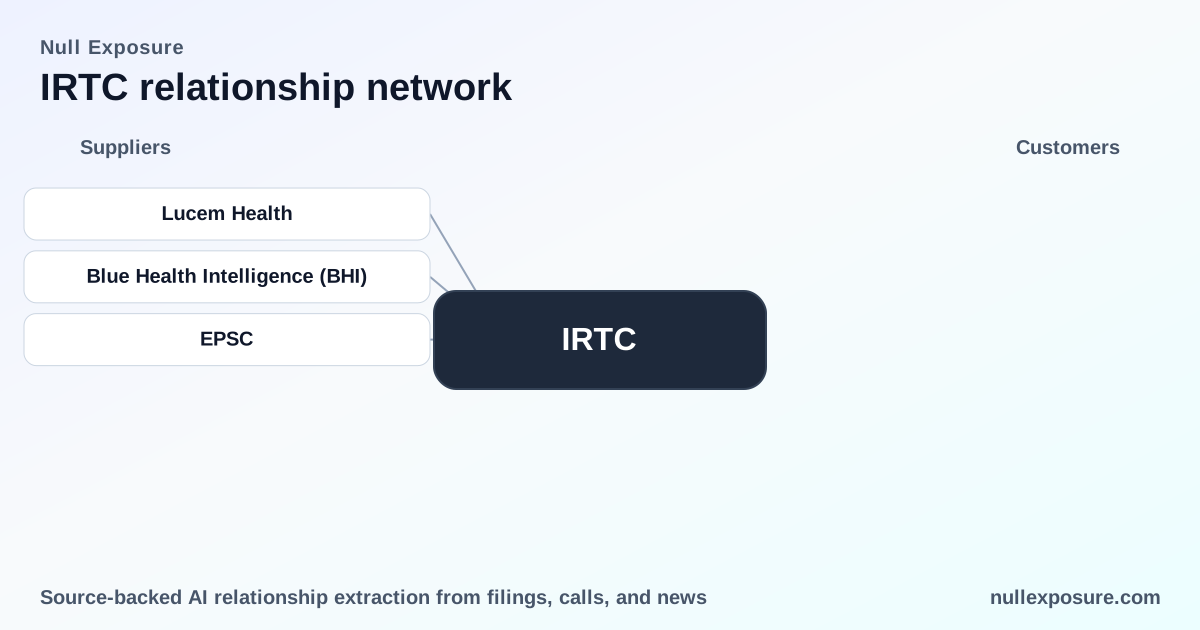
iRhythm’s commercial story is not just the patch hardware; it’s the ecosystem that converts monitored patients into reimbursed services. The three supplier relationships surfaced in recent reporting each play a distinct role: digital triage/patient identification (Lucem Health), outcomes/claims benchmarking (Blue Health Intelligence), and clinical workflow integration (Epic). Below are concise, source-linked summaries and what each connection practically delivers.
Lucem Health — early pilots for pre-identification
iRhythm reported that early pilots with Lucem Health achieved greater than 85% accuracy in pre-identifying patients with clinically relevant arrhythmias, a capability that accelerates patient selection and test yield and thus improves revenue per referral. This detail is reported in the Q4 2025 earnings call transcript published March 2026. (InsiderMonkey, Q4 2025 earnings call transcript, March 2026.)
Blue Health Intelligence (BHI) — closed claims for population analysis
iRhythm used a large national commercial closed-claims dataset maintained by Blue Health Intelligence for an analysis presented on ambulatory cardiac monitoring, providing benchmarking and utilization context that underpins reimbursement strategy and payer engagement. (DiCardiology article on iRhythm data presentations, March 2026.)
Epic — EHR integration and referral pathway
iRhythm describes Epic as a core partner, noting ongoing excitement about the relationship; Epic’s EHR footprint is an integration vector that increases clinician workflow access to Zio ordering and result delivery, improving customer adoption and operational scale. (InsiderMonkey, Q4 2025 earnings call transcript, March 2026.)
What iRhythm’s supplier constraints reveal about its operating model
iRhythm’s public disclosures and risk language surface a clustered, operationally critical supply and services posture. Treat these constraints as company-level signals about contracting posture, concentration, and maturity rather than as isolated supplier facts.
-
Geographic footprint includes APAC/Philippines resources. iRhythm disclosed that it uses third-party providers with resources outside the United States and has established company resources in the Philippines to support its independent diagnostic testing facilities (IDTFs). This signals deliberate offshore labor sourcing for operational scalability and cost control. (Company regulatory disclosures, 2025 risk language.)
-
Certain components and materials are single-sourced and critical. The company identifies single-source vendors for disposable housings, instruments and adhesive used in Zio patches, and manages circuit-board suppliers via contract electronic manufacturers—indicating high supplier concentration for physical components and a non-trivial replacement lead time. (Company filings and manufacturing risk disclosures, 2025.)
-
Service-provider reliance for billing and customer care. iRhythm relies on third-party billing partners to submit claims and collect payments, and since 2022 it has engaged named vendors (Sutherland Healthcare Solutions and Techindia Infoway) to support customer care and clinical operations, indicating outsourced repeatable processes that are core to cash collections and patient experience. (Company operational disclosures, 2022–2025.)
-
Manufacturing segment dependence on outside suppliers. External suppliers provide components and subassemblies for Zio production, reinforcing that contract manufacturing is a structural part of the supply chain. (Company risk and manufacturing commentary.)
Collectively, these signals show a contracting posture that mixes single-source critical components with outsourced service operations, a supplier concentration that creates substitution risk for hardware, and sufficient maturity in process outsourcing for revenue-cycle functions.
How these relationships and constraints affect valuation risk and upside
-
Revenue durability is tied to payer acceptance and claim throughput. The partnership with BHI for claims benchmarking supports stronger payer conversations; better outcomes and utilization benchmarks improve reimbursement levers that lift margins per study.
-
Clinical workflow integration is a distribution multiplier. Epic integration expands orderability and result visibility inside electronic health records, directly accelerating clinical adoption and volume growth. EHR partnerships are a scalable distribution channel that improves lifetime value per clinician.
-
Single-source manufacturing is the primary operational vulnerability. Inventory stress or supplier disruption for housings, adhesives or circuit boards would materially delay patch production and compress revenue. Manufacturing concentration is a non-linear risk to revenue and EBITDA realization.
-
Outsourced billing/customer care is both leverage and exposure. Outsourcing improves scale and cost control but increases operational dependence on third-party SLAs and offshore staffing. Cash collection speed and denial rates hinge on these service relationships.
Given iRhythm’s negative EPS but solid revenue base and analyst interest (majority Buy/Strong Buy consensus), investors must price in supply concentration risk against the durable advantages of strong EHR access and claims benchmarking.
Explore supplier risk scoring and decision tools at https://nullexposure.com/ to quantify these trade-offs.
Practical diligence checklist for operators and acquirers
- Validate suffix inventory and secondary sourcing plans for housings, adhesives, and circuit boards; request lead-time metrics and dual-sourcing roadmaps.
- Review outsourced billing KPIs (days sales outstanding, denial rate, recovery rate) and contract termination/transition clauses with Sutherland and Techindia-level providers.
- Confirm the depth of Epic integration (ordering, results, CDS triggers) and active clinician adoption metrics in target markets.
- Request methodologies and cohort definitions for BHI analyses to understand generalizability to payers and markets.
Bottom line: what to watch and the investor action
iRhythm’s alliances with Lucem, BHI and Epic are operational levers that improve patient identification, payer benchmarking and clinical distribution—key drivers of revenue yield and scalability. The counterweight is concentrated manufacturing inputs and reliance on outsourced billing and offshore service resources, which create real operational continuity risk that can compress realized margins.
For investors and operators focused on supplier risk-adjusted returns, prioritize diligence on secondary sourcing plans, billing partner performance, and the measurable outputs of EHR and data partnerships. For a structured supplier risk assessment tailored to healthcare suppliers, start with a tactical review at https://nullexposure.com/.
Conclude with a decision: monitor manufacturing sourcing remediation and billing KPIs as leading indicators; treat EHR reach and claims-benchmark evidence as upside catalysts. Visit https://nullexposure.com/ to access supplier intelligence that converts these qualitative signals into actionable risk-adjusted assessments.