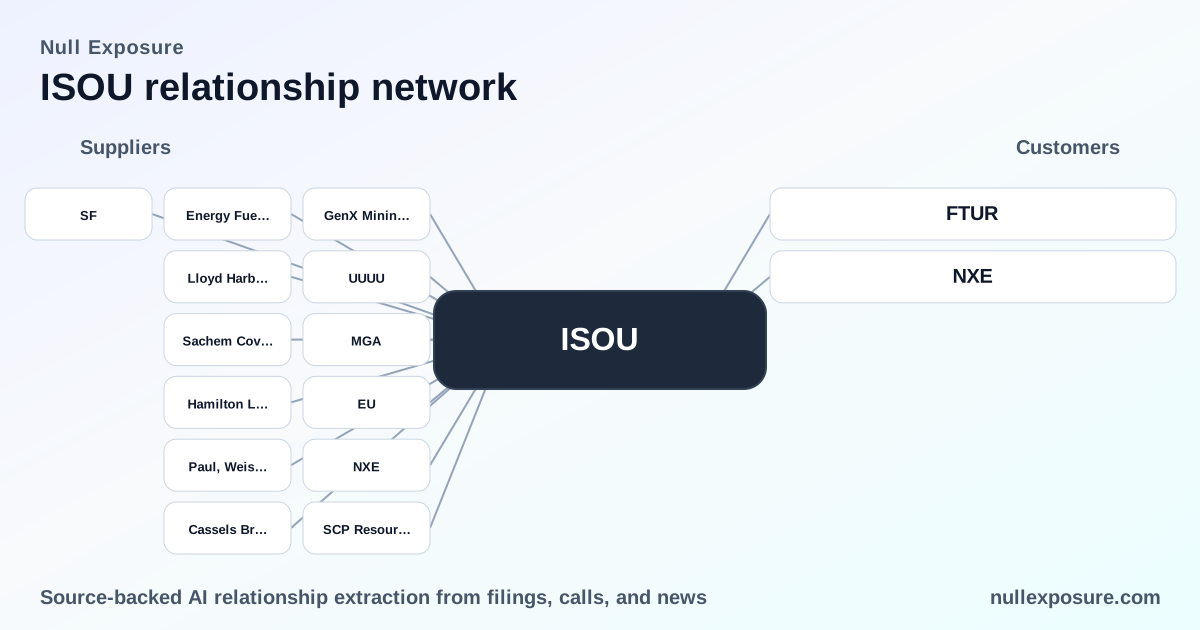
IsoEnergy (ISOU) — supplier relationships and what they tell investors
IsoEnergy operates as an acquisition-led uranium explorer/developer that monetizes through asset consolidation, toll-processing arrangements and targeted bulk-sample programs ahead of restart or disposal decisions. The company advances permitted, past-producing conventional uranium assets in Utah, develops Canadian and Australian projects, contracts out mine execution and processing, and supplements growth with strategic M&A and capital raises — a model that sells optionality on resource conversion rather than recurring operating cashflow today. For investors evaluating supplier exposure, the relevant facts are: no material operating revenue, negative EBITDA, high insider ownership, active use of contractors and toll mills, and an M&A-driven growth posture. Learn more at https://nullexposure.com/.
Why the supplier map matters for an operator with no operating revenue
IsoEnergy is effectively a project owner and transaction engine. That operating posture makes three supplier relationships structural to valuation and risk: contract miners who execute samples/restarts, toll-milling partners who convert ore into saleable product, and financial/legal advisors that enable capital and cross-border M&A. Each relationship is a lever for de-risking resources into value — and a potential concentration point if a partner is single-source or exclusive.
- Contracting posture: IsoEnergy outsources mine execution (bulk sampling) to specialist contractors rather than running heavy mobile equipment in-house.
- Processing criticality: Toll milling with a third-party processor removes near-term processing capex but creates operational dependency on mill availability and commercial terms.
- Capital and deal making: Bought-deal financings and external advisors are central to closing acquisitions and funding advancement; these parties influence timing and dilution.
If you want a supplier-risk scorecard and ongoing tracking for IsoEnergy relationships, explore more at https://nullexposure.com/.
Relationship roll call — every counterparty cited in public coverage
Below are the counterparties surfaced in IsoEnergy supplier and corporate announcements, each summarized in plain English with the original source noted.
GenX Mining Contractors, LLC
IsoEnergy contracted GenX Mining Contractors to execute a bulk-sample program at the Tony M project in Utah, extracting up to 2,000 tons over a 12–14 week program that commenced in late December 2025. Source: IsoEnergy press release via PR Newswire / Sahm Capital, January 7, 2026 (company announcement).
Energy Fuels Inc. (Energy Fuels / UUUU)
IsoEnergy uses a toll-milling arrangement with Energy Fuels’ White Mesa Mill in Utah; mineralized material from the bulk-sample program is being transported to White Mesa for processing, making Energy Fuels a critical downstream processor. Source: PR Newswire and multiple news reposts (January 2026).
Mega Uranium Ltd. (MGA)
IsoEnergy entered an agreement to acquire Consolidated Uranium Inc. from Energy Fuels and Mega Uranium as part of a CAD 240 million transaction, indicating transactional links to Mega Uranium in consolidation plays. Source: financial coverage on SimplyWallSt (reported March 2026 summarizing the transaction).
enCore Energy Corp. (EU)
IsoEnergy agreed to acquire Anfield Energy Inc. from a syndicate including enCore Energy as part of a CAD 110 million deal, reflecting share transfers and asset consolidation among mid-tier uranium companies. Source: SimplyWallSt coverage (2026).
NexGen Energy Ltd. (NXE)
NexGen is listed among vendors in the Anfield acquisition package sold to IsoEnergy, demonstrating NexGen’s role as an asset-holder in multi-party deal structures. Source: SimplyWallSt transaction summary (2026).
SCP Resource Finance LP
SCP Resource Finance LP acted as financial advisor to IsoEnergy on transactional activity reported in connection with a 2025 acquisition, serving as an external advisory provider in M&A execution. Source: Sharewise article summarizing the 2025 Toro Energy/portfolio transaction (2025–2026 reporting).
Lloyd Harbor Capital Management, LLC
IsoEnergy acquired an additional minority stake in Premier American Uranium from Lloyd Harbor Capital Management, signaling small-equity transfers and strategic stake-building that involve third‑party investment managers. Source: SimplyWallSt coverage (2026).
Sachem Cove Special Opportunities Fund, LP
IsoEnergy purchased a 3.169% minority stake in Premier American Uranium from Sachem Cove Special Opportunities Fund, demonstrating the use of targeted equity acquisitions to consolidate strategic positions. Source: SimplyWallSt (2026).
Cassels Brock Blackwell LLP
Cassels Brock Blackwell LLP served as Canadian legal advisor to IsoEnergy on multi-jurisdictional transactions, reflecting reliance on major corporate law firms for deal structuring in Canada. Source: Sharewise reporting on IsoEnergy’s cross-border acquisition activity (FY2025 reporting).
Hamilton Locke
Hamilton Locke acted as Australian legal advisor to IsoEnergy for transactions involving Australian assets, indicating the company’s use of local counsel to manage jurisdictional compliance and conveyancing in Australia. Source: Sharewise (2025 transaction reporting).
Paul, Weiss, Rifkind, Wharton & Garrison LLP
Paul Weiss acted as US legal advisor to IsoEnergy in its cross-border transactions, underscoring the need for top-tier US counsel on US assets and regulatory interfaces. Source: Sharewise article (2025).
Stifel Nicolaus Canada Inc. (SF)
Stifel Nicolaus Canada acted as sole bookrunner on a C$50 million bought‑deal equity offering for IsoEnergy, providing primary capital to fund acquisitions and project advancement. Source: Company announcement on Yahoo Finance / press coverage (2026).
What the network of suppliers reveals about IsoEnergy’s operating model
The relationship set confirms a project‑owner/operator posture that outsources execution:
- Execution is outsourced. Contract miners (GenX) deliver field work while IsoEnergy retains asset ownership and commercial control of samples and future restart decisions.
- Processing dependency is single-layered. Toll milling with Energy Fuels’ White Mesa Mill converts ore to processed product without IsoEnergy bearing mill capital costs, but that also creates operational dependence on Energy Fuels’ capacity and commercial terms.
- Growth is M&A-driven and advisor‑dependent. Repeated use of legal and financial advisors and multiple acquisitions (Consolidated Uranium, Anfield, minority stakes in Premier American Uranium) show IsoEnergy accelerates scale through deals, financed by equity offerings such as the C$50M bought deal led by Stifel.
- Maturity signals: IsoEnergy reports no revenue and negative EBITDA, positioning it squarely as a developer/exploration company where supplier performance — contractors, mill uptime, and advisor execution — directly affects value crystallization rather than recurring operational margins.
- Concentration and governance: Insider ownership ~35% and institutional ownership ~22% concentrate influence and align incentives around strategic transactions and resource conversion.
Investment implications and next steps
For investors and operators assessing supplier exposure, the practical conclusions are:
- Operational risk centers on milling and contract mining continuity. Any delay or capacity constraint at White Mesa or failure to execute the bulk-sample program to spec would push out value realization.
- Counterparty credit and commercial terms matter. Toll-milling economics and the contract structure with GenX determine net recoverable value from samples; review commercial terms where available.
- Capital trajectory is external. Expect further equity raises or asset disposals to fund activity; Stifel’s bought deal shows market appetite but also dilution dynamics.
If you want ongoing monitoring of IsoEnergy’s supplier relationships, contractual exposures, and event-driven supplier risk, visit https://nullexposure.com/ for detailed dashboards and alerting.
IsoEnergy’s thesis is straightforward: convert permitted, past-producing uranium assets into saleable product or higher‑value holdings using third‑party execution and processing while funding growth with capital markets and M&A. For investors focused on supplier concentration and execution risk, the relationships outlined above are the critical checklist — and the next material data points will be mill throughput results, bulk-sample recoveries, and the cadence of financing or asset deals. Check https://nullexposure.com/ to track these developments in real time.