Investar Holding Corp (ISTR) — supplier landscape and operational constraints investors should price in
Investar Holding Corporation is the banking holding company for Investar Bank, a regional commercial bank focused on individuals and small- and medium-sized businesses in southern Louisiana. The franchise monetizes through traditional banking channels: net interest margin on loan portfolios, fee income from deposit and payment services, and incremental noninterest revenue tied to transaction volumes and digital engagement. For investors evaluating supplier relationships, the key questions are how third-party payments and back-office outsourcing change deposit stickiness, fee capture, and operational risk exposure.
For a concise, analyst-grade supplier map and risk checklist, visit the Null Exposure homepage: https://nullexposure.com/
What the Zelle relationship means in plain English
Investar markets Zelle to both retail and business clients to enable real-time bank-to-bank payments and enhance digital channel engagement. According to a TradersUnion news item on March 10, 2026, Investar “offers 24/7 access, mobile banking, and Zelle® for consumers and businesses alike,” positioning the bank to capture transactional fee opportunities and reduce friction for depositors (TradersUnion, March 2026 — https://tradersunion.com/news/companies/show/1396191-investar-digital-banking/).
How supplier choices shape Investar’s operating model
Investar’s operating posture is shaped by two company-level signals that matter for investors evaluating supplier risk and strategic upside:
-
Long-term capital structure commitment. Company disclosures highlight a long-dated liability: “The 2032 Notes have a stated maturity date of April 15, 2032 and bear interest at a fixed rate of 5.125% per year…” This indicates a deliberate match of long-term funding to the balance sheet and reduces near-term refinancing risk, but it locks the bank into a fixed coupon that affects interest expense sensitivity and capital allocation decisions (company filing excerpt).
-
Outsourced core processing. Investar states: “We outsource many of our major systems, such as data processing and deposit processing.” This is an explicit company-level signal that the bank relies on third-party service providers for mission-critical operations, which lowers in-house fixed cost and accelerates digital feature rollout, while concentrating operational and vendor-risk exposure around a small number of suppliers (company disclosure excerpt).
These two signals combine into a clear operating profile: a capital-conservative regional bank using outsourced technology to scale digital services while carrying predictable long-term debt. Investors must weigh the efficiency and go-to-market speed of outsourcing against the single-point-of-failure risk that concentrated suppliers create.
Why outsourcing matters more than a feature list
Outsourcing deposit and data processing reduces software development cycle time and keeps IT headcount low, which helps margins in a rising-cost environment. However, outsourcing also elevates vendor concentration and operational criticality, meaning any supplier disruption—whether a core processor or payment network—can directly dent transaction volumes, deposit flows, and regulatory scrutiny. For regional banks, the combination of outsourced processing and a need to compete with national digital players increases the value of stable, well-governed supplier contracts.
Every supplier relationship in the record
Below is a complete list of supplier relationships found in the supplied results, with concise, investor-oriented summaries and source references.
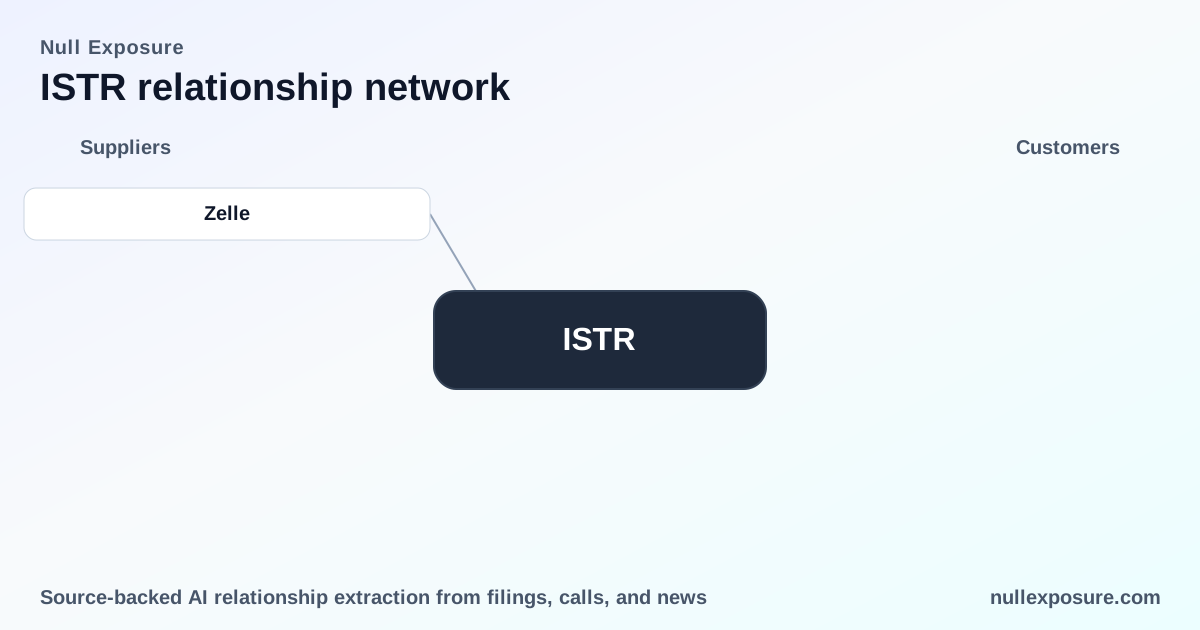
- Zelle — Investar offers Zelle® to consumers and businesses to enable immediate bank-to-bank payments and strengthen mobile-channel engagement; this is presented as part of the bank’s digital-banking proposition (TradersUnion news, March 10, 2026 — https://tradersunion.com/news/companies/show/1396191-investar-digital-banking/).
(There are no other supplier relationships in the current record.)
For a full supplier map and benchmarking against regional peers, see https://nullexposure.com/
Commercial and risk implications for investors
-
Revenue upside: Zelle integration supports higher transactional throughput and deposit engagement, which increases the addressable fee pool and improves cross-sell economics for lending and treasury products. Digital adoption reduces branch-related cost per transaction and helps stabilize deposit funding in younger demographics.
-
Operational risk: The company-level disclosure that key systems are outsourced transforms vendor contracts into critical operational assets. Vendor concentration is a material control risk—contract terms, service-level agreements, exit options, and data portability clauses should be reviewed during diligence.
-
Funding and capital considerations: The 2032 Notes (5.125% fixed) signal a conservative approach to liability management and an appetite to lock in long-term funding. This improves near-term funding certainty but constrains flexibility if market rates fall materially or capital is needed for acquisitions or technology investments.
-
Valuation context: Investar’s current metrics (market cap roughly $369M, P/TBV ~1.36, trailing P/E ~12.6) reflect a regional bank with stable profitability and modest growth. Supplier strategy—especially in payments and core processing—will be an earnings lever that justifies premium or discount to peers depending on execution and vendor risk management.
Due diligence checklist for operators and investors
- Confirm contract tenure and termination rights with core processors and payment partners; quantify migration costs and data transfer guarantees.
- Review service-level metrics for Zelle throughput and error rates; correlate with deposit inflows and active-user growth.
- Stress-test interest expense under alternate rate scenarios given the 5.125% 2032 Notes; assess the bank’s capacity to absorb incremental funding costs.
- Audit third-party risk governance: vendor audits, SOC/ISAE reports, and pandemic/incident response playbooks.
If you want an actionable vendor-risk scorecard and peer comparisons for Investar, start here: https://nullexposure.com/
Bottom line and recommended next steps
Investar leverages third-party payments and outsourced processing to accelerate digital capabilities while carrying disciplined long-term funding. That combination supports margin durability and product rollout speed, but introduces vendor concentration and operational criticality that investors must underwrite. For buy/hold decisions, prioritize contract terms, vendor redundancy, and how Zelle-driven transaction growth translates into fee income and deposit stickiness.
To see a full supplier risk profile and recommended remediation steps tailored to Investar, visit Null Exposure: https://nullexposure.com/