ITHAX Acquisition Corp III — supplier relationship briefing for investors and operators
ITHAX Acquisition Corp III is a special purpose acquisition company (SPAC) focused on technology, media, and telecommunications targets that monetizes by completing a business combination and unlocking public-market value for the target’s equity. As a listed vehicle, the company’s core economic model is transactional: it generates value for shareholders through deal sourcing, structuring, and the post-combination equity re-rating of the merged business, while maintaining a minimal operating cost base prior to a merger. Key operational levers for investors are liquidity and market infrastructure — the transfer agent and exchange relationships that enable unit separation, trading, and secondary market access.
For a concise portal to supplier relationship research and alerts, visit https://nullexposure.com/.
Why these two counterparties matter more than their size suggests
SPACs operate with a compressed set of service providers whose functions are operationally critical. For ITHAX, the transfer agent and the listing venue are not optional back-office vendors — they are the plumbing that converts sponsor and investor intent into tradable securities and measurable market liquidity. Operational failure or friction at either node translates directly into impaired investor exits, disrupted liquidity, and reputational damage for the sponsor.
- Contracting posture: SPACs typically use straightforward, short-term commercial arrangements for corporate services, focused on execution efficiency rather than long-term outsourcing. That makes supplier performance and SLA adherence highly visible.
- Concentration: a small number of counterparties support all shareholder actions (unit separations, share/warrant issuance and transfers, proxy mechanics). A single transfer agent or exchange issue creates systemic friction for the SPAC.
- Criticality: both the transfer agent and exchange are mission-critical — they enable trading, settlement, and the mechanics of redemptions and unit separation.
- Maturity: as a Class A listed SPAC, ITHAX’s supplier relationships are early-life, transactional, and will evolve rapidly through the deal process and post-merger integration. This is a company-level signal about supplier churn and the need for contingency plans.
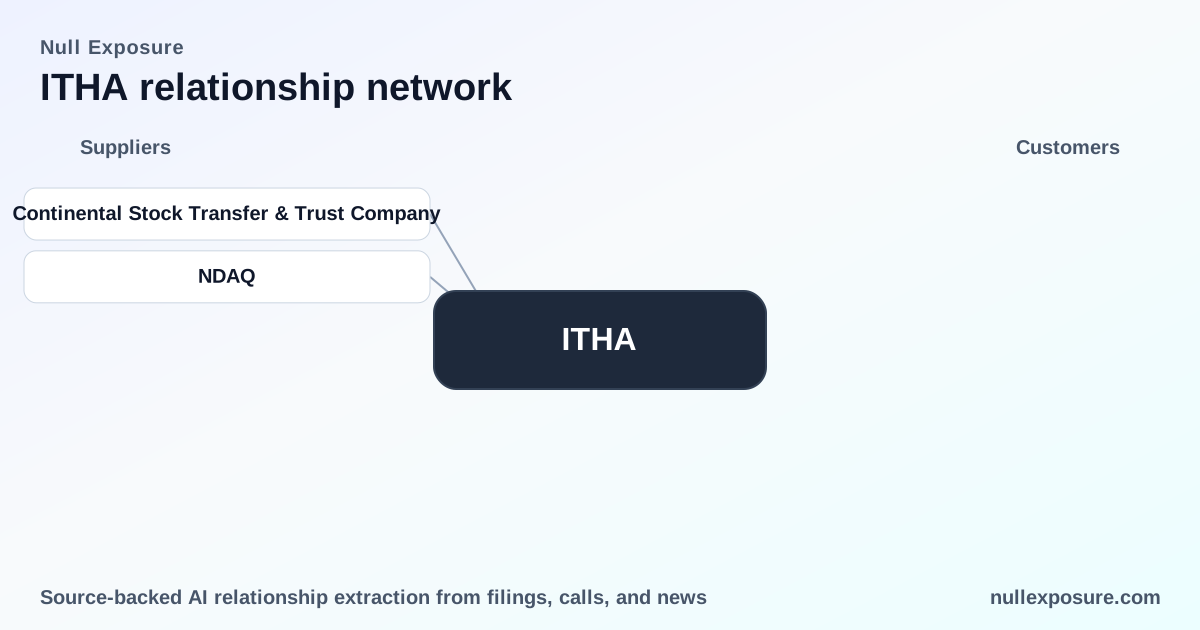
Supplier roster: the counterparties shown in filings and press
Below are the relationships identified in public disclosures and what each means in plain language.
- Continental Stock Transfer & Trust Company — ITHAX uses Continental as its transfer agent to administer shareholder records and execute the separation of units into Class A ordinary shares and warrants; holders must have their brokers contact Continental to process separations. This is the operative vendor for shareholder servicing and unit mechanics. According to the company’s GlobeNewswire press release dated January 16, 2026, holders must coordinate with Continental to separate units into shares and warrants (FY2026 press release).
- Nasdaq Global Market (Nasdaq) — ITHAX’s Class A ordinary shares and warrants trade on the Nasdaq Global Market under the symbols “ITHA” and “ITHAW,” respectively, which places the company on a regulated, visible trading venue with Nasdaq listing rules and market surveillance. The same January 16, 2026 GlobeNewswire release confirms the listing and ticker assignments (FY2026 press release).
These two entries are the complete set of supplier relationships surfaced in the public results for the supplier scope.
What the relationships imply for risk and execution
Operational and market risks condense around these named counterparties:
- Liquidity hinge: the Nasdaq listing channel provides primary liquidity; any interruption to trading eligibility or ticker status constrains exit options for investors.
- Process hinge: Continental is the single vendor through which unit separations and share/warrant servicing run; operational delay at the transfer agent delays trading readiness and investor exercises.
- Low diversification of suppliers is typical and acceptable in SPAC structures, but it places higher governance demands on the sponsor and board to monitor provider performance and to maintain backup procedures for critical processes (e.g., alternative transfer agent agreements, escrow handling).
Practical implications for investor diligence and operator contracts
Operators and counterparty managers should treat these supplier links as control points in liquidity engineering rather than passive back-office relationships.
- Verify the operational playbook: confirm cut-off dates, broker instructions, and expected timelines for unit separations and warrant issuance with Continental well ahead of any investor action.
- Monitor listing compliance: Nasdaq listing standards and ticker status are public signals of market access; maintain active communications with exchange contacts to anticipate notices or actions that affect trading.
- Include contingency objectives in vendor oversight: contract terms should include SLA metrics for processing separations, clear escalation paths, and service credits where feasible.
For a focused supplier risk monitor and real-time alerts on counterparties, see https://nullexposure.com/.
How to act on this intelligence
For investors evaluating ITHA exposure, the questions are operational as much as they are financial: how reliable is shareholder servicing, how robust is market access, and do operational timelines match your liquidity requirements? For counterparties and operators, prioritize integration testing with Continental and Nasdaq communications to ensure seamless unit separation and trading commencement.
If you want ongoing tracking of supplier announcements, regulatory notices, and counterparty risk signals for SPACs and other thin-operating public entities, explore further at https://nullexposure.com/.
Final takeaways
- Two suppliers — transfer agent and exchange — carry outsized operational significance for ITHAX. Their roles directly affect trading, liquidity and the practical mechanics investors use to realize value.
- Operational readiness and vendor SLAs are as material as sponsor strategy for SPACs in this stage of their life cycle.
- Investors and operator teams should treat these relationships as core controls: confirm processes, document contingency plans, and monitor public disclosures for timing and compliance signals (the January 16, 2026 press release is the operative disclosure for the relationships noted).
Sources: According to the company’s GlobeNewswire press release on January 16, 2026, ITHAX announced separate trading of Class A ordinary shares and warrants and described the transfer agent process for unit separation.