ITP (IT Tech Packaging): supply concentration, domestic feedstock, and a capital-markets touchpoint
IT Tech Packaging (ITP) manufactures and distributes paper products in China, monetizing through sales of recycled-paper packaging primarily supplied from domestic recycling stations. The company’s economics depend on highly concentrated raw-material relationships, short-term procurement contracts, and significant domestic sourcing, while occasional capital market activity (placement agents) shapes financing flexibility. For investors and procurement operators, the key questions are supply concentration risk, counterparty credit exposure, and how short contracting tenors translate into operational agility or volatility. Learn more at https://nullexposure.com/.
How ITP makes money and why suppliers matter
ITP’s revenue comes from manufacturing paper products using recycled paper sourced exclusively from within China — principally the Beijing–Tianjin metropolitan area. The company sells finished goods to industrial and commercial customers, capturing margins that are currently compressed: reported operating and net margins are negative, with a trailing gross profit of about $4.4 million on roughly $78.4 million revenue (TTM). These economics make input cost and availability the primary driver of operating performance: small shifts in recycled paper prices or disruptions with dominant suppliers will disproportionately affect profitability.
Short-term supplier contracting and what it implies
ITP operates with annual raw-material supplier contracts, which establishes a transactional, short-term contracting posture rather than long-term fixed supply agreements. Short tenors support flexibility to react to local price moves but also increase exposure to price volatility and supplier bargaining power when a small number of counterparties supply most inputs. According to the company’s disclosures, they “sign annual raw materials supplier contracts with our suppliers,” which is a direct indicator of this operating model.
A narrow and domestic sourcing footprint
The company uses domestic recycled paper exclusively and purchases “from some domestic recycling stations,” concentrating procurement within APAC and specifically the Beijing–Tianjin area. This concentration reduces FX and import logistics risk but creates geographic concentration risk: any regional policy change, local supply shock, or collection disruption in that metropolitan area would directly impair feedstock availability. The company’s public filings covering 2023–2024 make this sourcing geography explicit.
Supplier concentration is material and operationally critical
ITP discloses that two suppliers accounted for approximately 73% and 17% of purchases in a recent period, and that three major suppliers represented 73%, 17%, and 7% for the year ended December 31, 2024. Those percentages establish high counterparty concentration and elevate single-supplier risk: loss, insolvency, or contract termination by the largest counterparties would immediately stress operations. The disclosure also labels major suppliers as critical to procurement continuity.
Government counterparty exposure: land lease maturity profile
ITP leases nearly 33 acres from a local government under a lease that runs through December 31, 2031. This creates a direct government counterparty relationship for an essential asset (land/factory footprint). The lease’s remaining term and any local land-use policy shifts are a non-financial risk vector for operations and capacity planning, according to the company’s filings.
Supplier credit exposure: guarantee to Baoding Huanrun Trading Co.
The company has provided credit support for a major supplier: ITP guaranteed certain obligations of Baoding Huanrun Trading Co., including a long-term loan from financial institutions of RMB31,000,000 (about $4.3 million) that matures in 2028. This guarantee creates direct credit exposure to a supplier’s solvency and is a clear example of supplier relationships that go beyond simple buyer–seller transactions in practice, per company statements in its 2024 reporting.
Capital markets relationship you should note
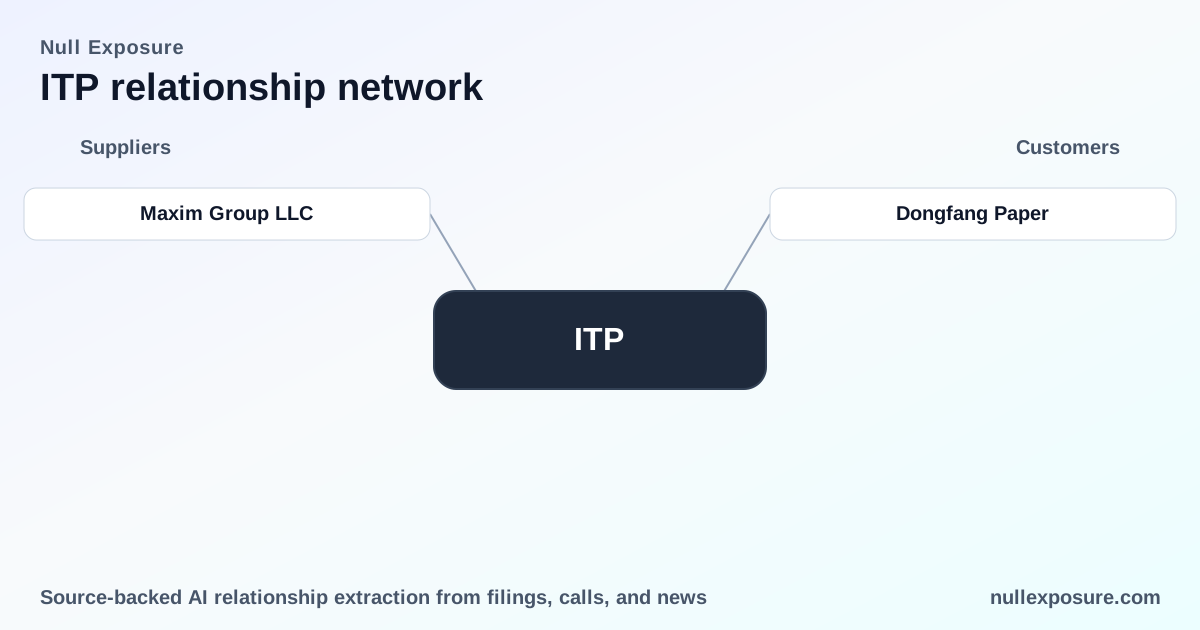
ITP engaged Maxim Group LLC as the sole placement agent for an offering, which is relevant for financing and liquidity dynamics. According to a Yahoo Finance press release dated March 10, 2026, Maxim Group LLC acted as the sole placement agent for the offering, indicating the company’s choice of intermediary for capital raises and potential future access to U.S. capital markets (https://finance.yahoo.com/news/tech-packaging-announces-pricing-1-121500197.html).
Full list of disclosed relationships (no omissions)
- Maxim Group LLC — Maxim acted as the sole placement agent for a recent offering; this is the company’s current disclosed capital markets intermediary (Yahoo Finance press release, March 10, 2026; https://finance.yahoo.com/news/tech-packaging-announces-pricing-1-121500197.html).
Company-level constraints and what they tell investors
Several constraints drawn from ITP’s disclosures are material to supplier risk analysis:
- Short-term contract posture: annual supplier contracts increase tactical procurement flexibility but heighten price and availability volatility as a structural company characteristic.
- APAC / domestic sourcing concentration: reliance on recycled paper sourced locally minimizes import risk but concentrates supply and regulatory exposure regionally.
- High supplier concentration and criticality: two or three suppliers account for the bulk of purchases, which is a central operational vulnerability.
- Government counterparty for land: the company’s leased land from a local government ties operational continuity to a public-sector relationship with a lease expiring in 2031.
- Supplier credit linkage: the guarantee for Baoding Huanrun Trading Co.’s loan creates contingent liabilities and aligns the company’s balance-sheet risk with a supplier’s credit profile.
When a constraint excerpt explicitly names an entity (for example, Baoding Huanrun Trading Co.), that is presented as a specific supplier relationship; all other constraints are summarized as company-level signals.
Learn how Null Exposure maps supplier concentration and counterparty risk at scale: https://nullexposure.com/.
What operators and investors should do now
- Procurement teams should prioritize contingency sourcing within the Beijing–Tianjin area and evaluate multi-supplier contracts or longer tenors for the largest feedstock lines to reduce single-supplier dependency.
- Treasury should quantify contingent exposure from the Baoding Huanrun guarantee and model covenant or refinancing risk to 2028.
- Investors should treat ITP as a small-cap, low-liquidity manufacturing play with material operational leverage to input availability and supplier credit; financing events handled via placement agents like Maxim will periodically alter capital structure and liquidity.
For a deeper supplier-risk profile and peer comparisons, visit https://nullexposure.com/ — our coverage is tailored for investment and procurement decision-making.
Bottom line
ITP operates with a concentrated, domestic recycled-paper supply base and short-term purchasing contracts that give the company flexibility but create acute counterparty and regional concentration risk. The company’s guarantee of a major supplier’s loan adds a non-trivial balance-sheet linkage to supplier health, while engagement of placement agents like Maxim reveals an active capital-markets posture. Investors and operators should adjust valuation and contingency planning to reflect these supplier-centric constraints rather than treating procurement as a run-of-the-mill cost line.