Integra Resources (ITRG): underwriting partners and what their presence means for investors
Integra Resources operates and monetizes as a public precious‑metals company: it develops and sells gold and associated metals from its projects while funding growth through capital‑markets transactions and disciplined project finance. The company produces revenue (Revenue TTM $219.1m) and positive EBITDA ($63.3m), and it supplements operating cash flows with underwritten equity offerings when advancing development milestones. Capital markets relationships therefore function as a core operational lever — not an incidental vendor.
Explore provider and counterparty exposures on the NullExposure homepage: https://nullexposure.com/
Quick financial snapshot that frames supplier risk
- Market capitalization: $656.9m
- Revenue (TTM): $219.1m; EBITDA: $63.3m — the company is generating operating cash flow.
- Trailing P/E: 21.7; Forward P/E: 5.6 — the market is pricing material near‑term earnings improvement.
- Institutional ownership: 33.2%; Insiders: 7.3% — healthy institutional participation, but not hyper‑concentrated.
These numbers explain why banks and broker‑dealers engage with Integra: the company is large enough to support syndicate underwriting and still requires periodic capital market access to accelerate development.
How Integra funds growth and why underwriters matter
Integra’s relationship with investment banks is not peripheral: underwritten offerings are an operational mechanism to translate project milestones into capital. That contracting posture means the quality and stability of underwriting partners directly influence deal pricing, execution speed, and dilution risk. Given Integra’s positive margins and forward earnings multiple, the firm alternates between using operating cash flow and syndicate financings to fund expansion — a pattern investors should monitor.
For an updated look at counterparty relationships, check NullExposure: https://nullexposure.com/
Who shows up in Integra’s syndicate (and what they do)
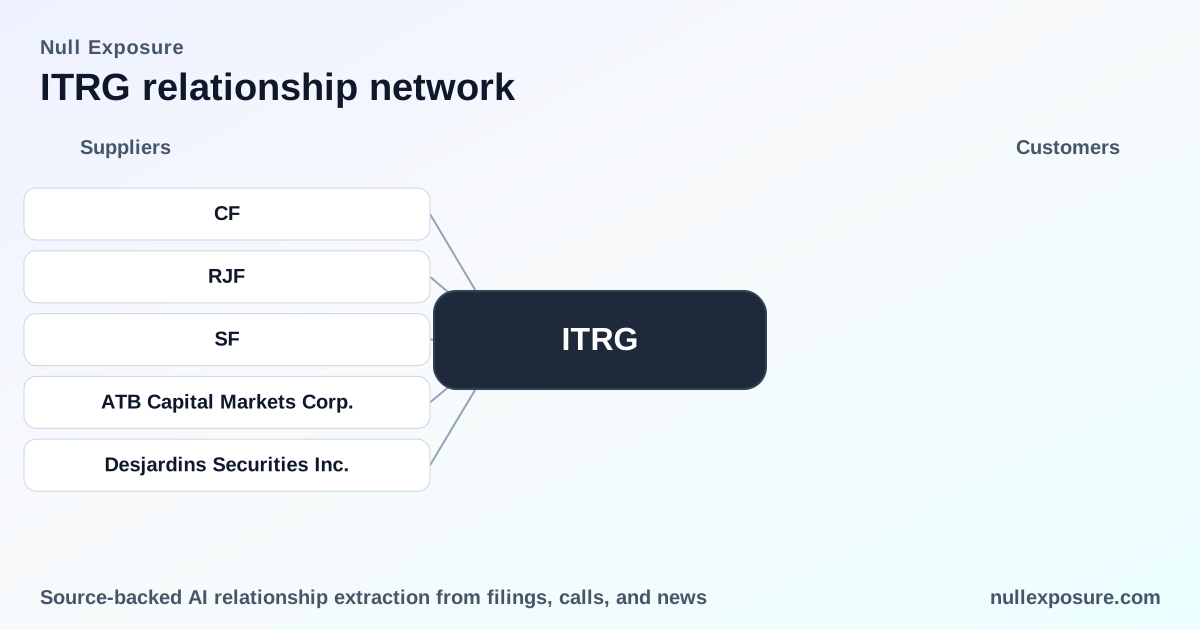
Management disclosed an offering in FY2026 that was led by two co‑leads and supported by a syndicate of dealers. The following captures every named participant reported in the public summary.
-
Canaccord Genuity Corp. — Served as a co‑lead underwriter and joint bookrunner on Integra’s FY2026 offering, signifying primary execution responsibility and pricing influence. This role puts Canaccord at the center of the transaction mechanics. (Finviz news summary, March 10, 2026.)
-
Stifel Nicolaus Canada Inc. — Co‑lead underwriter and joint bookrunner alongside Canaccord, sharing lead responsibilities and distribution oversight for the syndicate. Stifel’s co‑lead role positions it as a key execution partner for Integra’s capital raises. (Finviz news summary, March 10, 2026.)
-
Raymond James Ltd. — Named as a syndicate underwriter supporting the offering, providing distribution reach and secondary market liquidity for the placement. Raymond James participated as a syndicate member rather than a co‑lead. (Finviz news summary, March 10, 2026.)
-
ATB Capital Markets Corp. — Identified as a participating underwriter in the syndicate, contributing regional distribution and client access for the transaction. ATB’s inclusion broadens the dealer footprint for the placement. (Finviz news summary, March 10, 2026.)
-
Desjardins Securities Inc. — Listed among syndicate underwriters, offering additional distribution capacity and institutional placement channels for the offering. Desjardins expands the syndicate’s Canadian market reach. (Finviz news summary, March 10, 2026.)
Each of these relationships was publicly reported in a market note summarizing management commentary on the FY2026 offering; the disclosure frames these firms as counterparties for that specific capital‑markets event (Finviz, March 10, 2026).
Constraints and company‑level operational signals
There are no explicit third‑party contractual constraints in the collected results. That absence is itself a signal: there are no recorded supply‑contract exclusivities or named service constraints in the source set. From a business model perspective, the following operational characteristics are material:
- Contracting posture: capital‑markets driven and episodic — Integra uses underwritten offerings when advancing key development milestones rather than relying on continuous loan facilities disclosed in this set.
- Concentration: moderate counterparty dispersion — the use of two co‑leads plus several syndicate members reduces single‑counterparty concentration risk for financings, although co‑lead dependency creates focal points for execution risk.
- Criticality: high — these underwriting relationships are critical for timely capital access and therefore for project schedules and dilution outcomes.
- Maturity: transitioning producer/developer — positive Revenue TTM and EBITDA indicate operations beyond pure exploration, which changes counterparties’ commercial expectations around deal structure and covenanting.
What this means for counterparties and investors
- For banks and brokers: co‑lead status confers execution leverage but also places reputational risk on the underwriter if a placement is poorly received; syndicate members get distribution benefits but limited pricing control.
- For institutional investors: monitor future offerings because syndicated deals will influence share supply and short‑term pricing; Integra’s forward P/E suggests earnings expectations that could compress if financing costs rise.
- For operators and procurement teams: capital partners are a form of supplier — their terms (fees, lock‑ups, stabilization) materially affect net proceeds and project economics.
Key risk indicators to watch: volatility (beta 1.48) and forward capital raises that would dilute existing shareholders. The presence of multiple reputable underwriters is positive for execution but not a substitute for tight cost control and disciplined allocation of proceeds.
Actionable next steps for investors and operators
- Review recent and prospective underwriting agreements and lock‑up terms before committing new capital; underwriter selection matters for both cost and timing.
- Monitor Integra’s operating cash flow trajectory against the company’s use of proceeds disclosed in financing announcements — that will determine whether future reliance on syndicates increases.
- For a consolidated view of supplier and counterparty exposure across public filings and news, consult the NullExposure platform: https://nullexposure.com/
Bottom line: Integra’s banking relationships are functional pillars of its capital strategy — co‑lead underwriters and a multi‑dealer syndicate improve execution but create concentrated operational touchpoints that investors must track alongside the company’s improving operating metrics.