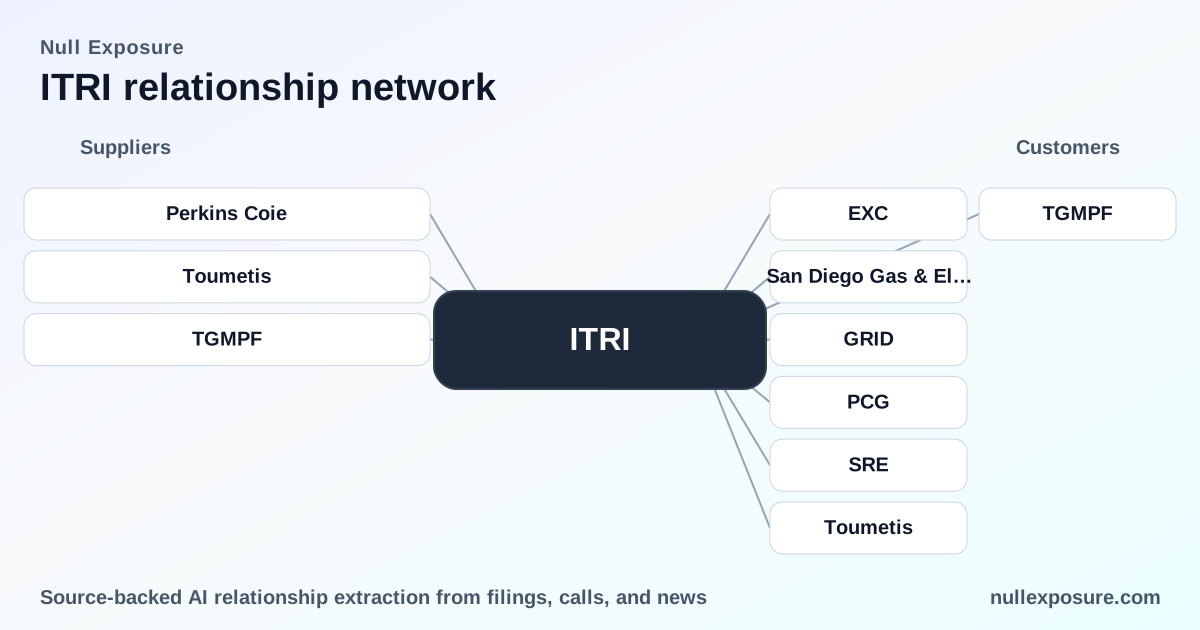
Itron Inc (ITRI): supplier relationships that shape product delivery and capital allocation
Itron is a hardware-and-software integrator that monetizes by selling metering hardware, recurring software and services, and outcome-based utility solutions to energy, water and smart-city customers worldwide. The company’s economics combine device revenue (Gen5 Riva meters), software/licensing revenue, and professional/operational services, while balance-sheet actions — including an $805 million convertible note placement in FY2026 — shape capital structure and investor returns. For investors and operators, supplier relationships around manufacturing, analytics partnerships, IP licensing and legal/financing counsel directly affect delivery risk, margin stability and go-to-market velocity.
For a concise view of supplier and partner risk across utilities and smart-infrastructure, visit Null Exposure.
Why supplier relationships matter for Itron’s earnings quality and execution
Itron’s business model depends on synchronized hardware supply chains, licensed software integrations, and third-party analytics that enhance meter value at the grid edge. Supplier and partner arrangements therefore influence product availability, upgrade cadence for Gen5 meters, and the effectiveness of outcomes sold to utilities. Recent public disclosures and media coverage in FY2026 highlight three categories of relationships that move the needle:
- Legal and financing advisors who enable capital transactions that affect leverage and optionality.
- Technology partners that embed analytics or waveform classification into meters to create differentiated offerings for wildfire risk and outage reduction.
- Licensing partners that extend sensor/RTU and data-collection capabilities into utility networks.
Below I summarize each reported relationship in the public record and explain the investor-relevant implication.
Company-level operating signals that investors should note
The following constraints are company-level signals drawn from Itron’s public commentary and filings; they do not assign these characteristics to any single supplier unless the evidence names that supplier.
- Contracting posture: short-term dominant. Itron’s disclosures state that purchase orders and obligations are treated as short-term given termination provisions, indicating flexibility but also potential exposure to order volatility.
- Geography: global manufacturing footprint. The company operates manufacturing facilities worldwide to manage costs and inventory and to adjust to shifting customer demand, which supports geographic diversification of supply risk.
- Role profile: partial in-house manufacturing with outsourced partners. Itron manufactures and assembles a portion of its products while relying on external manufacturing partners for others, reflecting a hybrid supply model that balances control and cost.
- Spend concentration: material procurement scale. Purchase orders and other obligations were $641.4 million as of December 31, 2024, signaling >$100 million annual procurement scale and the importance of supplier continuity for operations.
These signals imply moderate supplier concentration risk but operational flexibility: the short-term posture reduces long-term lock-in yet increases execution reliance on timely supplier performance.
Supplier and partner roll-up (each reported item)
Perkins Coie — legal counsel on convertible notes (FY2026)
Perkins Coie represented Itron in its private placement of $805 million of convertible senior notes, including the full exercise of an initial purchaser option, a transaction that directly impacts Itron’s capital structure and liquidity profile. According to a Perkins Coie press release in FY2026, the firm advised on the Rule 144A private placement that funded strategic and balance-sheet initiatives.
Source: Perkins Coie press release on Itron’s $805 million convertible offering (FY2026).
Toumetis — grid-edge analytics integration with Gen5 Riva meters (GlobeNewswire, FY2026)
Itron formed a strategic relationship with Toumetis to integrate Cascadence analytics with Itron’s waveform detection and classification agents on Gen5 Riva meters, enabling utilities to detect precursor conditions, prioritize risk and shorten restoration time. A GlobeNewswire release in FY2026 described the partnership as focused on wildfire risk reduction and reliability improvements.
Source: GlobeNewswire announcement describing the Itron–Toumetis strategic relationship (FY2026).
Toumetis — executive commentary confirming strategic tie (InsiderMonkey, FY2026)
Itron’s Senior VP of Outcomes, Don Reeves, publicly confirmed the Toumetis integration on Gen5 meters, reinforcing that the partnership is positioned as an operational capability embedded at the grid edge to accelerate detection and response. InsiderMonkey picked up executive remarks reiterating the strategic nature of the relationship in FY2026.
Source: InsiderMonkey report quoting Itron executive comments on Toumetis integration (FY2026).
Tantalus — extension of ERT license agreement (Finviz, FY2026)
Tantalus extended an ERT license agreement with Itron, indicating ongoing commercial interoperability and a licensing relationship that supports data collection and communications layers for utilities. A Finviz news notice in FY2026 referenced the license-extension event.
Source: Finviz coverage noting the extension of the ERT license agreement between Tantalus and Itron (FY2026).
Tantalus — additional reporting of the ERT license extension (Finviz, FY2026)
A second Finviz item reiterated that Tantalus extended its ERT license agreement with Itron, underscoring recurrent licensing activity rather than a one-off transaction, which supports recurring revenue and product integration for certain utility customers.
Source: Finviz follow-up coverage on the Tantalus–Itron licensing arrangement (FY2026).
What these relationships signal for investors and operators
- Capital strategy and optionality are active. The engagement of Perkins Coie on an $805 million convertible suggests management is using hybrid securities to fund growth and operations while preserving flexibility. That transaction directly affects leverage metrics and equity dilution scenarios.
- Embedded analytics are a growth vector. The Toumetis partnership demonstrates that Itron is packaging analytics at the device level to sell higher-value outcomes (wildfire risk reduction, faster restoration). This supports higher software/service attach rates and improves customer stickiness.
- Licensing deals sustain recurring streams. Repeated license activity with Tantalus signals sustained interoperability and potential for non-hardware recurring revenue, which improves margin stability as hardware cycles vary.
Key risk points: hardware supply timing, manufacturing partner performance, and the execution risk of scaling analytics across legacy networks. Investors should monitor order backlog, gross margin trends, and any supplier-specific disruptions tied to the global manufacturing footprint.
For an operational risk deep-dive and supplier concentration scoring, see Null Exposure.
Tactical takeaways for due diligence
- Validate the timing and terms of the convertible notes to understand near-term cash interest and dilution impact.
- Request evidence of deployment pilots and utility acceptance for Toumetis-integrated meters to confirm commercial traction beyond proof-of-concept.
- Review the scope and duration of license agreements like the Tantalus ERT arrangement for renewal cadence and revenue recognition patterns.
For portfolio teams seeking supplier-level insights and contractual red flags, visit Null Exposure to align diligence with operational priorities.
Conclusion — invest with supplier visibility
Itron’s supplier and partner footprint reveals a company balancing capital market actions with product-level integrations that extend meter value. Legal and financing counsel, analytics partners, and licensing counterparts collectively shape Itron’s ability to monetize hardware through recurring software and services. Track these relationships as direct inputs to margin sustainability and growth conversion of Gen5 deployments.