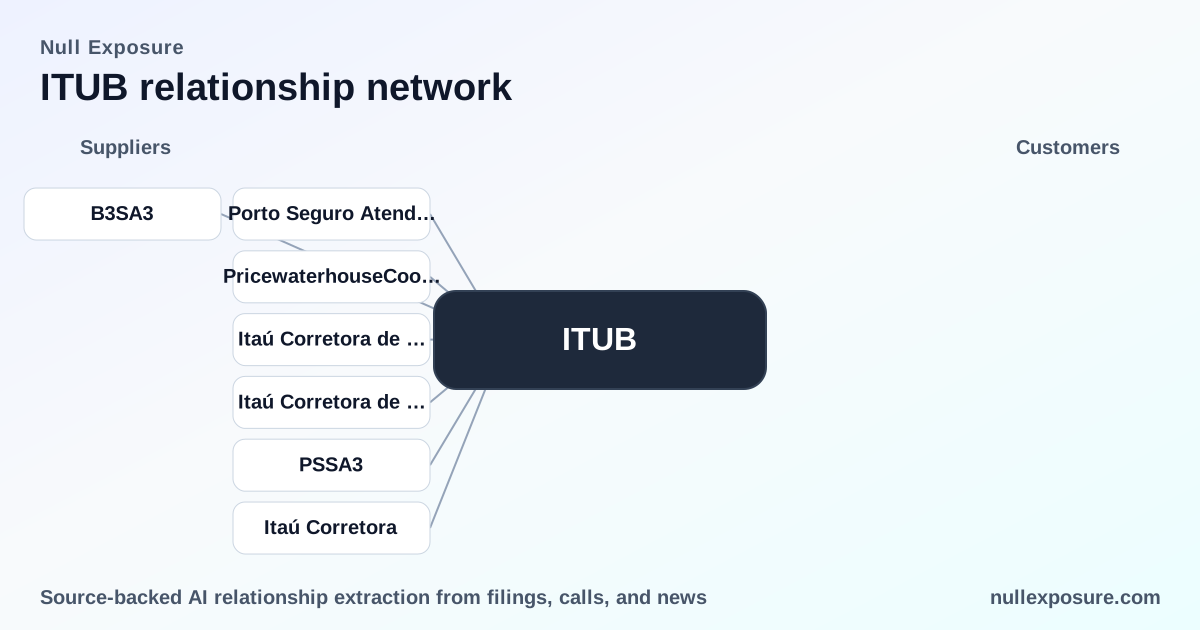
Itaú Unibanco (ITUB) — supplier relationships that shape execution risk and capital allocation
Itaú Unibanco monetizes a broad financial-services platform: traditional retail and corporate banking, insurance distribution and servicing through affiliate arrangements, brokerage and custody services that facilitate capital actions, and exchange-listed trading and settlement. Revenue and capital decisions lean heavily on a mix of internal intermediaries and external market infrastructure, so supplier relationships around auditing, share intermediation, call-center servicing and exchange auctions materially influence execution and governance. For investors evaluating counterparty and operational risk, the following vendor and affiliate relationships are directly relevant to governance, liquidity execution and customer-facing operations. For additional supplier intelligence and supplier-risk scoring, visit https://nullexposure.com/.
Big-picture implications for investors
Itaú’s commercial model reduces marginal cost by outsourcing distribution and transaction plumbing to affiliates and market utilities, while retaining customer balances and fee capture. That hybrid model delivers scale but concentrates operational risk in a small set of service providers: auditors for financial credibility; affiliated brokers for buybacks and shareholder settlements; insurance affiliates for product distribution; and B3 for auction and settlement mechanics. These relationships are operationally significant for corporate actions, regulatory transparency and customer experience.
If you evaluate counterparty concentration as part of investment due diligence, our platform can help quantify those exposures — learn more at https://nullexposure.com/.
Operational posture and company-level signals
There are no explicit supplier constraints disclosed in the extracted relationship feed — the dataset contains no flagged contractual limitations or compliance deadlines recorded as constraints. That absence itself is a company-level signal: no material supplier-imposed restrictions were surfaced in the latest crawl, not that none exist in filings or contracts outside this coverage.
From the disclosed relationships we can characterize Itaú’s operating model as:
- Contracting posture: pragmatic and affiliate-forward — long-standing related-party service agreements and use of group intermediaries for capital-market operations.
- Concentration: moderate — several critical functions (auditing, exchange auctions, brokerage intermediation, call-center servicing) are handled by a small number of named counterparties.
- Criticality: high — these suppliers handle audit credibility, investor distributions, share buybacks and customer service, which amplify operational and reputational risk if they fail.
- Maturity: established — references to formalized auditor appointments and long-standing service agreements signal mature, recurring vendor relationships rather than ad hoc suppliers.
Relationship-by-relationship: what investors need to know
Porto Seguro Atendimento Ltda.
Itaú disclosed a BRL 50 million related‑party call‑center agreement between Itaú Corretora de Seguros S.A. and Porto Seguro Atendimento Ltda., indicating outsourced customer service operations with an affiliate of Porto Seguro S.A. (FY2026 disclosure). A Globe and Mail press release documented this related‑party transaction and the monetary scale of the contract in early 2026. (Source: The Globe and Mail press release, FY2026).
Porto Seguro S.A.
Itaú partners with Porto Seguro S.A. as an affiliate distribution and servicing channel for retail insurance products such as vehicle and real‑estate insurance, demonstrating strategic cooperation in insurance origination and servicing across Brazil. The relationship was described in Itaú’s FY2026 related‑party disclosures and summarized in press coverage. (Source: The Globe and Mail press release, FY2026).
PricewaterhouseCoopers (PwC)
Itaú formalized PricewaterhouseCoopers as its independent auditors for the 2022–2024 period, underscoring the external audit backbone that supports financial statement credibility and regulatory reporting. This appointment was recorded in the company’s updated 2024 reference form and FY2026 guidance materials. (Source: The Globe and Mail press release on updated reference form, FY2026).
Itaú Corretora de Valores
The board authorized a new share repurchase program (Feb 5, 2026–Aug 4, 2027) with up to 200 million preferred shares to be repurchased via exchange transactions intermediated by Itaú Corretora de Valores, confirming the use of a group brokerage arm to execute material capital‑allocation activity. That intermediation centralizes execution risk inside the group. (Source: The Globe and Mail press release on buyback program, FY2026).
Itaú Corretora de Valores S.A.
A subsequent notice clarifies that purchases under the buyback will be executed on exchange at market prices, intermediated by Itaú Corretora de Valores S.A., reiterating that the group’s brokerage entity will act as the market-facing execution agent for repurchases. (Source: The Globe and Mail press release titled launch of new stock buyback program, FY2026).
Itaú Corretora
Itaú indicated that cash proceeds from fractional‑share sales after a bonus share distribution will be made available to eligible shareholders with direct deposits handled by Itaú Corretora, signaling that shareholder settlement and payment rails are routed through the group’s custody and brokerage operations. (Source: The Globe and Mail press release on fractional‑share auction proceeds, FY2026).
B3 (B3 S.A.)
Itaú uses B3, Brazil’s exchange, to pool and auction fractional shares after a bonus issue, with auctions executed on B3 (auction date noted as February 24, 2026) and the trading window running January–February 2026. This places market‑structure risk — auction liquidity and settlement — squarely on the exchange’s mechanics. (Source: The Globe and Mail press release on fractional auctions and FY2025/FY2026 disclosures).
B3 (repeat mention in FY2026)
A follow‑up disclosure again confirmed that fractions arising from the bonus share distribution were consolidated and sold on B3 in an auction held February 24, 2026, restating the operational reliance on the exchange for fractional‑share disposition. (Source: The Globe and Mail press release on distribution of cash from fractional‑share auction, FY2026).
Key investment takeaways
- Related‑party exposures are explicit and material. The BRL 50 million call‑center agreement with a Porto Seguro affiliate signals ongoing affiliate reliance for retail service delivery.
- Corporate actions are executed through in‑house intermediaries and exchange infrastructure. Buybacks and fractional‑share auctions run through Itaú Corretora entities and B3, concentrating execution and settlement risk within a tight operational perimeter.
- Financial credibility rests on a major global auditor. PwC’s role for the 2022–2024 audit cycle supports confidence in reported financials.
- Operational risk is concentrated but mature. These are established, recurring arrangements rather than one‑off vendors — that reduces volatility but increases systemic exposure to counterparty failure.
For a deeper supplier‑risk scorecard and to integrate these relationship signals into investment models, explore our platform at https://nullexposure.com/.
Final thought and next steps
Itaú’s supplier map shows a deliberate architecture: internalize fiduciary functions where control matters (brokerage, settlements), outsource volume services to affiliates, and use market utilities for auction mechanics. That structure supports profitability and scale but formalizes concentration risks that investors should monitor through filings and vendor disclosures. For tailored supplier analysis and to track these counterparties over time, visit https://nullexposure.com/ and request a briefing.