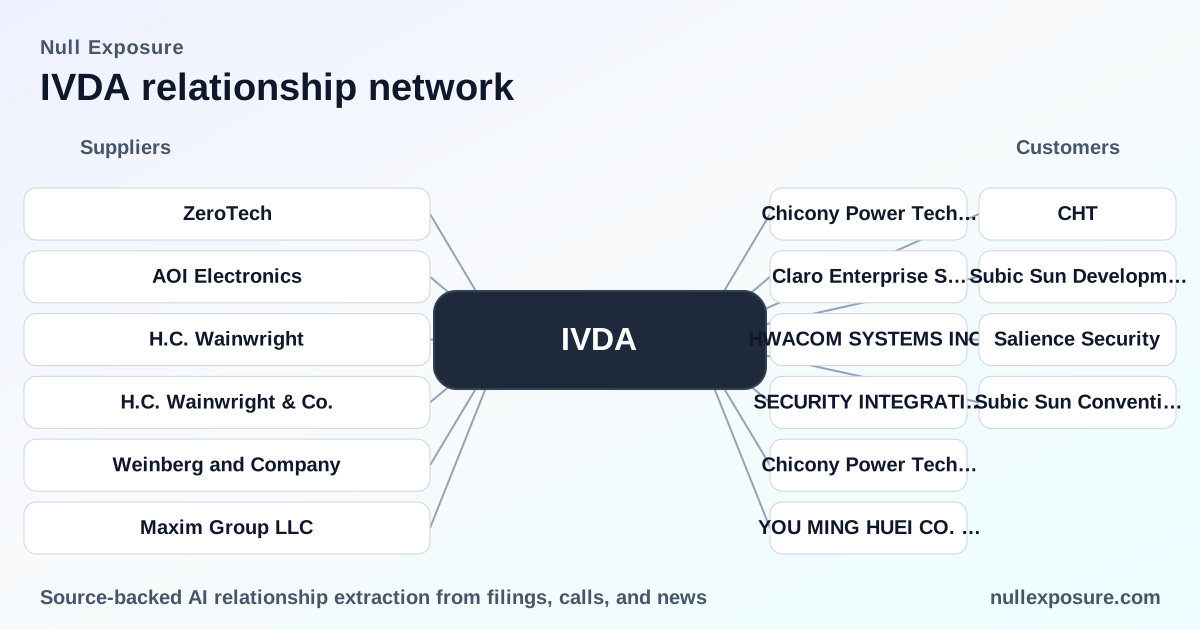
Iveda Solutions (IVDA): supplier relationships, capital partners and what they mean for investors
Iveda Solutions operates as a niche provider of AI-enabled surveillance hardware and software, monetizing through camera and systems sales, software development and licensing, professional services, and occasional joint ventures and capital raises to fund R&D and working capital. Revenue is driven primarily by product shipments and licensing of Iveda360 solutions, while balance-sheet actions — private and public placements — supply liquidity and shape dilution risk. For investors evaluating supplier exposure and counterparties, the mix of local manufacturing partners in APAC and repeated placement-agent engagements is the defining commercial architecture. Learn more on the firm at https://nullexposure.com/.
A compact read on what changed this cycle
Iveda disclosed new manufacturing and placement relationships through early 2026 that materially change execution risk and capital access. The company is moving manufacturing into APAC sources (Taiwan) to increase flexibility, while relying on placement agents for recurring capital — both strategic and structural shifts. Below I catalog each public relationship reference and explain how it affects operating and financial risk.
Direct relationship entries (one per reported result)
ZeroTech — local production partner for Iveda360 (news)
Iveda announced that ZeroTech will participate in local production of the Iveda360 360-degree smart surveillance camera as part of an Egyptian manufacturing initiative. This partnership signals a shift toward regionally placed manufacturing to support international deployments (TechS2, March 10, 2026).
AOI Electronics — co-manufacturer in Egypt (news)
AOI Electronics is named alongside ZeroTech in the same announcement to begin local production of the Iveda360 camera, indicating a multi-vendor manufacturing approach for that regional program (TechS2, March 10, 2026).
H.C. Wainwright — placement agent for $2 million offering (Globe and Mail press release)
Iveda priced a $2 million public offering where H.C. Wainwright acted as placement agent; the financing included customary lock-ups and placement-agent warrants and committed proceeds for R&D, debt repayment, working capital and potential acquisitions (The Globe and Mail press release, February 2026).
H.C. Wainwright & Co. — underwriter role described in market brief (Intellectia.ai)
Market coverage reiterated H.C. Wainwright & Co.’s role as exclusive placement agent, which provides Iveda with capital-market access and signals the company’s continued reliance on boutique equity capital markets firms for recurring financing (Intellectia.ai summary, February 2026).
H.C. Wainwright & Co. — official company press release confirming placement-agent role (GlobeNewswire)
The company’s own press release confirms that H.C. Wainwright & Co. is the exclusive placement agent for the $2 million offering, underscoring that capital raises are structured with short-dated placement warrants and fees (GlobeNewswire, February 10, 2026).
H.C. Wainwright & Co. — coverage repost (Sahm Capital)
A distribution of the press release through Sahm Capital reiterates the placement-agent arrangement and associated term highlights, demonstrating broad market dissemination of the financing terms and reinforcing execution consistency across outlets (Sahm Capital release, February 2026).
Weinberg and Company — auditor ratified at 2024 annual meeting (Globe and Mail press release)
Shareholders ratified Weinberg and Company as Iveda’s independent registered public accounting firm for the fiscal year ending December 31, 2025, indicating continuity in external financial oversight and audit coverage (The Globe and Mail press release, 2025 annual meeting filing).
Maxim Group LLC — placement agent for 2022 private placement (GlobeNewswire, 2022)
Iveda used Maxim Group LLC as the sole placement agent for a $5 million private placement in 2022, exhibiting a pattern of recurring engagements with boutique securities firms to raise equity capital across multiple years (GlobeNewswire, August 9, 2022).
What the supplier and capital relationships collectively reveal
- Manufacturing strategy: The explicit move to source cameras from Taiwanese manufacturers and to set up local production in Egypt with AOI and ZeroTech positions Iveda as a company outsourcing hardware manufacture to APAC firms to gain cost, lead-time and deployment flexibility. This is a deliberate operating posture rather than ad hoc purchasing.
- Capital strategy: Multiple placement-agent engagements (H.C. Wainwright, Maxim Group) across years demonstrate a business model that depends on frequent equity raises to fund growth, R&D and working capital, which raises dilution risk for existing shareholders.
- Governance and controls: The ratification of Weinberg and Company as auditor is a routine governance signal that contributes to financial reporting stability amid recurring capital activity.
- Geographic concentration signal: The company-level constraint explicitly notes sourcing in Taiwan and APAC manufacturers, which creates concentration exposure to APAC supply chains and regional logistics for its core hardware offering.
Constraints translated into operating characteristics
The APAC sourcing signal drives four practical characteristics of Iveda’s operating model:
- Contracting posture: Supplier relationships are primarily outsourced manufacturing contracts rather than vertically integrated production, increasing flexibility but transferring inventory and quality control risk to partners.
- Concentration and criticality: Reliance on Taiwan and regional manufacturers makes the hardware supply chain a critical single point of failure for product revenue; local production in Egypt mitigates but does not eliminate that concentration.
- Maturity: The mix of joint ventures and small-cap financings shows a company in growth/reshaping mode rather than steady-state operational maturity; expect operational processes and supplier governance to evolve rapidly.
- Capital dependency: Recurrent placement-agent financings are embedded into the corporate plan as a primary liquidity source, which is a structural constraint on valuation and dilution profiles.
If you want a consolidated supplier-risk scorecard or comparative exposure versus peers, start here: https://nullexposure.com/.
Investment and operational implications
- For investors: Expect episodic dilution and capital raises; value the business primarily on revenue traction and execution of regional manufacturing rollouts rather than on margin stability. The presence of boutique placement agents is a liquidity enabler but also a signal that the company lacks sustained internal cash generation.
- For operators and procurement teams: Prioritize supplier qualification and dual-sourcing in APAC and Cairo-based production lines. Enforce contractual quality metrics and lead-time SLAs given the outsized impact of hardware supply on revenue.
- Key risk: APAC concentration plus recurring capital raises create a two-front operational-financial risk — supply interruptions will compress near-term revenue while financing cycles drive dilution.
Explore a deeper risk and relationship analysis at https://nullexposure.com/ — the homepage provides concise intelligence for evaluating counterparties and funding partners.
Bottom line
Iveda’s supplier footprint is shifting toward APAC manufacturing with local Egyptian assembly partners while its financing strategy relies on specialist placement agents to fund R&D and working capital. These paired movements increase commercial flexibility but raise concentration and dilution risks that must be priced by investors and managed by operators. For a tailored briefing linking counterparties to contractual risk and value scenarios, visit https://nullexposure.com/ and request a supplier-impact assessment.