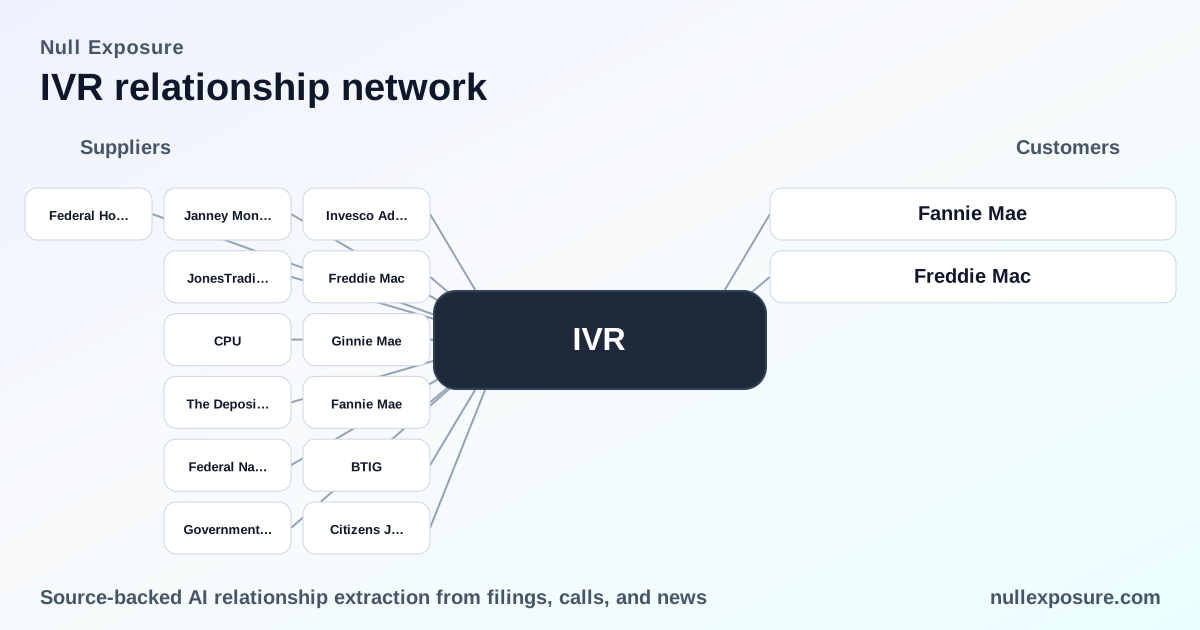
Invesco Mortgage Capital (IVR): who supplies the balance sheet and how that shapes risk
Invesco Mortgage Capital operates as an externally managed mortgage REIT that earns through interest spread on Agency and other mortgage-backed securities while levering those assets with short-term repurchase financing. The firm monetizes inventory via net interest margin and returns cash to holders through a monthly dividend; balance-sheet liquidity and capital markets access are therefore direct drivers of performance and valuation. For a deeper vendor-risk view and relationship mapping, visit https://nullexposure.com/.
Why the supplier map matters to investors
IVR’s economics are simple and capital-structure driven: asset yields minus funding costs, amplified by leverage. That makes the identity, tenure and contract terms of counterparties — financing desks, depositaries, trustees, and an external manager — determinative for credit, liquidity and operational risk. Below I map the active relationships surfaced in recent filings and press, then synthesize how those links constrain IVR’s operating model.
Active counterparty and service roster — one-line takeaways
-
Invesco Advisers, Inc. — IVR is externally managed and advised by Invesco Advisers, Inc., which supplies IVR’s management team, office services and investment oversight under a formal management agreement (company filings and PR releases, FY2026 / FY2024).
(Source: PR Newswire and company releases cited in FY2026 filings.) -
Freddie Mac (Federal Home Loan Mortgage Corporation) — A substantial portion of IVR’s agency RMBS and agency CMBS exposure is to securities issued or guaranteed by Freddie Mac, used for yield and diversification (SEC 10‑K / trading commentary, FY2026).
(Source: TradingView summary of IVR SEC filings, FY2026.) -
Fannie Mae (Federal National Mortgage Association) — IVR holds agency RMBS and a large share of agency CMBS in Fannie Mae DUS products, providing a core, government‑sponsored guarantee profile to the portfolio (company disclosures and market notes, FY2026).
(Source: MarketScreener and TradingView reporting, FY2026.) -
Ginnie Mae (Government National Mortgage Association) — Ginnie‑guaranteed RMBS are an explicit component of IVR’s agency RMBS allocation and therefore underpin part of its credit profile (dividend and portfolio disclosures, FY2026).
(Source: MarketBeat / MarketScreener coverage, Feb–Mar 2026.) -
BTIG — Named as a selling agent under IVR’s at‑the‑market (ATM) equity program to distribute up to 40 million common shares, BTIG is a capital‑markets counterparty supporting equity issuance and liquidity management (ATM announcement, Feb 2026).
(Source: TradingView reporting on ATM program, Feb 2026.) -
Citizens JMP Securities — Included alongside other broker‑dealers as an agent under the new ATM equity program, participating in equity execution and primary issuance activity (ATM announcement, Feb 2026).
(Source: TradingView coverage of the ATM, Feb 2026.) -
Janney Montgomery Scott — Listed as a counterparty/agent on the ATM and distribution activities, Janney provides execution capacity and distribution reach for IVR’s equity programs (ATM announcement, Feb 2026).
(Source: TradingView ATM notice, Feb 2026.) -
JonesTrading Institutional Services — Engaged as an ATM sales agent to execute share placements and provide institutional distribution capability in IVR’s equity program (ATM announcement, Feb 2026).
(Source: TradingView ATM announcement, Feb 2026.) -
Computershare Trust Company N.A. — Appointed as the redemption and payment agent for the Series B preferred stock redemption, handling settlement and DTC payment flows for the corporate action (PR Newswire release, FY2024 filings).
(Source: PR Newswire release concerning Series B preferred redemption, FY2024.) -
The Depository Trust Company (DTC) — All issued and outstanding Series B preferred shares are held in book‑entry form through DTC, making DTC the central securities depository that underpins IVR’s settlement landscape (redemption release, FY2024).
(Source: PR Newswire redemption notice, FY2024.)
What the relationship map implies about IVR’s operating constraints
IVR’s supplier relationships reveal a capital‑markets and repo‑centric operating model:
-
Short-term funding posture: The company funds a large proportion of assets with repurchase agreements that carry short maturities (typically one to six months), creating continual rollover and liquidity management requirements. This is a company‑level signal supported by IVR’s disclosures on repo terms.
-
Government‑backed asset concentration: A majority of inventory is in Agency RMBS and Agency CMBS (Fannie, Freddie, Ginnie), which lowers credit risk but raises sensitivity to GSE policy, agency spread dynamics and pool prepayment behavior. This is a company‑level signal from portfolio statements.
-
North America concentration: Financing counterparty exposure is geographically concentrated in North America, concentrating legal, market and settlement risk within U.S. market plumbing.
-
Critical funding relationships: Repurchase agreements finance the majority of IVR’s portfolio and are therefore critical to the firm’s ability to maintain leverage and dividend distributions; repo counterparties effectively act as short‑term secured lenders. The company discloses that repos are the primary financing vehicle.
-
Buyer role in repo mechanics: Under repo arrangements IVR effectively sells assets to counterparties with a contractual repurchase obligation — structurally this makes the counterparty the temporary buyer in the transaction and shapes collateral and margin mechanics.
-
External management as a central service relationship: IVR’s reliance on Invesco Advisers for staffing, portfolio management, and office services makes the manager relationship a core operational dependency (the management agreement is explicit).
-
Large exposure and active stage: With repurchase borrowings in the billions and securities pledged over $5 billion, IVR’s counterparty spend and collateral magnitude are material (100m+ spend band signal).
Together these constraints mean liquidity, repo terms and the health of agency markets are the primary operational levers and risk factors for IVR’s returns.
Practical implications for investors and operators
- For investors: monitor repo roll‑rates, collateral haircuts, and any changes in GSE guarantee mechanics; these variables transmit directly into funding cost and dividend sustainability.
- For operators: diversify dealer outlets for repos and equity placement, and maintain clear contingency funding plans given the short tenor of repurchase agreements.
If you want a consolidated supplier-risk scorecard and counterparty timeline for IVR, see our platform at https://nullexposure.com/ — we aggregate filings and market notices into investor‑ready profiles.
Final thought and next steps
IVR runs a levered agency-focused mortgage book whose economics depend on continuously available short‑term secured financing and reliable capital markets execution for equity needs. The manager relationship with Invesco and settlement paths through Computershare and DTC are operational anchors, while BTIG, Janney, Citizens JMP and JonesTrading provide critical distribution capacity for equity programs. For active investors, the priority signals are repo maturity profile, pledged collateral size, and GSE exposure trends.
To evaluate counterparty concentration and stress‑test IVR’s funding under market dislocation, begin with the company’s filings and the relationship notes above — or get a synthesized supplier report at https://nullexposure.com/ to accelerate due diligence.