IVR-P-C: A compact map for investors assessing supplier exposure
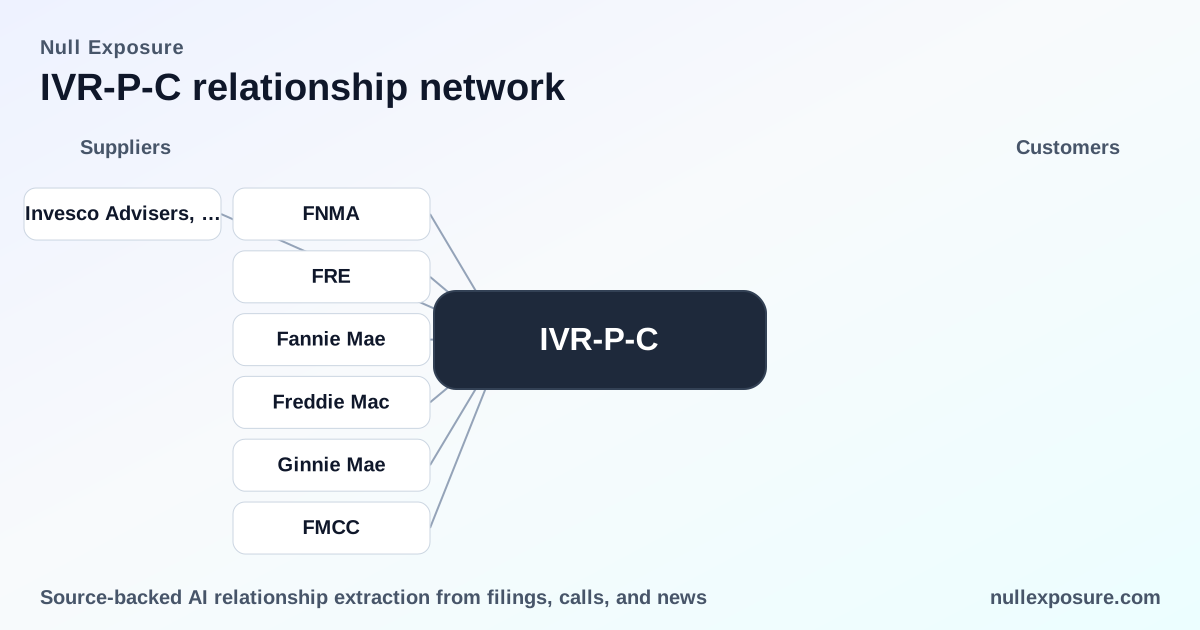
Invesco Mortgage Capital’s IVR-P-C is a fixed-to-floating cumulative redeemable preferred that monetizes investor capital through a portfolio concentrated in agency-guaranteed residential mortgage-backed securities and an external management agreement with Invesco’s adviser arm. Cash returns for IVR-P-C derive from mortgage asset cash flow and capital structure priority, while operating economics are driven by asset selection, agency credit support, and the fees and decisions of an external manager. If you are sizing counterparty, credit and governance risk around this security, this note distills the supplier relationships that matter and the practical implications for portfolio exposure. For deeper supplier maps and comparable security analysis visit https://nullexposure.com/.
How IVR-P-C actually earns its dividend and where control sits
IVR-P-C pays a fixed coupon that converts to a floating rate at a defined step, giving investors an income profile that benefits from stable mortgage cash flows early and a floating reset later. The underlying business model for the issuer — Invesco Mortgage Capital Inc. — is to generate net interest margin from mortgage securities while using capital structure instruments (like preferreds) to attract yield-seeking institutional capital. Two structural features dominate economics and risk: (1) heavy allocation to agency-guaranteed RMBS, which de-risks credit exposure but concentrates the portfolio; and (2) external management by Invesco Advisers, which centralizes portfolio and operating decisions outside the issuer.
These characteristics imply a distinct contracting posture: the firm relies on an external manager for investment selection and balance-sheet decisions, while investors in IVR-P-C depend on agency guarantees and the management team's execution. That combination reduces issuer credit default risk but raises governance and operational reliance on the external adviser.
Supplier relationships that matter — the full list
Below are the specific counterparties and relationships surfaced in public coverage; each is summarized in plain English with the original source cited.
Fannie Mae
IVR-P-C’s issuer holds a portfolio weighted toward RMBS issued or guaranteed by Fannie Mae, giving the preferred security exposure to loans that carry Fannie Mae’s guarantee on principal and interest. According to MarketBeat filings and alerts in March 2026, Invesco Mortgage Capital highlights agency-guaranteed RMBS exposure, explicitly naming Fannie Mae as a primary collateral source (MarketBeat, March 2026 — https://www.marketbeat.com/instant-alerts/filing-picton-mahoney-asset-management-buys-shares-of-126353-invesco-mortgage-capital-inc-ivr-2026-03-07/).
Freddie Mac
The company’s mortgage holdings also include RMBS issued or guaranteed by Freddie Mac, so IVR-P-C benefits from Freddie Mac’s credit support on those securities and is exposed to any servicing or legal changes that affect Freddie Mac guarantees. This relationship was noted in MarketBeat coverage and investor alerts in early March 2026 (MarketBeat, March 2026 — https://www.marketbeat.com/instant-alerts/invesco-mortgage-capital-inc-nyseivr-sees-large-increase-in-short-interest-2026-03-04/).
Ginnie Mae
Invesco Mortgage Capital’s portfolio includes Ginnie Mae-guaranteed securities, which are backed by the full faith and credit of the U.S. government and therefore represent the most direct federal credit support in the issuer’s collateral mix. MarketBeat reporting in March 2026 lists Ginnie Mae alongside Fannie Mae and Freddie Mac as a material component of the RMBS weighting (MarketBeat, March 2026 — https://www.marketbeat.com/instant-alerts/filing-picton-mahoney-asset-management-buys-shares-of-126353-invesco-mortgage-capital-inc-ivr-2026-03-07/).
Invesco Advisers, Inc.
Invesco Mortgage Capital is externally managed and advised by Invesco Advisers, Inc., a subsidiary of Invesco Ltd.; the adviser performs portfolio management and operational functions that directly influence the issuer’s NAV, leverage and cash-distribution decisions. The issuer’s press release and investor update explicitly identify Invesco Advisers as the external manager (PR Newswire, investor update, FY2026/FY2025 releases — https://www.prnewswire.com/news-releases/invesco-mortgage-capital-inc-announces-monthly-common-dividend-and-provides-update-on-book-value-and-leverage-302662811.html).
What those relationships mean for investors and operators
- Concentration with agencies is a two-edged sword. Agency guarantees materially reduce credit-loss risk across the mortgage book, improving expected dividend sustainability for IVR-P-C; however, the portfolio’s concentration in agency RMBS creates exposure to policy shifts, prepayment dynamics, and servicing/legal regime changes that affect all agency-backed securities simultaneously.
- External management centralizes execution risk. Because Invesco Advisers controls day-to-day investing, fee arrangements and governance decisions are critical: the manager’s incentives and stability directly affect returns available to preferred holders. PR Newswire disclosures confirm that Invesco Advisers is the formal manager.
- Preferred structure reduces equity volatility but not all risks. The fixed-to-floating preferred provides priority for dividends but still exposes holders to interest-rate and liquidity risk tied to mortgage prepayments and market spreads as the coupon resets.
- Operational maturity and counterparty criticality are high. Agency issuers (Fannie, Freddie, Ginnie) are mature, systemically critical counterparties; that reduces idiosyncratic credit risk but increases sensitivity to macro and regulatory changes that act on the entire securitized market.
These are company-level signals: they reflect how the issuer runs and monetizes its balance sheet rather than discrete supplier contract terms.
For a structured view of how these relationships compare across preferred issues and mortgage REITs, visit https://nullexposure.com/ to see our supplier-mapping resources.
How to act on this supplier map
- Validate agency concentration against your risk budget. If your mandate penalizes regulatory or prepayment concentration, treat the agency-weighted exposure as a primary allocation decision rather than a secondary yield pick.
- Underwrite external manager continuity. Review the terms of the external management agreement and assess the adviser’s incentives; management discontinuity or strategy shifts are a greater threat to preferred dividend integrity than individual mortgage credit losses.
- Stress-test interest-rate and prepayment scenarios. The fixed-to-floating change in IVR-P-C’s coupon requires scenario analysis for spread compression or widening at the float reset.
If you want a tailored counterparty map and scenario analysis for IVR-P-C in a portfolio context, start with our supplier intelligence hub at https://nullexposure.com/.
Final takeaways for investors
- Agency guarantees materially lower credit risk but concentrate systemic exposure.
- External management is the central operational dependency and a clearest governance lever for investors.
- IVR-P-C’s fixed-to-floating structure and preferred priority produce a stable income profile, but require active monitoring of interest-rate dynamics and manager performance.
For ongoing coverage, supplier-specific risk scores, and comparative intelligence across preferreds and mortgage REITs, visit https://nullexposure.com/ to subscribe and download the full supplier map.