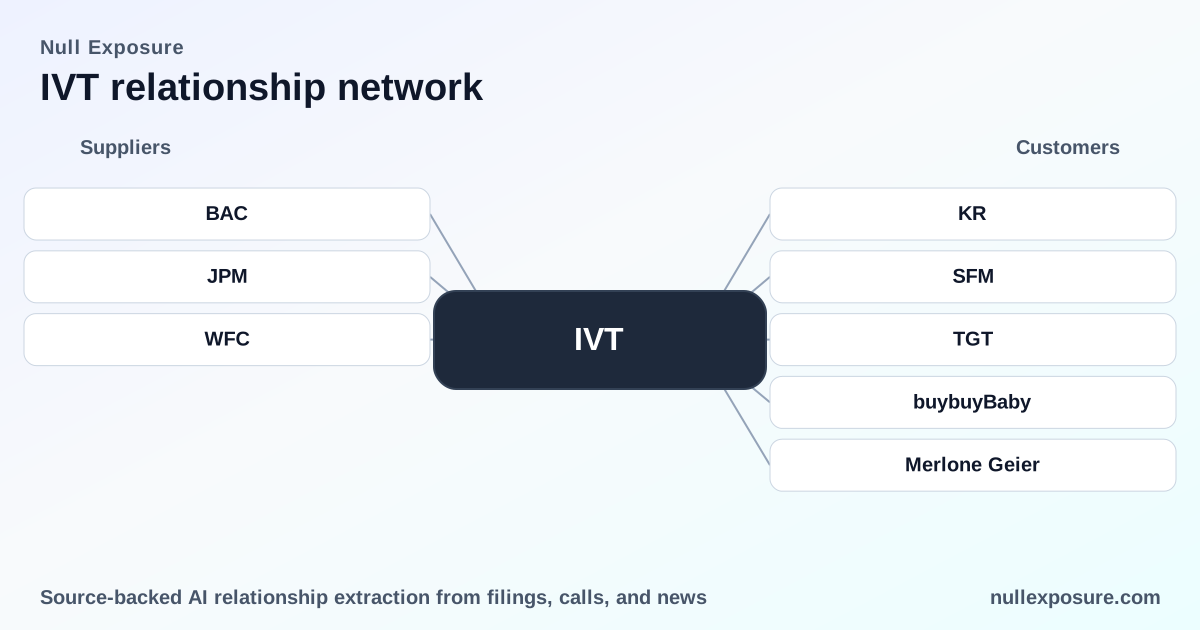
InvenTrust Properties (IVT): Capital partners, supplier posture, and what underwriter activity signals to investors
InvenTrust Properties operates as a retail-focused REIT that monetizes through leasing stabilized retail properties and episodic capital markets access—rent rolls generate operating cash flow while equity offerings and banking relationships supply growth and balance sheet flexibility. Recent underwriter activity and the company’s documented use of external service providers offer a clear lens into both short-term funding strategy and longer-term supplier governance. For a quick view of related supplier intelligence, visit https://nullexposure.com/.
How InvenTrust runs the business and why suppliers matter
InvenTrust is a market-capitalized REIT with recurring rental revenue (Revenue TTM $299M) and a policy of accessing public equity to manage growth and leverage. The operating model is dual‑sourced: predictable leasing cash flow for operations and capital‑markets transactions for portfolio and capital structure management. That duality makes relationships with underwriters and external service providers strategically important: banks enable access to equity when the company elects to issue stock, while external vendors support operational resilience (for example, cybersecurity controls).
Key company metrics that shape supplier risk posture:
- Market capitalization ~ $2.46B, EBITDA $173M, and a dividend yield ~3.04%, reflecting a mature REIT profile.
- Institutional ownership ~80.5%, indicating investor scrutiny and reliance on public capital.
- Recent equity issuance activity, which creates episodic but material dependency on investment banking partners.
Learn more about supplier exposures and signals at https://nullexposure.com/.
What the recent underwriter syndicate reveals about capital strategy
In September 2024 InvenTrust completed an SEC‑registered offering of 9,200,000 shares (including the full exercise of the underwriters’ option). That transaction was led by a syndicate including JP Morgan, BofA Securities, and Wells Fargo Securities—traditional, top‑tier capital markets counterparties. Using established banks for a block equity placement signals a management preference for broad distribution and liquidity preservation, rather than private placements or opportunistic single‑partner funding.
- Contracting posture: episodic, market‑facing engagement with large investment banks for equity issuance.
- Concentration: diversified across leading banks for a single issuance; no single‑bank dependency evident from this transaction.
- Criticality: high at the time of issuance—underwriters enabled immediate access to public capital.
- Maturity: relationships with major underwriters are mature, market‑standard engagements rather than bespoke financing.
Relationship roundup: the banks that underwrote the offering
Below are the supplier relationships identified in public reporting related to the equity offering. Each relationship entry is described in plain language with a source note.
-
BofA Securities worked as a lead underwriter on InvenTrust’s SEC‑registered offering of 9,200,000 shares, taking part in the syndicate that executed the equity placement. According to a Sidley press release announcing representation of the underwriters (September 2024), BofA was one of the syndicate leaders. (Sidley announcement, Sept 2024.)
-
JP Morgan acted as a lead underwriter for the same 9.2 million‑share offering, forming the core of the syndicate that distributed the deal to the market. The Sidley announcement documenting counsel for the underwriters lists JP Morgan as a leading bookrunner. (Sidley announcement, Sept 2024.)
-
Wells Fargo Securities joined BofA and JP Morgan as a lead underwriter in the placement of 9,200,000 InvenTrust shares, participating in the syndicate that executed the transaction and exercised the underwriters’ option. The role is described in the Sidley notice concerning representation of the underwriting group. (Sidley announcement, Sept 2024.)
Company‑level constraint: external service providers and cybersecurity posture
InvenTrust’s public disclosures state the company’s cybersecurity program explicitly uses external service providers to assess, test, and assist with security controls. This is a company‑level signal that the firm contracts third parties for specialized security functions rather than relying solely on internal teams. That contracting posture implies:
- Operational dependency on vendors for security assurance, increasing importance of vendor selection and oversight.
- Moderate criticality: cybersecurity providers are critical to risk management continuity, though they are not the same as capital providers in terms of immediate cash flow impact.
- Maturity: the existence of a documented cybersecurity program that includes third‑party providers signals institutionalized governance rather than ad‑hoc outsourcing.
This constraint is part of the company’s supplier footprint and should be evaluated separately from capital markets counterparties.
Investment implications and operational takeaways
- Capital access is organized and conventional. Using JP Morgan, BofA, and Wells Fargo for an SEC‑registered equity placement is consistent with a strategy that preserves public liquidity and broad investor distribution. That reduces the probability of execution risk relative to smaller or concentrated underwriter groups.
- Supplier risk is distributed but operationally material. Banking counterparties are episodically critical for capital events; cybersecurity and other external service providers are persistently critical for day‑to‑day operational resilience.
- Monitor three vectors: subsequent capital markets activity (frequency and size of offerings), changes in the underwriter roster (signaling preferred partners), and vendor governance disclosures around cybersecurity and business continuity.
If you want a structured supplier risk profile for IVT or comparable REITs, see more at https://nullexposure.com/.
Final assessment and next steps for investors
InvenTrust’s supplier signals show a well‑executed capital markets playbook and an institutional approach to external service providers. For investors and operators assessing vendor risk, the immediate priorities are verifying continuity plans with cybersecurity vendors and tracking whether capital raises continue to rely on the same bank consortium. These items drive both short‑term dilution and long‑term operational resilience.
For a deeper supplier mapping and ongoing monitoring of IVT’s counterparties, visit https://nullexposure.com/ and evaluate the supplier relationships that shape capital access and operational risk.