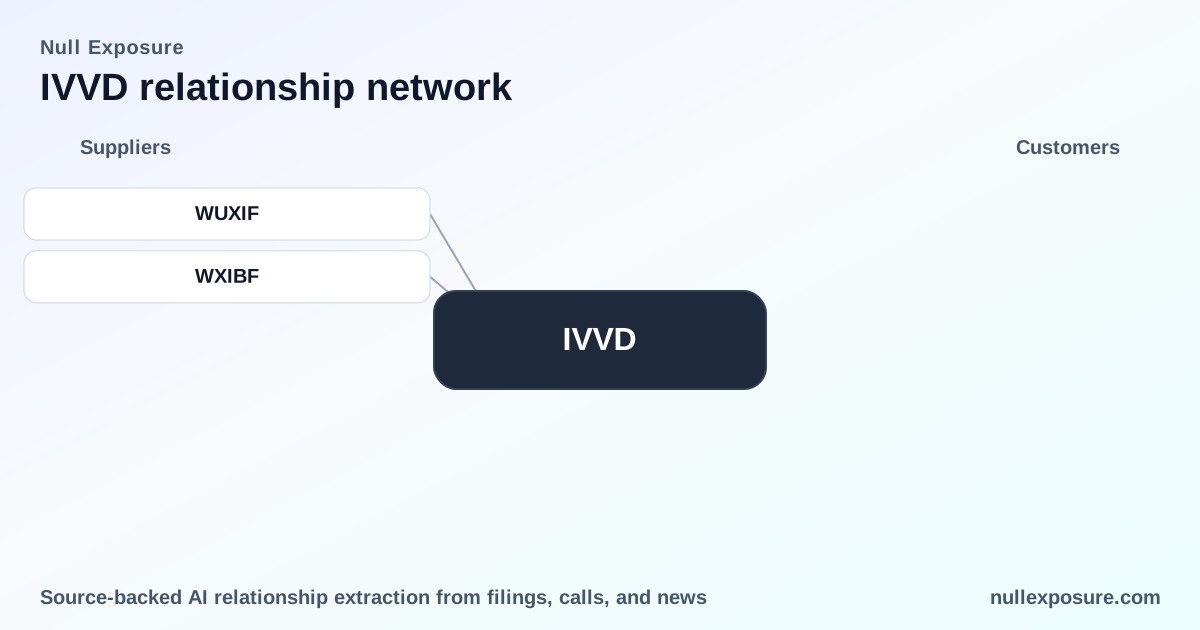
Invivyd (IVVD) — supplier map and operational risk for investors and operators
Invivyd is a clinical‑stage monoclonal‑antibody developer that outsources almost all chemistry, manufacturing and control (CMC) activity to third‑party providers and licenses key cell‑line intellectual property. The company monetizes exclusively through successful clinical development and subsequent commercialization of antibody therapeutics; manufacturing and supply agreements with contract development and manufacturing organizations (CDMOs) are therefore the primary operational lever that converts R&D progress into revenue. For investors, the single largest supplier relationship—WuXi Biologics—drives both near‑term delivery capacity and long‑term commercialization risk. Explore supplier intelligence at NullExposure: https://nullexposure.com/
Why WuXi matters — the operational axis for Invivyd
Invivyd structures its manufacturing and certain IP rights through long‑running master agreements with WuXi Biologics. WuXi functions as the company's CDMO, manufacturer and a licensor of a proprietary cell line, and the contracts are written to support both clinical and commercial supply over multi‑year terms. According to the company’s 2024 Form 10‑K, Invivyd has a Commercial Manufacturing Agreement with WuXi Biologics that was originally executed in December 2020 and amended multiple times through 2023; the agreement governs commercial drug‑substance and drug‑product manufacture and creates contractually binding purchase obligations. The same filing documents that Invivyd entered a Cell Line License Agreement with WuXi Biologics (Hong Kong) Limited granting a royalty‑bearing, sublicensable license to certain IP associated with a proprietary cell line.
A mid‑2026 market news item reinforced that WuXi continues to supply both clinical and commercial product for Invivyd and that inventory capitalization began in March 2024 to support commercial supply. This combination of manufacturing responsibility plus licensed IP makes WuXi the single point of failure for CMC execution and short‑term delivery.
Relationship: WuXi (TradingView news)
Invivyd has continued reliance on third‑party CDMOs with WuXi supplying clinical and commercial product; inventory capitalization to support commercial supply began in March 2024. This report was summarized in a TradingView news item on March 10, 2026.
Relationship: WuXi Biologics (Company 2024 10‑K)
The company’s 2024 Form 10‑K documents a long‑term Commercial Manufacturing Agreement with WuXi Biologics, sole‑source procurement of certain raw materials through WuXi, noncancelable purchase obligations for commercial batches and a Cell Line License Agreement granting Invivyd rights to WuXi‑developed cell line IP. These disclosures are found in Invivyd’s 2024 Form 10‑K (filed for FY2024).
How the contractual and sourcing posture shapes the business model
Invivyd’s supplier footprint is not a passive cost center — it defines the company’s ability to execute commercial launches and the shape of its capital requirements.
- Contracting posture: Invivyd has long‑term master services arrangements with WuXi that include automatic five‑year renewal language and explicit commercial manufacturing terms, which creates predictable capacity but slow contractual flexibility. According to the 2024 10‑K, the Commercial Manufacturing Agreement remains in effect for an initial five‑year period and renews for successive five‑year terms unless earlier terminated.
- Concentration and criticality: The company explicitly depends on a single contract manufacturer for critical drug substance, single‑source purification resins and cell culture media. The 10‑K warns that loss of these suppliers or their inability to supply sufficient material at required quality levels would harm the business — therefore supplier concentration is a material, high‑criticality risk to commercialization.
- Geographic exposure: Invivyd’s manufacturing and clinical supply flow through China‑based facilities, which introduces export, regulatory and geopolitical vectors into product continuity — a company‑level signal supported by the filing’s discussion of China‑based manufacturing and an historical export delay in December 2020.
- Spend profile and balance‑sheet impact: Contractual purchase obligations disclosed as of December 31, 2024 — including $27.5M related to commercial batch commitments and $11.3M for materials procurement expected to be paid in 2025 — place supplier spend squarely in the $10M–$100M band and create timing pressure for working capital.
- Adjacent supplier roles: Beyond WuXi, Invivyd engages third‑party logistics (a 3PL agent) for distribution and a services master agreement with Population Health Partners (PHP) for other deliverables; these contracts are active and necessary for labeling, packaging, storage, distribution and certain program support.
These characteristics collectively produce a sourcing regime that is predictable on pricing and capacity in the near term but highly susceptible to single‑point operational events, regulatory export controls and supplier performance variability.
(If you’re benchmarking supplier concentration or modeling COGS sensitivity, NullExposure has comparative supplier intelligence and contract posture analysis at https://nullexposure.com/.)
What investors and operators should watch next
For a capital markets audience, the supplier profile translates into a short checklist of high‑priority items to monitor and act on:
- Supply continuity metrics. Track WuXi manufacturing KPIs, batch release timelines, and inventory capitalization cadence; the March 2024 inventory capitalization event is an early indicator of transition to commercial execution.
- Contract renewals and escape provisions. Long‑form five‑year renewals reduce renegotiation frequency; investors should focus on termination rights, capacity reservation mechanics and transfer‑of‑technology clauses in future filings.
- Regulatory and export risk exposure. The 10‑K documents a December 2020 export delay related to new Chinese procedures, establishing a precedent that regulatory actions in China can directly interrupt shipments.
- Spend and cash‑flow timing. The $27.5M and $11.3M purchase obligations disclosed as of year‑end 2024 create concentrated near‑term cash outflows that must be reconciled with operating cash and financing plans.
- Mitigation moves by management. Look for signs of dual‑sourcing, additional CDMO engagements, or incremental manufacturing investments that reduce sole‑source dependence.
Key takeaway: the WuXi relationship is both operationally indispensable and strategically defining for Invivyd’s pathway to revenue. Any valuation or scenario model must embed a robust probability of supply disturbance and the cash impact of purchase obligations.
Practical steps for operators and sourcing teams
Operators and procurement leads evaluating this supplier relationship should prioritize three actions immediately:
- Establish operational readouts and SLAs with WuXi that map to launch milestones and define penalties or make‑good pathways for missed releases.
- Validate secondary sourcing options for single‑source items (purification resins, media) and negotiate supply continuity clauses or consignment stock arrangements.
- Stress‑test working capital plans against the contractual payment profile disclosed in the 2024 Form 10‑K and build covenant buffers.
For deeper supplier benchmarks and contract‑level analytics, see NullExposure’s supplier research hub: https://nullexposure.com/
Bottom line: a concentrated supplier dependence that drives valuation risk
Invivyd’s model converts science into revenue only through successful CMC execution, and WuXi Biologics is the fulcrum of that conversion — manufacturer, licensor and commercial supplier under long‑term contract. The combination of concentrated spend, China‑based manufacturing and meaningful purchase obligations creates a clear, investable risk profile: high operational leverage to a single partner that influences both timing and probability of commercial success. Monitor contract terms, manufacturing KPIs, and any management moves toward diversification as the primary signals that will change the risk/return calculus.
Learn more about supplier risk and contract posture analysis at NullExposure: https://nullexposure.com/