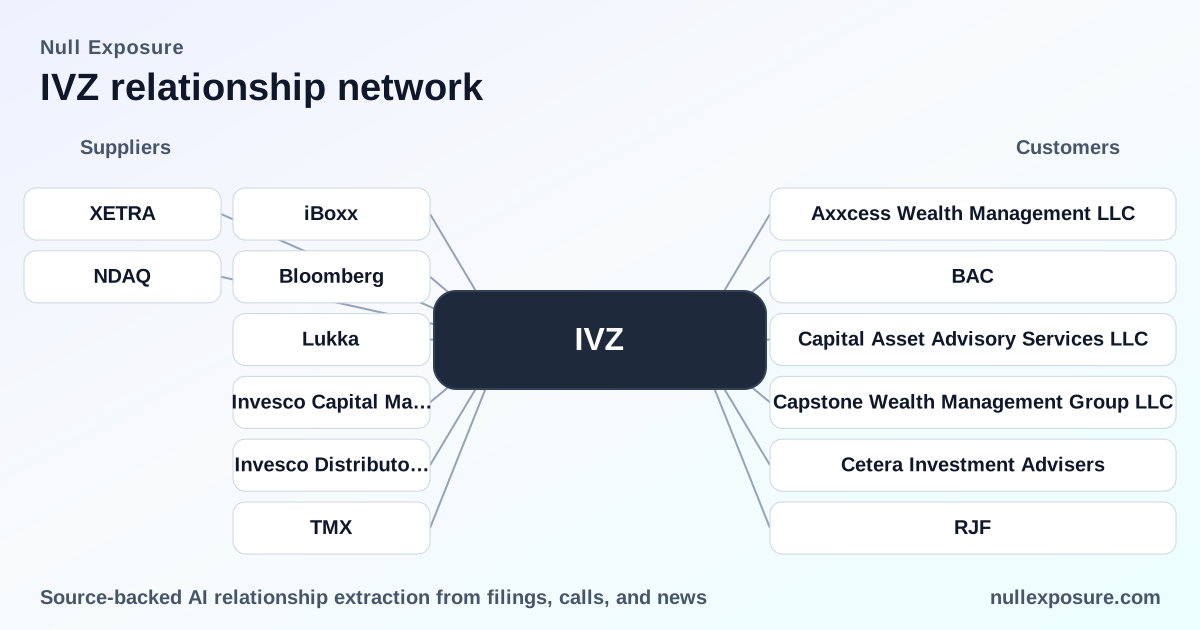
Invesco Plc (IVZ) as a Supplier: who it contracts with, how it monetizes, and what that means for counterparties
Invesco Plc operates as a global, independent asset manager that monetizes primarily through management and distribution fees across active and passive funds, ETFs, and advisory mandates. The firm generates recurring fee income from retail and institutional clients, collects 12b‑1 and distribution fees in U.S. retail channels, and leverages listed vehicles and UCITS wrappers to scale product distribution globally; Invesco reported roughly $6.38 billion in trailing revenues and a $10.2 billion market capitalization in its latest public snapshot (FY2025–FY2026 metrics). For counterparties and procurement teams, Invesco’s supplier footprint reflects a mix of index providers, trading venues, distribution entities and outsourced operations service providers—each relationship has distinct contractual and operational implications for reliability and revenue flow. Visit the Nullexposure homepage for more supplier intelligence: https://nullexposure.com/
How Invesco’s partner set actually drives fees and product access
Invesco’s business is structured so that index and benchmark providers, exchanges, and distributors are direct conduits of asset flows and fee capture, while custodial, back‑office and technology vendors underpin the operational plumbing. That structure creates a two‑tier dependency: revenue sensitivity to distribution and index licensing on the one hand, and operational dependency on outsourced service providers and trading venues on the other. The company discloses 12b‑1 distribution pass‑throughs and recurring outsourced costs in public filings, which is consistent with a contracting posture that mixes long‑term service agreements (data centers, office leases, outsourced middle/back office) and variable commercial payments (distribution commissions and index licensing). Learn more about Invesco supplier relationships and risk mapping at https://nullexposure.com/
iBoxx — index license for IG corporate bond ETFs
Invesco’s IG Corporate Bond Yield Plus UCITS ETFs track the iBoxx indices to provide exposure to euro‑ and US dollar‑denominated investment‑grade corporate bonds, a classic index licensing relationship that underpins ETF product construction and fee collection. According to Funds Europe (March 2026), Invesco uses the iBoxx family to target higher income within the investment‑grade segment (FY2026).
Bloomberg — benchmark for euro government short‑term ETF flows
A market note referencing Bloomberg data explains that Invesco’s Euro Government 1–3 Year ETF tracks the Bloomberg Euro Government Select 1–3 Year Index, with flows driven by liability matching and short‑term hedging. This is an example of benchmark dependency that influences AUM volatility and index licensing economics (Meyka, March 2026, referencing Bloomberg, FY2026).
Lukka — crypto reference price and staking benchmark
Invesco’s Galaxy Solana ETF uses the Lukka Benchmark to track spot SOL and capture staking rewards net of a staking fee, establishing a direct data/benchmark relationship with a crypto pricing and reference‑rate provider. TradingView coverage (citing Lukka) highlights that staking economics and unrealized crypto P&L are materially referenced to Lukka’s benchmark (TradingView, March 2026, FY2026).
Invesco Capital Management LLC — internal advisory arm named on funds
Invesco names Invesco Capital Management LLC as the primary advisor on certain listings, reflecting in‑group advisory and portfolio management arrangements that centralize investment decision‑making and legal responsibilities within the corporate family (TradingView fund filings, FY2026).
Invesco Distributors, Inc. — distribution vehicle for U.S. retail
Invesco Distributors, Inc. appears as the registered distributor on U.S. listings, supporting the firm’s U.S. retail go‑to‑market through commission and 12b‑1 fee structures that feed broker compensation and support retail shelf placement (TradingView fund filings, FY2026).
Toronto Stock Exchange (TMX) — venue relationship for Canadian/TSX‑listed products
Regulatory and issuer pages point users to both Invesco and the Toronto Stock Exchange for fund facts and listings, indicating exchange distribution and market‑making dependencies in the Canadian market (Meyka, March 2026, FY2026).
XETRA — European trading venue for UCITS ETFs
XETRA listed Invesco’s Euro Government Bond 1–3 Year UCITS ETF and experienced an after‑hours volume spike highlighted by market reporting; this shows execution venue exposure and liquidity risk characteristics that matter to ETF counterparties and market makers (Meyka, March 2026, FY2026).
NASDAQ — index composition dependency for buyback ETF
Invesco’s buyback ETF invests at least 90% of assets in the NASDAQ US BuyBack Achievers Index, illustrating another index licensing dependency where index composition drives tracking performance and investor demand (Ad‑hoc News, March 2026, FY2026).
What Invesco’s supplier constraints reveal about operating posture
Invesco’s public disclosures describe recurring third‑party distribution and renewal commissions (12b‑1), plus pass‑through distribution costs, which signals a contracting posture marked by long‑standing distributor agreements and variable commission structures. Separately, the company lists costs for outsourced technology, middle office and back‑office management as part of general and administrative expenses; combined with non‑cancelable office and data‑center leases, this forms a mature operational backbone with higher switching costs and substantial vendor lock‑in for critical services. Both constraints are company‑level signals: they indicate high dependency on distributors for revenue generation and on service providers for day‑to‑day operations.
- Contracting posture: a mix of fixed, long‑term vendor commitments (leases, outsourcing) and variable fee arrangements (distribution commissions) that can compress margins if flows slow.
- Concentration and criticality: distribution partners are revenue‑critical; index and venue dependencies are critical to product viability and liquidity.
- Maturity: established supplier relationships and capitalized infrastructure point to operational resilience but also to potential vendor lock‑in and periodic renewal negotiation risk.
Strategic implications for counterparties and operators
- Revenue sensitivity: Products tied to third‑party indices (iBoxx, Bloomberg, NASDAQ) mean index licensing and composition changes can shift AUM and fees; counterparty risk rises if an index provider changes methodology.
- Operational reliance: Outsourced middle/back office and leased data centers are operational single points of failure if service providers underperform; counterparties should model continuity risk.
- Liquidity and market‑making: Exchanges like XETRA and TMX provide listed liquidity, but sudden volume spikes illustrate episodic liquidity events that require robust market‑making arrangements.
- New asset classes: The Lukka relationship underscores Invesco’s exposure to digital‑asset benchmarks and staking economics, which introduce nontraditional counterparty risk and fee structures.
For investors and procurement teams building counterparty assessments, these facts translate into concentration and continuity checks on distribution contracts, evaluation of index‑licensing terms, and operational resilience audits of outsourced providers. If you want a structured supplier risk profile for Invesco and peer comparatives, start a deeper review at https://nullexposure.com/
Final read: what to watch next
Monitor index licensing renewals and any methodology shifts from iBoxx, Bloomberg and NASDAQ, track listed product liquidity on XETRA and TMX, and review ongoing disclosures around distribution fees and outsourced service arrangements in Invesco’s filings; these areas are the proximate drivers of fee stability and operational risk. For a targeted supplier due diligence package and ongoing monitoring, visit https://nullexposure.com/ — our portal aggregates the kind of relationship evidence professional investors and operators use to make contracting and portfolio decisions.
Key takeaway: Invesco’s supplier set blends revenue‑critical distributor and index relationships with mature outsourced operational arrangements, creating a profile that demands both commercial diligence on distribution/index terms and operational diligence on outsourced service continuity.