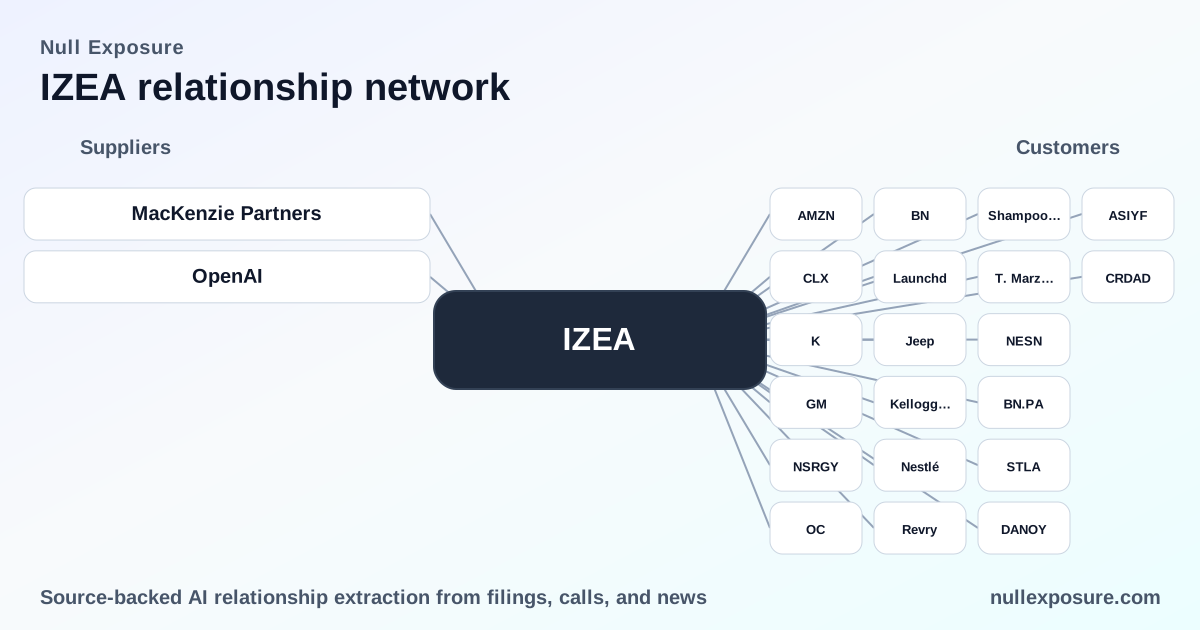
IZEA Inc.: Supplier relationships that drive a creator-economy marketplace
IZEA operates a two-sided marketplace that connects brands and marketers with individual creators and content producers; it monetizes by charging for managed services, platform access and campaign facilitation while reporting Managed Services revenue on a gross basis with direct creator payments recorded in cost of revenue. Investors should view IZEA as a services-led marketplace where supplier economics — largely individual creators and third‑party technology or agent vendors — directly determine margin variability and delivery risk. For a concise view of supplier exposure and contractual signals, see https://nullexposure.com/.
How IZEA sources value from creators and vendors
IZEA’s business model centers on matching marketers with creators to produce content, and it captures value across both platform fees and managed-service engagements. The company discloses that direct payments to third‑party creators are recorded in cost of revenue, which makes gross margin highly sensitive to creator pricing and campaign mix. IZEA also layers technology (its FormAI offering) and third‑party tools to speed production and scale output. With trailing revenue of roughly $36.2 million and a market capitalization near $62.3 million, IZEA is a small-cap, margin‑pressured operator where supplier cost structure is a primary lever for profitability.
Visit https://nullexposure.com/ for deeper supplier-level intelligence relevant to underwriting IZEA exposure.
Supplier relationships investors should note
MacKenzie Partners — information agent for a modified Dutch auction tender offer
IZEA engaged MacKenzie Partners to act as the information agent for a modified Dutch auction tender offer to repurchase up to $8.7 million of common stock; shareholders were directed to obtain offer documents from MacKenzie Partners. This is a transactional, agency-level relationship tied to capital allocation activities rather than core operations — GlobeNewswire, May 16, 2025.
OpenAI — one of the generative model technologies used in FormAI
IZEA’s FormAI product leverages a variety of generative AI technologies, explicitly including Stable Diffusion and OpenAI models, indicating IZEA integrates third‑party AI providers into content production workflows. That relationship positions OpenAI (and similar model vendors) as technology suppliers that contribute to product capabilities and go‑to‑market differentiation — Financial Post coverage of IZEA’s FormAI, FY2024.
Operational constraints and what they signal about supplier posture
The company-level disclosures and constraint excerpts reveal a consistent operating posture:
- Creators are individual service providers. IZEA compensates individual creators for text, photo, video and amplification services. This implies a highly distributed supplier base with largely variable contract terms and limited long‑term lock‑in for any single creator — a structural driver of both flexibility and delivery risk.
- Supplier role is service provision, not inventory. Cost of revenue consists largely of direct payments to creators for Managed Services, which IZEA reports gross. That accounting choice increases reported revenue but also magnifies costline volatility and makes margin management more dependent on campaign mix, pricing discipline and operational control.
- Business is services‑first. The company’s core segment is services, so supplier performance equates to customer fulfilment — uptime and content quality are operationally critical even though individual suppliers themselves are not capital assets.
- Vendor spend bands indicate mid‑tier professional fees. The company disclosed that the aggregate fees billed by Grant Thornton for audit and review services were $0.8 million in FY2024, placing some professional services relationships squarely in the $100k–$1m spend band and suggesting recurring but contained third‑party professional spend.
Taken together, these signals point to a supplier ecosystem that is broad, operationally critical, and cost‑variable — a profile that requires continuous supplier engagement, quality controls and technology to scale.
(If you are evaluating IZEA’s supplier risk in detail, we maintain supplier intelligence and benchmarking at https://nullexposure.com/.)
What this means for investors: risk and opportunity
- Margin sensitivity is structural. Because IZEA reports Managed Services revenue gross and pays creators directly, short‑term margin swings are driven by campaign composition and creator pricing. Investors should stress‑test margins under scenarios where creator compensation rises or high‑margin platform revenue lags.
- Technology partnerships are a growth enabler. Integration of OpenAI and other generative models into FormAI is a positive product signal: it lowers unit production costs and can expand addressable demand for content, but it also introduces dependency on third‑party model providers and licensing terms. Control over model costs and IP licensing will materially affect unit economics.
- Capital allocation actions are active. The tender offer supported by MacKenzie Partners shows management executing buyback activity, which is a signal on capital deployment priorities and potential share‑count management.
- Vendor concentration risk is moderate but trackable. Audit and professional fees in the ~$0.8M range indicate a recognizable set of recurring third‑party relationships; these are not immaterial and should be tracked as fixed or semi‑fixed cost commitments that influence operating leverage.
IZEA’s fundamentals also give investors a concrete baseline: trailing revenue of $36.2M, gross profit of $16.4M, and negative EPS of -$0.19, which together portray a company still working toward sustained profitability and scale.
Practical takeaways for operators and procurement teams
- Prioritize creator onboarding and retention programs to reduce cost volatility and protect campaign delivery quality.
- Negotiate transparent pricing and licensing with AI model vendors to cap model‑related cost inflation and secure predictable unit economics.
- Track professional services spend (audit, legal, investment banking) as semi-fixed costs that influence near‑term cash burn and should be weighed against buyback or growth investments.
For a supplier risk scorecard and vendor benchmarking against peers, visit https://nullexposure.com/ and request the IZEA supplier briefing.
Conclusion: supplier exposure is the fundamental lever
IZEA’s value creation hinges on its ability to orchestrate a large network of individual creators while controlling third‑party technology and professional services costs. That makes supplier strategy a first‑order investment thesis item: efficient creator economics and prudent third‑party vendor contracting will determine whether IZEA converts its platform momentum into sustainable margins. Investors should watch creator pricing trends, AI vendor terms, and recurring professional fees as leading indicators of cash‑flow resilience.
If you want a targeted supplier diligence package for IZEA or comparable marketplace operators, start here: https://nullexposure.com/.