Janus Henderson (JA): The on‑chain CLO play and what its supplier links reveal
Janus Henderson operates as an active asset manager that monetizes capital through management and performance fees across traditional and alternative credit strategies; the company is now extending distribution and product engineering into on‑chain structured credit, collecting fees from CLO issuance and servicing while outsourcing specialist infrastructure and distribution to external partners. The recent $1 billion on‑chain allocation into the Janus Henderson Anemoy AAA CLO Strategy (JAAA) highlights a deliberate commercial move to monetize credit strategies via new distribution channels and third‑party crypto infrastructure.
For more supplier intelligence and deal tracing, visit https://nullexposure.com/.
How a $1B on‑chain allocation reframes JA's supplier map
The June 2025 transaction rearranges how investors should think about Janus Henderson’s supplier exposure. By placing a flagship CLO strategy on‑chain, JA converts vendor selection and counterparty risk into revenue levers: partners that provide custody, tokenization and liquidity engineering become de facto distribution and operations vendors whose performance influences AUM and fee capture. A single large allocation delivered through a decentralized liquidity engine converts supplier execution into a revenue‑sensitivity factor.
A June 25, 2025 AlternativesWatch report flagged the allocation and partners involved, indicating JA’s willingness to use non‑bank infrastructure to scale product flows (AlternativesWatch, 2025). For more context on supplier relationships and deal flow, see https://nullexposure.com/.
Operating model signals and company‑level constraints
The record here contains no formal supplier constraints flagged against JA; that absence is itself a signal of the information set. At the company level, the observable characteristics are:
- Partner‑centric contracting posture. Janus Henderson is outsourcing on‑chain product infrastructure and distribution rather than building full stack crypto rails internally, which concentrates operational dependency on specialist vendors.
- Concentration‑sensitive monetization. A large single allocation channel for a specific strategy creates revenue concentration: execution or reputational issues with the partner could produce pronounced AUM and fee volatility.
- Criticality of nontraditional vendors. Firms that provide tokenization, on‑chain settlement and institutional liquidity functions become critical suppliers whose performance directly affects JA’s ability to distribute and monetize the strategy.
- Early‑market maturity. On‑chain CLOs remain nascent. That implies higher execution and regulatory uncertainty relative to conventional CLO distribution channels, with operational complexity outsourced to partners.
These signals should guide counterparty diligence, contractual protections and fee waterfall design for investors evaluating JA’s supplier relationships.
Supplier relationships we can verify
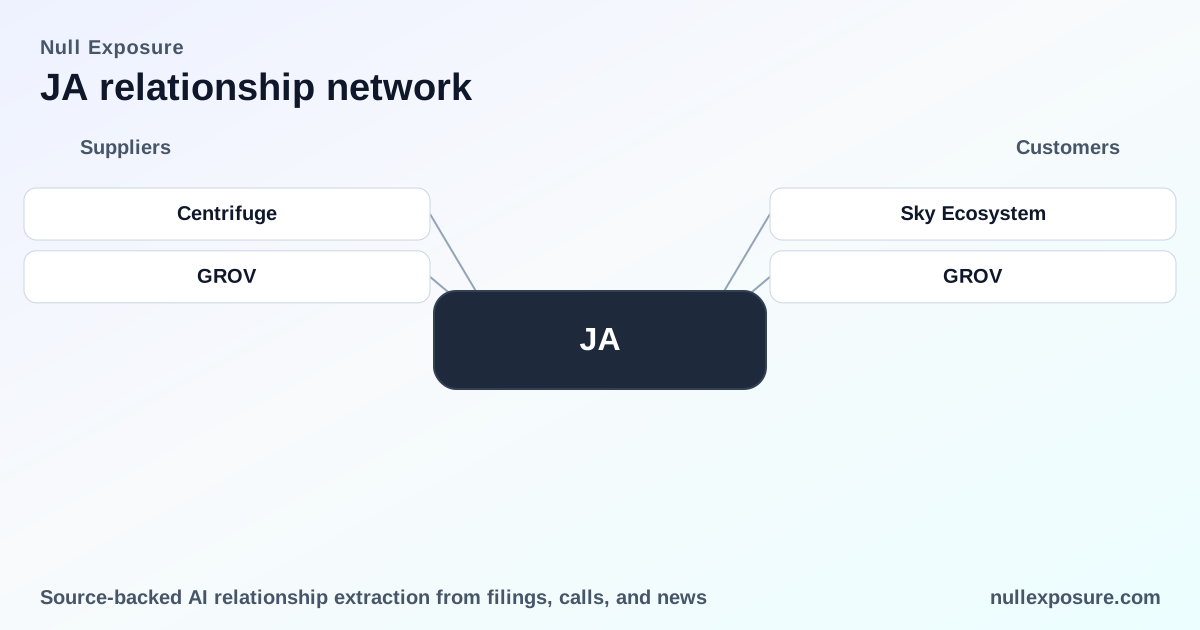
The available records list two supplier relationships connected to the JAAA on‑chain activity. Each relationship is summarized below with the original reporting.
Grove — institutional-grade DeFi liquidity engine
A June 25, 2025 report from AlternativesWatch describes Grove as the decentralized finance protocol that executed a $1 billion allocation into Janus Henderson’s JAAA on‑chain CLO strategy, positioning Grove as the liquidity engine for institutional credit flows into JA’s product. The report explicitly credits Grove with completing the on‑chain allocation into the JAAA vehicle (AlternativesWatch, June 25, 2025).
Source: AlternativesWatch, June 25, 2025 — https://www.alternativeswatch.com/2025/06/25/new-defi-protocol-grove-provides-1bn-inflows-for-janus-henderson-onchain/
Centrifuge — product partner for on‑chain CLO launch
The same AlternativesWatch piece notes that the JAAA strategy was launched in partnership with Centrifuge, indicating Centrifuge’s role in structuring or facilitating the on‑chain CLO mechanics for Janus Henderson’s offering. That partnership signals an operational dependency on specialist tokenization and asset‑onboarding capabilities (AlternativesWatch, June 25, 2025).
Source: AlternativesWatch, June 25, 2025 — https://www.alternativeswatch.com/2025/06/25/new-defi-protocol-grove-provides-1bn-inflows-for-janus-henderson-onchain/
What investors and operators should prioritize next
This cross‑section of supplier exposure translates directly into risk and opportunity items that investors and operations teams must treat as actionable:
- Contract terms and service levels. Insist on clearly defined SLAs and indemnities with partners who execute on‑chain allocations, because vendor performance will influence AUM timing and fee realization.
- Concentration limits and liquidity stress testing. Model revenue and AUM sensitivity to single‑partner execution failure; a $1 billion conduit can move JA’s strategy economics materially in a short window.
- Regulatory and custody oversight. On‑chain mechanics shift custody and regulatory boundaries; legal and compliance frameworks must be explicit in partner agreements to control reputational and enforcement risk.
- Operational redundancy and exit mechanics. Require playbooks and technical escape hatches in vendor contracts to unwind or migrate tokenized positions if a supplier fails or regulatory environments change.
These items are not theoretical; they are the operational levers that convert supplier performance into realized management and performance fees.
For deeper intelligence and supplier scoring on structured credit partnerships, visit https://nullexposure.com/ and request a briefing.
Bottom line: supplier selection has become revenue strategy
Janus Henderson’s use of Grove and Centrifuge to deliver and structure a $1 billion on‑chain allocation demonstrates an explicit business strategy: leverage specialist vendors to accelerate AUM growth in alternative credit while preserving fee capture through product ownership. That strategy delivers upside in distribution scalability but creates concentrated vendor dependency and regulatory complexity that directly affects revenue durability.
For investors evaluating Janus Henderson’s supplier risk, the practical next step is contract‑level diligence on Grove and Centrifuge analogs, scenario modeling for partner failure, and governance measures to monitor execution risk in real time. Schedule a supplier risk review and access tailored analysis at https://nullexposure.com/.