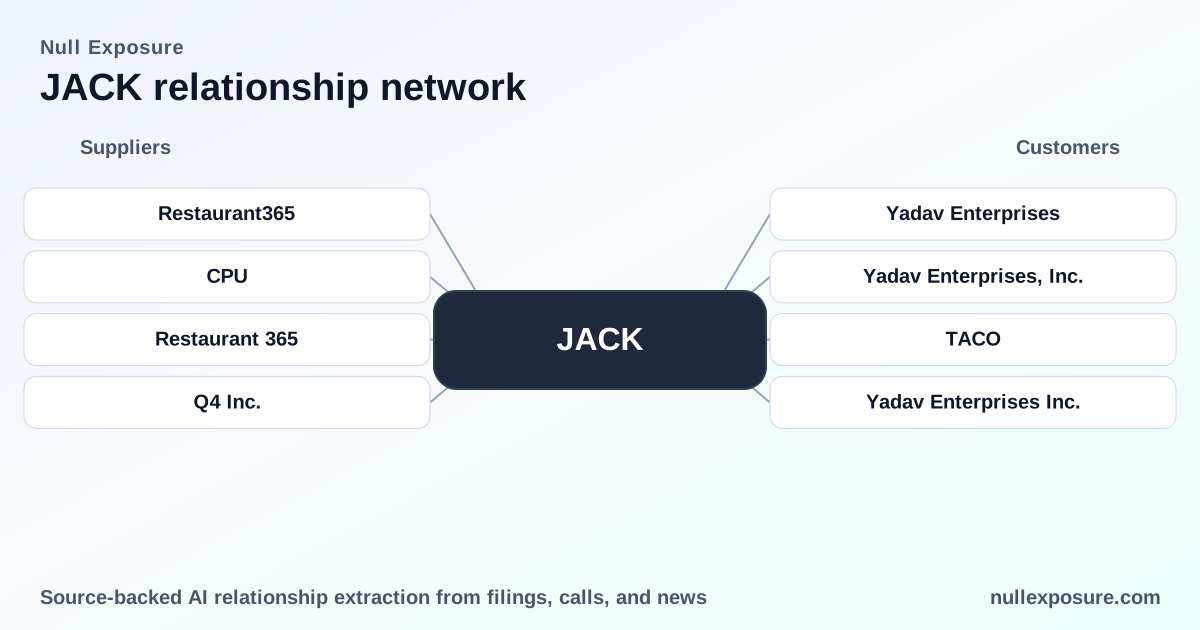
JACK supplier relationships: what investors need to know now
Jack in the Box (JACK) runs and franchises quick-service restaurants and monetizes through in-store sales, franchise fees and rental income, and company-owned restaurant operations that convert menu traffic into cash flow. The company operates a tightly integrated supply chain and back-office infrastructure where third-party vendors handle inventory, distribution, transfer agent services, and investor communications—each relationship directly affecting operating leverage and execution. For investors, the critical read is how vendor concentration, contract maturity, and strategic platform choices influence cost control and operational resilience.
Visit https://nullexposure.com/ for deeper supplier analysis and monitoring tools.
How JACK’s vendor choices translate into economics
Jack in the Box is a high-frequency retail operator whose margins depend on consistent product availability, tight commodity purchasing, and efficient restaurant operations. Third-party vendors are not peripheral: they are conduits of margin stability. Selecting a single enterprise inventory platform or a single primary distributor concentrates both upside (scale, standardization) and downside (single-point failure, contract pricing exposure). The company’s vendor posture therefore drives both short‑term operating volatility and longer-term cost trajectory.
Operating model signals investors should read between the lines
JACK’s public disclosures and related reporting deliver several actionable company-level signals about how it contracts and spends:
- Contracting posture and maturity: The company uses long-term distribution contracts that extend into 2027, reflecting deliberate multi-year commitments that lock in logistics and pricing frameworks. This is a structural lever for cost predictability and negotiation power with distributors.
- Concentration and criticality: JACK contracts a single primary food service distributor for substantially all food, packaging and supplies, indicating high concentration and high criticality of that counterparty to system-wide operations.
- Buyer behavior and procurement sophistication: Management actively uses purchasing contracts and pricing arrangements to manage commodity exposure, signaling an institutional procurement approach that reduces spot-price risk for major ingredients.
- Service and technology reliance: The firm engages third parties for cybersecurity and back-office platforms—evidence of increasing reliance on external service providers for both risk management and operational automation.
- Spend scale and balance-sheet posture: Corporate facilities include a revolving financing structure permitting borrowings up to $150 million, indicating meaningful near-term liquidity capacity that supports letters of credit and supplier financing needs.
These are company-level operating characteristics inferred from public excerpts rather than attributes of any single vendor.
Named supplier relationships and what they mean for operators and investors
Restaurant365 / Restaurant 365 — systemwide inventory platform
Jack in the Box selected Restaurant365 as its sole back-office inventory platform, consolidating inventory management across the system to a single provider; this increases operational standardization and data centralization while increasing vendor reliance for critical inventory controls. Source: Finviz and Orange County Business Journal coverage, March 2026.
Computershare Shareowner Services LLC — transfer agent and registrar
Computershare is listed as JACK’s transfer agent and registrar, a standard institutional relationship that governs shareholder records and proxy services; this is operationally low-risk but essential for capital markets administration. Source: Jack in the Box investor release (March 2026).
Q4 Inc. — IR/web platform provider
Jack’s investor site references Q4 Inc. as the platform powering investor communications, indicating the use of a third-party SaaS provider for IR engagement and disclosure delivery; this is a routine but material service in terms of investor reach and compliance. Source: Jack in the Box investor release (March 2026).
Why these relationships matter to valuation and operational risk
Investors should weigh both the strategic benefits and concentration risks embedded in JACK’s vendor roster:
- Standardization vs single-point risk. Bringing systemwide inventory onto Restaurant365 reduces operational variance and can lower shrinkage, but it also creates a dependency that elevates operational risk if integration problems or outages occur.
- Distribution concentration. The disclosed practice of using a single primary food-service distributor for most supplies through at least August 2027 concentrates logistics and negotiating leverage; the result is predictable fulfillment but greater exposure to distributor pricing changes or service disruptions.
- Procurement discipline mitigates cost shocks. JACK’s stated use of purchasing contracts and pricing arrangements for commodities is a positive risk mitigation tool that smooths input-cost volatility and supports margin stability.
- Service-provider exposure is manageable but real. Transfer-agent and IR-provider relationships (Computershare, Q4) are standard and have limited operational risk, but cybersecurity outsourcing and core inventory systems are higher-stakes because they intersect with customer service, compliance, and supply continuity.
- Liquidity supports supplier commitments. The company’s revolving financing capacity up to $150 million signals financial flexibility to back letters of credit or supplier financing, which is relevant during commodity-driven working-capital stress.
If you track JACK’s supplier posture over time, prioritize vendor SLAs, contract expiry calendars (notably 2027 distribution expiries), and any disclosed contingency plans for alternate distributors or multi-vendor inventory rollouts.
Visit https://nullexposure.com/ to map contract expiries and concentration metrics for JACK and comparable operators.
Practical checklist for investors and operators
- Confirm contract end-dates and optionality on key distribution and inventory platform agreements.
- Monitor operational KPIs after the Restaurant365 rollout: inventory turns, stockouts, and ordering cycle times.
- Validate contingency plans for distribution (alternate distributors, dual-sourcing) given the single-distributor posture.
- Review cybersecurity third-party assessments and vendor SOC reports because back-office platforms and investor systems are integration points for risk.
- Keep an eye on commodity hedging disclosures and purchasing arrangements to assess margin resilience.
Final takeaways and next steps
JACK is standardizing critical operational infrastructure while keeping distribution concentrated—this trade-off increases predictability but raises single-counterparty exposure. For investors, the most material items to monitor are contract maturities (notably distribution through August 2027), performance metrics post-inventory platform implementation, and any disclosure on contingency sourcing. For operators, ensure SLA rigor and dual-source planning where feasible.
Learn more about supplier concentration, contract timelines, and operational risk for JACK and peers at https://nullexposure.com/. For continuous monitoring and supplier mapping services, visit https://nullexposure.com/ to get started.