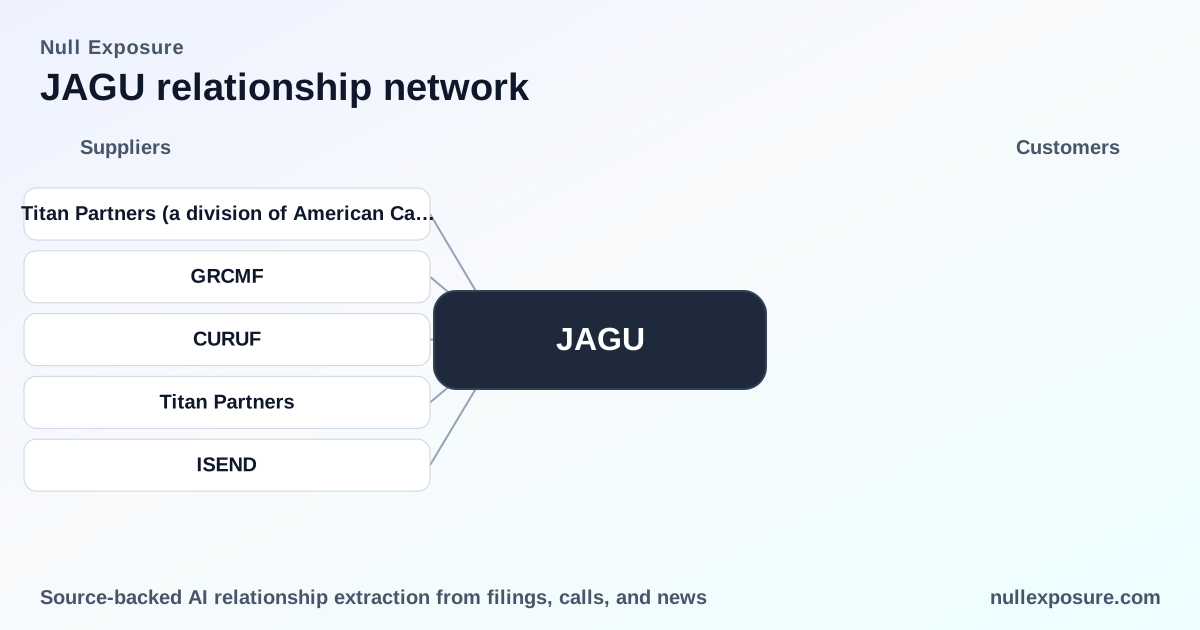
Jaguar Uranium (JAGU): supplier relationships and commercial implications for investors
Jaguar Uranium is an exploration-and-development company that monetizes through two levers: capital markets financing to fund exploration and acquisitions, and royalty arrangements on acquired Argentine uranium projects that provide contingent upside without adding operational overhead. The company operates with no current revenue, relies on equity raises for cash, and transfers exploration risk through royalty grants and asset purchases. For ongoing monitoring of Jaguar’s counterparty map and capital events visit https://nullexposure.com/.
How Jaguar makes money — a clear, capital-dependent model
Jaguar’s economics are straightforward for an early-stage uranium explorer: it acquires or takes title to uranium projects, finances exploration and permitting through equity issuances, and structures royalties that convert future production into a non‑operating revenue stream. Jaguar’s public metrics reinforce this profile: zero reported revenue, negative EBITDA, and meaningful insider ownership (approximately 36.6%), signaling a tightly held, founder-investor structure that depends on outside capital for near-term activity. Market capitalization is modest (~$46M), and the company’s financials show a development-stage balance between exploration upside and financing risk.
Operating model signals investors should weigh
Jaguar’s supplier and counterparty posture is transactional and financing‑centric, not vertically integrated. Key operational characteristics:
- Contracting posture: Predominantly short‑term, deal‑by‑deal agreements (royalties and placement agents) rather than long-term service contracts.
- Concentration: A small number of counterparties (bookrunner and royalty recipients) control critical funding and asset economics, increasing single‑counterparty exposure.
- Criticality: Relationships that deliver financing or royalty terms are strategically critical; failure to execute with these partners would materially slow exploration.
- Maturity: Corporate stage is nascent; contracts are commercially standard for juniors, and business model dependence on capital markets elevates liquidity and execution risk.
Key supplier and partnership relationships you must know
Below are every named relationship identified in public coverage to date, with plain-English summaries and sources.
Titan Partners (division of American Capital Partners)
Titan Partners acted as sole bookrunner on Jaguar’s recent offering that raised $25 million, positioning the firm as Jaguar’s primary capital markets intermediary for the IPO and follow-on financing. According to a Newsfile press release and reporting in March–May 2026, Titan Partners was the exclusive manager of the offering, making it the principal execution partner for Jaguar’s near-term funding. (Newsfile press release, March 2026; Investing.com coverage, May 2026)
American Capital Partners
Titan Partners operates as a division of American Capital Partners, which therefore provides the institutional relationship and underwriting channel behind Jaguar’s capital raise. Multiple press reports in spring 2026 list American Capital Partners as the parent organization through which the sole-bookrunner services were delivered. (Investing.com, May 2026)
Green Shift Commodities (GRCMF)
Jaguar granted royalties to Green Shift Commodities on select assets (notably Berlin-linked interests), creating a revenue‑sharing line that will pay out if and when production or monetizable resource events occur. TradingView and related coverage in March 2026 note Green Shift Commodities as a royalty recipient on Jaguar’s Argentine projects. (TradingView, March 2026)
Consolidated Uranium (CURUF)
Consolidated Uranium-affiliated entities received royalty interests tied to the Argentina projects Jaguar acquired, embedding future cashflow obligations into Jaguar’s project economics while shifting exploration/production risk to Jaguar. TradingView reported royalties to Consolidated Uranium affiliates in the company’s transaction disclosures in March 2026. (TradingView, March 2026)
IsoEnergy (ISEND)
IsoEnergy sold its Argentina-based uranium projects to Jaguar, a transaction that underpins Jaguar’s core asset base, and IsoEnergy/affiliates are noted in press as connected to royalty provisions on those projects. Mining-Technology and related outlets covered the divestiture and transfer of assets in reporting on Jaguar’s formation of project holdings. (Mining-Technology, March 2026)
What these relationships mean for investors
- Financing dependency is concentrated. Titan Partners/American Capital Partners functioned as sole bookrunner for the $25M raise, a critical single point of execution for Jaguar’s capital plan. That concentration accelerates execution when aligned but raises refinancing risk if the relationship changes. (Newsfile / Investing.com, March–May 2026)
- Royalties trade operational burden for future cost. Royalty grants to Green Shift Commodities, Consolidated Uranium affiliates, and IsoEnergy reduce Jaguar’s near-term capital commitment but dilute long‑term upside and complicate future project economics if resource conversion becomes material. (TradingView, March 2026)
- Asset-led growth with partner handoffs. The purchase of Argentina projects from IsoEnergy supplied Jaguar with its asset base while simultaneously creating third-party economic claims, which is a common junior‑miner pattern to scale reserves without building operating capability. (Mining-Technology, March 2026)
For continued tracking of how these supplier dynamics influence Jaguar’s financing cadence and project economics, see https://nullexposure.com/.
Risks, catalysts, and a short checklist for diligence
- No operating revenue and negative EBITDA make Jaguar fully reliant on capital markets for near-term activity.
- High insider ownership aligns management incentives with long-term value creation but can hinder external governance and liquidity.
- Royalties reduce both upside and financing flexibility by creating recurring obligations against future project cashflows.
- Single-bookrunner concentration accelerates execution when stable but increases vulnerability if underwriting capacity exits.
- Catalysts to watch: successful deployment of the $25M raise into resource definition; changes to royalty arrangements; follow‑on financing terms or a syndicate expansion beyond Titan/American Capital.
Bottom line for investors
Jaguar Uranium is a classic exploration-stage junior: asset acquisition financed by equity and structured with royalties, creating a levered exposure to uranium price and discovery outcomes while embedding counterparty dependencies into its capital and revenue structure. Evaluate Jaguar through two lenses: (1) execution risk — can the company convert capital into delineated, permit‑ready resources — and (2) counterparty economics — how the royalty and underwriting relationships will shape net recoveries to shareholders. For a rolling view of Jaguar’s counterparties and headline events, visit https://nullexposure.com/.