Janux Therapeutics: supplier relationships, concentration risks, and what investors should price
Janux Therapeutics develops cancer therapies using its TRACTr platform and monetizes by advancing candidates through clinical milestones toward commercial licensing or direct commercialization; the company outsources core manufacturing and leverages in-license agreements for cell lines and key biological materials, while funding operations primarily through equity and milestone/royalty structures. For investors and operators, the relevant thesis is simple: Janux is a development-stage biotech that externalizes manufacturing and core biological assets, making its value trajectory dependent on third-party supplier continuity and license economics. Explore supplier intelligence at NullExposure: https://nullexposure.com/
One supplier dominates the disclosed relationship map — why that matters
Janux does not operate internal cGMP manufacturing and relies on external partners for the Bulk Drug Substance (BDS) and licensed cell lines. This structure reduces capital intensity but creates operational concentration and single-source exposure, elevating supplier criticality for timelines and cost control. The company’s public disclosures show a licensing posture (in-licenses for cell lines) and recurring reliance on service providers for research, clinical and administrative support; these factors together define the contracting posture as license-heavy, outsourced-manufacturing, and single-source dependent.
- Contracting posture: Janux is primarily a licensee for cell-line technology and a buyer of third-party manufacturing and support services, with no internal cGMP capacity.
- Concentration and criticality: The company acknowledges single-source suppliers for BDS in the foreseeable future, concentrating production risk and potential commercial bottlenecks.
- Maturity of relationships: Material supplier contracts date to 2021 (cell-line license and support services) with corporate lease commitments extending through 2033, indicating multi-year commitments on both supplier and property fronts.
- Spend scale: Disclosed contractual economics — a license milestone fee and a buyout option up to $15.0 million, along with a $38.0 million noncancelable real estate lease — position Janux’s supplier and facility commitments comfortably inside the $10m–$100m spend band.
Explore how these supplier dynamics translate into valuation and operational risk at NullExposure: https://nullexposure.com/
The full relationship list (disclosed results)
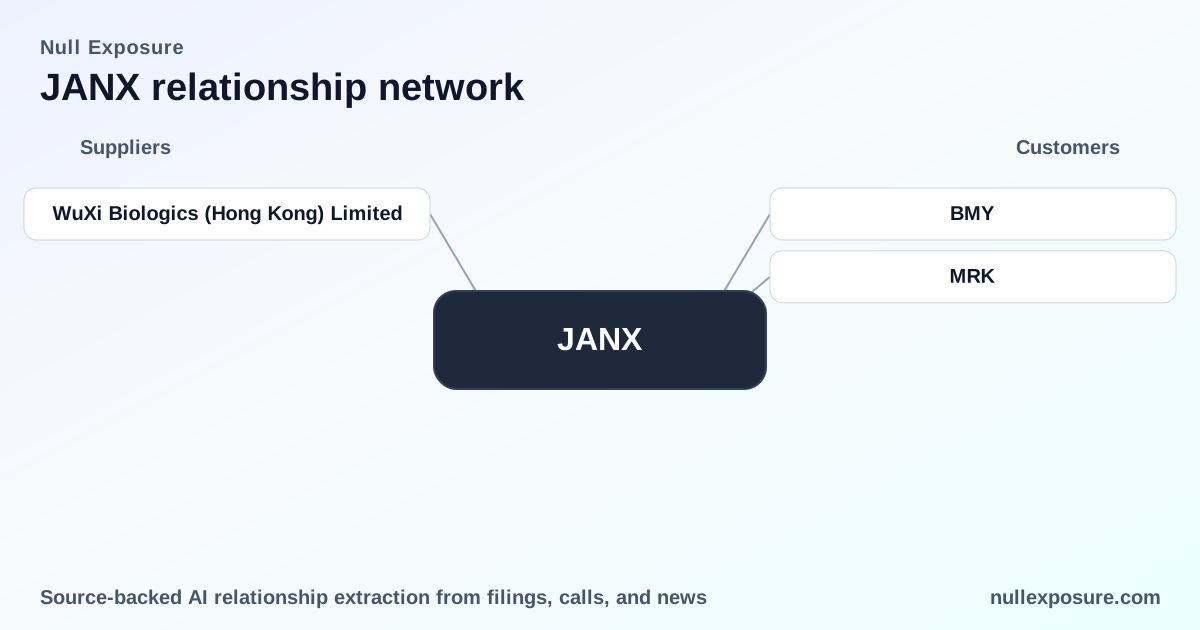
WuXi Biologics (Hong Kong) Limited — Janux holds a cell-line license that supplies biological materials used to manufacture components of its PSMA-TRACTr and EGFR-TRACTr candidates; the license is non‑exclusive, worldwide and sublicensable, and included a one-time milestone fee as well as a buyout option up to $15.0 million to eliminate ongoing royalties. According to Janux’s FY2024 Form 10‑K, the April 2021 Cell Line License Agreement grants rights to use WuXi’s licensed technology to make and commercialize specified therapeutic products. (Source: Janux 2024 Form 10‑K, fiscal year ended 2024.)
Additional supplier and contract signals flagged in filings
The 10‑K and related disclosures include other supplier and service arrangements that shape Janux’s operating profile even if they are not long-term manufacturing partners:
- Janux relied on a Support Services Agreement with Avalon BioVentures that provided shared back-office and R&D support; that agreement terminated on December 31, 2024, changing the company’s administrative outsourcing posture. (Source: Janux 2024 Form 10‑K.)
- Janux explicitly states it does not own or plan to build cGMP manufacturing capacity and currently contracts third parties for manufacturing and supply of TRACTr components, which establishes a persistent dependency on external manufacturers for clinical and commercial supply. (Source: Janux 2024 Form 10‑K.)
- The company leases office and laboratory space in San Diego under a noncancelable lease that commenced in July 2022 and runs through January 2033, with aggregate payments of approximately $38.0 million — a fixed overhead commitment that affects cash runway planning and supplier spend prioritization. (Source: Janux 2024 Form 10‑K.)
What the supplier mix means for risk and upside
Janux’s business model choices create a distinct risk-reward profile:
- Operational risk: Single-source BDS and licensed cell lines create high vendor dependence. A manufacturing disruption or licensing dispute could delay clinical programs and compress near-term optionality.
- Commercial leverage: The license is sublicensable and non‑exclusive, allowing Janux to scale or partner for commercialization without owning the upstream cell-line IP outright; the buyout option offers a lever to convert royalty exposure into a finite upfront cost if commercial prospects justify it.
- Financial flexibility: With buyout economics capped in the low‑to‑mid tens of millions, Janux can convert a variable royalty liability into a fixed charge if capital markets or partnering discussions support that trade — a tactical tool for commercialization planning.
- Fixed overhead pressure: The long-term real estate lease raises the company’s fixed cost base, making predictable supplier commitments and milestone achievement more important for solvency and dilution management.
Practical takeaways for investors and operators
- Investors: Price in a combination of binary clinical risk and concentrated operational risk. The presence of sublicensable licenses and a capped buyout option reduces perpetual royalty uncertainty but leaves schedule risk concentrated on third-party manufacturers.
- Operators: Prioritize diversifying BDS supply and building contractual redundancy for critical components. Use the buyout option and sublicensing flexibility as strategic levers in partner negotiations and commercialization strategy.
- Risk mitigation: Secure secondary manufacturing capacity and negotiate service-level and contingency clauses in future contracts to protect program timelines and regulatory filings.
Relationship detail — single-line investor summary
WuXi Biologics (Hong Kong) Limited: Provides a non-exclusive, worldwide, sublicensable cell-line license used to manufacture key components of Janux’s PSMA-TRACTr and EGFR-TRACTr candidates; the agreement included a milestone-paid license fee and a buyout option up to $15.0 million to extinguish royalties. (Source: Janux 2024 Form 10‑K.)
Final recommendation and next steps
Janux’s supplier posture is conventional for a clinical-stage biotech — outsourced manufacturing with strategic licensing — but concentration at the BDS and cell-line level creates a material operational lever that will influence clinical timelines and valuation. Investors should monitor any announcements on additional manufacturing partners, exercised buyout options, or sublicensing deals as catalysts that materially reduce execution risk.
For timely supplier intelligence and alerts that map these exact dynamics against counterparties and contract terms, visit NullExposure and subscribe: https://nullexposure.com/