JBDI Holdings: who supported the IPO and what those supplier relationships tell investors
JBDI Holdings operates a focused trading business that buys, reconditions and sells industrial containers across Singapore and Southeast Asia, monetizing through resale margins and volume-driven recycling services. The company’s public-market profile was established through an $11.25 million IPO process in 2024, creating a new set of professional supplier relationships (investment banks, legal counsel and investor relations) that govern its access to capital and public reporting. For investors and operators, the relevant signal is that JBDI’s supplier network is transactional, concentrated around capital markets support, and closely tied to its ability to scale revenue beyond modest current levels. Learn more about supplier risk and visibility at https://nullexposure.com/.
Quick read: the core facts investors need
JBDI’s latest trailing-twelve-month revenue is $8.08 million with gross profit of $3.058 million, but negative EBITDA and EPS. Insider ownership is unusually high at 76.5%, institutional ownership is negligible, and the free float is small relative to shares outstanding. Those company-level facts shape how supplier relationships operate: short, high-impact engagements for access to capital and market communication rather than long-term strategic vendor reliance.
Who participated in the IPO and investor communications (each relationship)
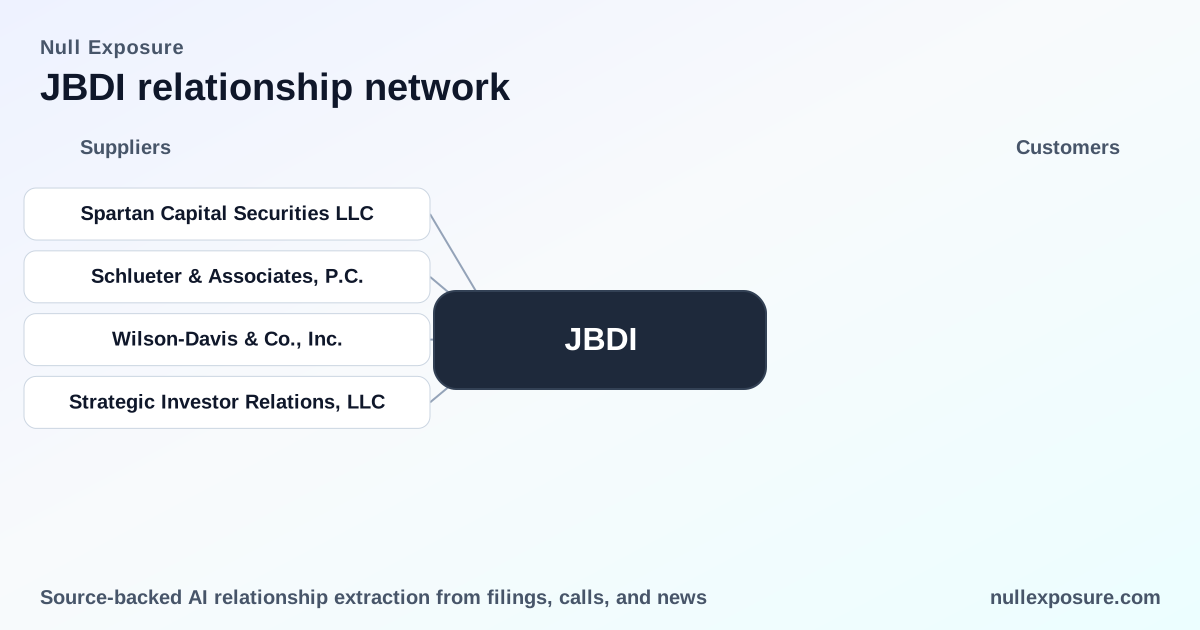
Wilson-Davis & Co., Inc.
Wilson‑Davis served as lead underwriter and representative for JBDI’s initial public offering, executing the primary capital raise that established the company’s public market valuation and free float. Source: GlobeNewswire press release announcing the closing of the $11.25 million offering, August 28, 2024.
Spartan Capital Securities LLC
Spartan Capital participated as a selling group member in the IPO, acting as an execution partner to broaden distribution and place shares with retail or other broker‑dealer clients during the offering. Source: Yahoo Finance coverage of Spartan Capital’s involvement in the offering, March 10, 2026.
Schlueter & Associates, P.C.
Schlueter & Associates provided legal counsel to JBDI in connection with the offering, handling company-side compliance, disclosure and transactional law matters necessary to close the IPO. Source: Both GlobeNewswire (Aug 28, 2024) and subsequent reporting reference Schlueter & Associates as JBDI’s counsel for the offering.
Strategic Investor Relations, LLC
Strategic Investor Relations (contact Matthew Abenante) has handled investor relations and external financial communications for JBDI, serving as the contact point for analysts, media and shareholders during earnings and corporate announcements. Source: Company press releases and financial reporting that list Strategic Investor Relations as the investor relations contact (GlobeNewswire Aug 28, 2024; Yahoo Finance March 2026).
How these relationships fit the operating model
These supplier ties are transactional and capital‑market centric. The underwriter and selling group relationships established during FY2024 are discrete engagements tied to the IPO rather than ongoing supply contracts for core operations; legal counsel and investor relations perform recurring but standard professional services. From a contracting posture perspective, expect short, defined scopes with fee-based compensation rather than equity or deeply integrated strategic partnerships.
Concentration is material: the company relied on a small number of professional service providers to complete a single transformative financing event. That concentration elevates execution risk around future capital raises and public disclosure. Maturity of these relationships is shallow — most sourcing activity recorded in FY2024 around the offering — so the company has limited track record of long-term engagement history with these suppliers.
No supplier‑level constraints were flagged in the available reporting. This absence is a company-level signal: there are no documented contractual limitations or supplier contingencies disclosed in the materials reviewed that would materially restrict JBDI’s operations or access to advisory services.
(If you need deeper supplier due diligence or tracking for other portfolio companies, start your investigation at https://nullexposure.com/.)
Investor implications: what matters for valuation and operations
- Capital-raise dependency: JBDI’s public-market existence and small market capitalization ($~13 million) make near-term financing strategy a primary value driver. The underwriter/selling-group relationships that closed the IPO are critical to any follow-on capital access.
- Governance and float risks: With insiders holding 76.5% of shares and institutions below 1%, public-market liquidity is limited and control risks are concentrated. That ownership profile heightens the influence of insider decisions on governance and M&A or capital-raise outcomes.
- Execution risk around communications: Investor relations is outsourced to a boutique firm; consistent, accurate disclosure and proactive IR will materially affect investor perception given the firm’s small float and negative margins.
- Operational scale constraints: The business generates modest revenue and negative profitability metrics. That profile means professional suppliers are primarily supporting capital markets and disclosure functions rather than scaling complex supply chains.
Key takeaway: the supplier network confirms that JBDI is early in its public-company lifecycle: relationships are concentrated, fee-based and oriented to capital-markets execution rather than integrated operational support.
How operators and managers should think about these suppliers
Operators evaluating JBDI as a counterparty should view current professional suppliers as standard capital-markets support rather than indicators of operational resilience. For managers and service providers considering work with JBDI, the profile implies predictable, short-term engagements tied to reporting cycles and financing activity, but limited long-term purchasing power until the company materially scales revenue and profitability.
For investor teams, monitoring any change in counsel, underwriter partners or IR providers provides an early signal about upcoming financing activity or shifts in governance strategy. To set up automated monitoring and deeper supplier due diligence workflows, visit https://nullexposure.com/ for tools and reports.
Final view and recommended next steps
JBDI’s supplier relationships are straightforward: banks and legal counsel closed the IPO, and investor relations manages public communications. These relationships are critical to capital access but limited in scope and maturity, so the primary investment risks are liquidity, insider concentration, and the company’s ability to reach scale profitably.
Actionable items for investors:
- Track any changes in underwriter or legal counsel engagement as signals of future financing activity.
- Monitor IR output and frequency of disclosures; with a small float, sentiment can move quickly.
- Evaluate the company’s ability to convert gross margins into positive operating cash flow before expecting strategic supplier commitments.
For a structured supplier-risk briefing or to subscribe to ongoing coverage of JBDI and comparable small-cap suppliers, go to https://nullexposure.com/.