J.B. Hunt’s supplier footprint: how the company secures capacity and controls costs
J.B. Hunt Transport Services operates as a hybrid logistics platform that monetizes through a blend of asset-based hauling (trucks and intermodal equipment) and asset-light brokerage and ICS (Integrated Capacity Solutions) services. The company generates revenue by owning and operating fleet and intermodal assets while scaling variable-cost services through third‑party carriers and independent contractors, a structure that preserves margin leverage as freight volumes normalize. Fiscal-scale decisions — from buying intermodal assets to refreshing tractors — drive both near-term capital use and multi-year operating leverage.
For a focused supplier-risk readout and relationship mapping, visit https://nullexposure.com/.
Why supplier relationships matter for JBHT’s competitive position
JBHT’s supplier choices reveal an operating posture that mixes deliberate capital deployment with flexible outsourcing. Purchasing assets such as intermodal equipment and new tractors signals a willingness to fund capacity ahead of demand, while partnerships with railroads and third‑party carriers embed the company in broader transportation networks that determine service reach and cost. Two company-level signals deserve investor attention:
- High usage of independent contractors: Public disclosures reference arrangements with 2,303 independent contractors to move freight in JBHT’s trailing equipment, a clear indicator of a large, decentralized labor/driver base that drives flexibility but increases counterparty and compliance exposures.
- Service-provider orientation through ICS: JBHT’s ICS offers non‑asset and asset‑light transportation solutions that integrate third‑party carriers with company-owned equipment, reflecting a dual-contracting posture that balances capital intensity against scale and margin control.
These are company-level characteristics that shape concentration, criticality, and maturity: the contracting posture is mixed (capital plus outsourced capacity), counterparty concentration is relatively dispersed across many contractors and large institutional rail partners, criticality is high for fleet OEMs and railroads, and relationship maturity is elevated given longstanding intermodal contracts and recent strategic asset purchases.
For deeper supplier analytics and risk scoring, see https://nullexposure.com/.
The relationships that matter (direct summaries and sources)
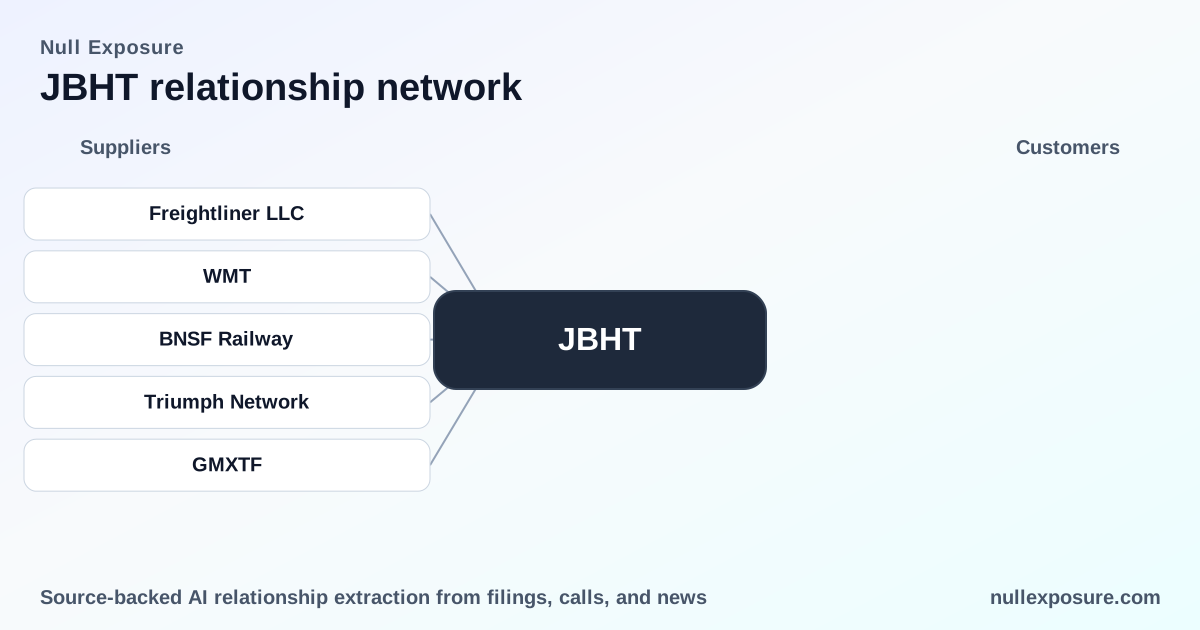
Freightliner LLC — fleet renewal through a big truck order
JBHT agreed to purchase roughly 2,100 Freightliner trucks in a one‑for‑one trade to replace older vehicles, a large fleet refresh transaction that reduces maintenance tail risk and improves fuel/technology standards for the company’s truck operations. TruckingInfo covered the deal on March 10, 2026, reporting the 2,100-truck sale and trade package.
Walmart — strategic acquisition of intermodal assets to prefund capacity
Management disclosed on the 2025 Q4 earnings call that JBHT prefunded capacity growth by purchasing Walmart’s intermodal assets, positioning the company to expand without significant incremental capital deployment for that capacity layer. The comment came during JBHT’s 2025 Q4 earnings call (remarks reflected in the transcript dated March 7, 2026).
BNSF Railway — co‑launching time‑sensitive Mexico intermodal service
JBHT partnered with BNSF Railway to launch a new intermodal product for Mexico businesses focused on time-sensitive deliveries, strengthening cross-border network capability and underscoring rail partnerships as critical to JBHT’s intermodal value proposition. TruckingInfo reported the service announcement on March 10, 2026.
GMXT — Mexican rail partner in cross‑border intermodal expansion
As part of the Mexico service, JBHT collaborated with GMXT, identified as a leading rail provider in Mexico, to deliver the time-sensitive intermodal offering, expanding the company’s reach into Mexican lanes and improving ground-to-rail interoperability for cross-border shippers. TruckingInfo’s March 10, 2026 coverage referenced GMXT’s role in the new service.
Triumph Network — payments and working‑capital efficiency
JBHT joined the Triumph Network to implement automated payment solutions aimed at improving payment efficiency, reflecting an operational focus on reducing processing friction and optimizing working capital across its supplier base. The move was noted in a SahmCapital analysis published February 15, 2026.
What these vendor ties imply for investors
JBHT’s supplier relationships reveal a deliberate combination of vertical control and third‑party scale:
- Capital allocation signal: Buying Walmart’s intermodal assets and 2,100 Freightliner tractors shows management accepts near-term capital outlay to secure capacity and service reliability, shifting some future variable costs into controlled, owned assets. This reduces the need for spot-market capacity but increases depreciation and maintenance obligations.
- Network dependency: Partnerships with BNSF and GMXT make rail operators strategically critical; intermodal performance and pricing depend on these relationships and overall rail network health.
- Operational flexibility: Heavy reliance on independent contractors (2,303 referenced) and ICS-managed third‑party carriers gives JBHT the ability to flex capacity quickly, which controls costs during demand troughs but raises exposure to contractor availability, regulatory scrutiny, and contracting costs.
- Working‑capital and supplier finance: Adoption of automated payment systems via Triumph Network signals an intent to tighten supplier cash cycles and reduce administrative friction, which improves unit economics across brokerage and carrier payments.
Key risk tradeoffs: owning assets reduces variable cost exposure but concentrates capital risk and residual-value sensitivity; relying on rail partners and contractors improves geographic coverage and scalability but creates counterparties that are operationally critical.
Investment implications and next steps
JBHT’s supplier actions are consistent with a strategy to lock in capacity and broaden intermodal reach while preserving margin via asset-light ICS. For investors and operators evaluating supplier risk, focus on three areas:
- Monitor capital spend versus utilization trends after the Freightliner and Walmart transactions to gauge returns on capacity investments.
- Track service metrics and contractual terms with rail partners (BNSF, GMXT) for signs of revenue uplift or friction in cross‑border lanes.
- Evaluate contractor costs, compliance posture, and Triumph Network payment outcomes to assess working-capital improvements and execution risk.
For a detailed supplier-risk scorecard and relationship heatmaps, go to https://nullexposure.com/.
Bottom line
JBHT’s supplier footprint shows a confident operator using a hybrid model: targeted asset purchases to stabilize capacity, coupled with network partnerships and contractor scale to flex operations. This mix creates a distinct set of operational levers — improved control and higher fixed capital on one hand, and variable-capacity agility and payment efficiency on the other — that will define JBHT’s margin path as freight markets evolve. For continuous monitoring of these supplier relationships and implications for portfolio risk, visit https://nullexposure.com/.