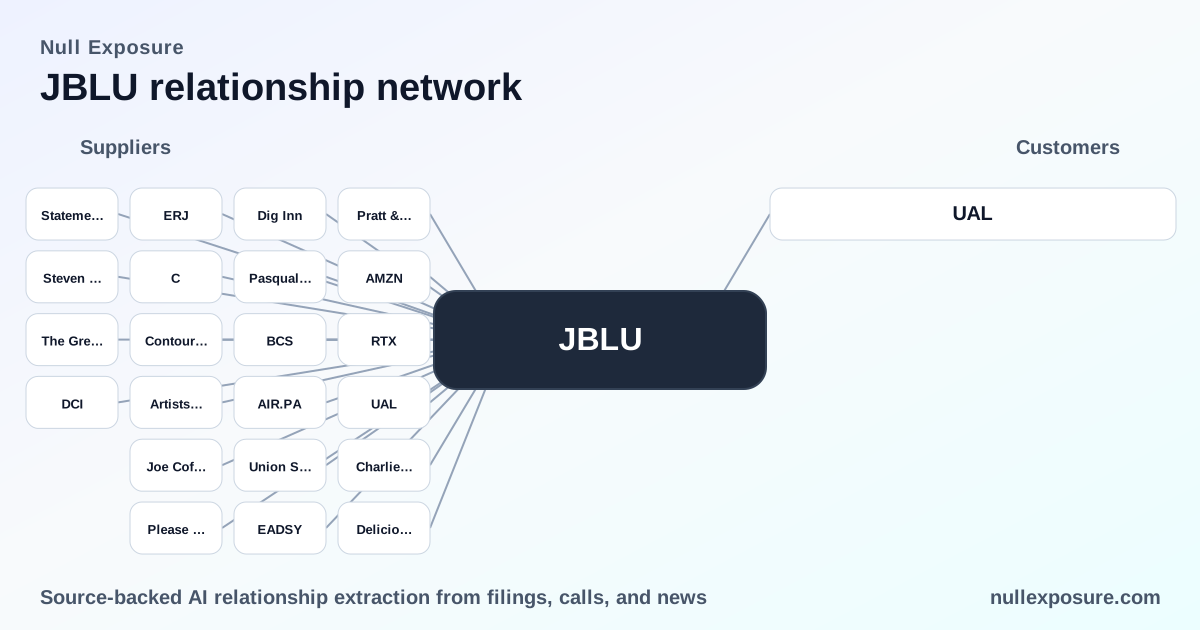
JetBlue (JBLU) Supplier Relationships: What investors and operators need to know
JetBlue monetizes passenger air transportation through a mix of core domestic routes, premium Mint services on select transatlantic and coastal flights, and ancillary revenue from credit-card partnerships and vacation packages. The airline runs a largely Airbus/Embraer fleet, outsources heavy maintenance and many in‑flight services, and finances capital through a mix of lease and purchase commitments; this combination concentrates supplier risk around engines, airframe OEMs, and service partners while generating recurring operating cash flows from ticketing and travel packages. For procurement and counterparty risk teams, the priority is understanding which suppliers are operationally critical, which contracts are long‑dated, and where short‑term exposures (fuel, engine inspections) create potential cash or capacity shocks. For deeper supplier analytics visit the NullExposure home page: https://nullexposure.com/
Supplier map: relationships that shape JetBlue's operations
Below I cover every supplier relationship found in public filings and news for JetBlue in the provided results, with a short plain-English summary and source attribution for each company.
Pratt & Whitney (RTX)
JetBlue disclosed that Pratt & Whitney GTF engines on some aircraft required FAA‑mandated inspections and removals due to a rare powdered‑metal production issue, leading to groundings and higher operating costs. This relationship is an operational pain point because engine inspections have forced fleet adjustments and parked aircraft. According to JetBlue's FY2025 10‑K and subsequent coverage (FY2025–FY2026), Pratt & Whitney engine issues have driven inspection programmes and capacity impacts.
Amazon (AMZN)
JetBlue intends to adopt Amazon’s satellite broadband solutions—references include commitments to Amazon’s Leo and Project Kuiper initiatives—to upgrade onboard Wi‑Fi by 2027, positioning the airline to outsource in‑flight connectivity to a major technology provider. TradingView and InsiderMonkey reported on JetBlue’s announcements in early 2026 (FY2026) regarding Amazon’s satellite broadband plans.
United Airlines (UAL)
JetBlue and United began offering reciprocal inventory for JetBlue Vacations packages, allowing United flights in Flight+Hotel bundles and expanding destination reach for JetBlue customers. A JetBlue press release (2026) described this sales cooperation as an immediate channel extension for JetBlue Vacations (FY2026).
Charlie Bird / Pasquale Jones / Delicious Hospitality Group (DHG)
JetBlue sources premium Mint cabin dining from DHG restaurants including Charlie Bird and Pasquale Jones to deliver elevated onboard meals on select routes. JetBlue’s 2025 route announcements and press materials cite DHG (FY2025) as the culinary curator for Mint service.
Dig Inn
JetBlue partners with Dig Inn to supply complimentary passenger meals on core routes, reflecting the airline’s strategy to differentiate with higher‑quality complimentary food in economy cabins. This is noted in JetBlue’s 2025 service announcements (FY2025).
Barclays US Consumer Bank (BCS)
Barclays issues JetBlue’s Premier World Elite Mastercard, JetBlue’s first premium co‑branded card, which includes complimentary lounge (BlueHouse) access and accelerates points earning—an important distribution and loyalty funding partner. JetBlue described the Barclays card partnership in its BlueHouse lounge announcement (FY2025).
Airbus (AIR.PA / EADSY)
JetBlue operates Airbus A320 family aircraft and deferred a portion of A321neo deliveries (44 units deferred from 2025–2029 into 2030+), reducing near‑term capex by roughly $3 billion and concentrating fleet OEM dependence on Airbus. Market commentary and JetBlue communications in 2025–2026 (FY2025–FY2026) reference Airbus fleet strategy and delivery deferrals.
Embraer (ERJ)
JetBlue operates Embraer 190 aircraft alongside its Airbus narrowbodies, which supports operational consistency but requires continuing supplier support for spares and MRO. Marketbeat reporting in early 2026 (FY2026) highlights the single‑fleet approach including Embraer 190s.
Citibank (C)
JetBlue held a $600 million line of credit with Citibank and managed liquidity with cash and investment securities; Citibank is a short‑term finance counterparty for working capital needs. TradingView coverage (FY2026) described JetBlue’s cash and liquidity posture and the Citibank facility.
Contour Airlines
JetBlue entered an interline agreement with Contour Airlines to improve regional connectivity and passenger feed on select routes, expanding access without full capacity commitments. Finviz reported the interline deal in 2026 (FY2026).
Union Square Events / BlueHouse lounge partners (Artists for Humanity, Joe Coffee, Dona, Please Don’t Tell, Statement Of, Steven Smith Teamaker, The Greats of Craft)
JetBlue curated its BlueHouse lounge offerings with a suite of local NYC partners—Union Square Events for food preparation, Artists for Humanity and Statement Of for art, and local beverage/coffee suppliers such as Joe Coffee, Dona, Steven Smith Teamaker, Please Don’t Tell, and The Greats of Craft—positioning lounge experience as a brand differentiator. JetBlue press materials from 2025 (FY2025) detail these vendor relationships.
Dona (DCI)
As part of BlueHouse food and beverage programming, Dona supplies specialty chai and matcha; JetBlue’s lounge release lists Dona among curated beverage partners (FY2025).
What the constraints tell investors about JetBlue’s supplier posture
JetBlue’s public disclosures reveal a mixed contracting posture: long‑term commitments coexist with notable short‑term exposures.
- Long‑dated capital commitments and leases. JetBlue states it has aircraft commitments through 2033 and a Terminal 5 lease with the Port Authority of New York & New Jersey (PANYNJ) through November 2042 (with an early‑termination option it elected not to exercise), which implies high lease maturity concentration and long‑horizon operational commitments (company 2025 filings).
- Indemnities that mirror financing terms. The company says indemnity terms can match the related lease or loan up to 25 years, signaling extended counterparty obligations tied to financing and asset dispositions (company filing evidence).
- Usage‑based supplier contracts. Several maintenance agreements are fixed per flight‑hour, aligning MRO spend with utilization and limiting some fixed cost exposure for heavy maintenance.
- Short‑term market exposures. JetBlue uses short‑dated OTC energy derivatives for fuel protection and reported an average remaining lease term of roughly two years for certain aircraft, indicating near‑term rollover risk on select fleet leases and material sensitivity to fuel price volatility.
- Material spend concentration. JetBlue identifies aircraft fuel as one of its largest expenses and reports multi‑billion dollar operating costs, suggesting supplier risk around fuel, engines (Pratt & Whitney), and OEM delivery schedules.
- Spend scale. Public figures show total operating cost lines in the billions, supporting a >$100M spend band for core supplier categories (company financial disclosures).
These constraints are company‑level signals that frame supplier diligence: boards and procurement should prioritize engine manufacturers, fuel hedging counterparties, OEM delivery schedules, and long‑dated lease counterparties.
Investment implications: where counterparty risk translates to value
- Engine supplier risk materially affects capacity and cash flow. JetBlue’s Pratt & Whitney inspection issues led to parked planes and higher maintenance cost, directly compressing capacity and revenues (10‑K FY2025).
- Fleet deferrals and liquidity measures reduce near‑term capex but push future delivery risk. Deferral of A321neo deliveries conserves cash today while preserving long‑term growth optionality; investors should watch delivery cadence and compensation terms with Airbus (press and market reports, FY2025–FY2026).
- Loyalty and card partnerships are revenue multipliers. The Barclays co‑brand card and United/Vacations distribution tie into recurring revenue and customer acquisition dynamics (JetBlue press releases, FY2025–FY2026).
For tailored supplier risk scoring and counterparty conflict detection for JetBlue and peer carriers, explore NullExposure analytics here: https://nullexposure.com/
Bottom line and recommended next steps
JetBlue’s supplier ecosystem is a mix of durable long‑term leases and capital commitments, usage‑sensitive maintenance contracts, and material short‑term exposures—chief among them engine reliability and fuel price swings. Active monitoring of Pratt & Whitney remediation progress, Airbus delivery schedules, and progress on satellite connectivity rollouts with Amazon will drive operational stability and investor sentiment. For procurement teams and credit analysts, prioritize engine MRO capacity, contractual remedies with OEMs, and the airline’s liquidity actions.
If you want a concise supplier risk brief or a counterparty heat map for JetBlue, request a tailored report at NullExposure: https://nullexposure.com/