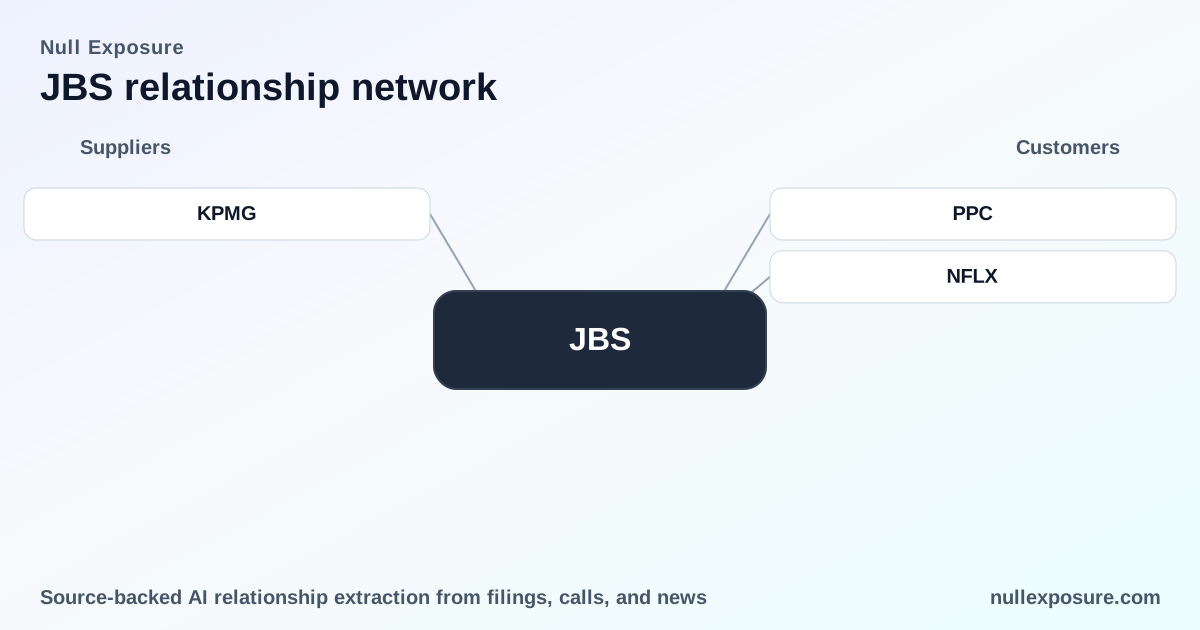
JBS: supplier footprint, counterparty signals, and what investors should price in
Thesis: JBS N.V. is a global protein and food company that monetizes scale in slaughtering, processing, and branded packaged foods through high-volume commodity sales and value-added branded channels; its cash flow derives from integrated operations across raw-material sourcing, processing, and global distribution, with profitability driven by throughput, processing margins, and scale-driven purchasing power. Investors should treat JBS as an operationally intensive, supply-chain-dependent enterprise whose investment case is driven as much by cost-of-goods and procurement dynamics as by branded-margin expansion. For deeper supplier relationship intelligence and monitoring, visit https://nullexposure.com/.
How JBS runs the business and where the margins come from
JBS is a vertically integrated meat and protein platform: it purchases livestock, slaughters and processes at scale, manufactures packaged and prepared foods, and distributes to retail, foodservice, and export channels. The company’s global footprint and throughput enable it to capture raw-material arbitrage in different geographies and to compress per-unit processing costs; revenue scales with volume (TTM revenue ~$84.15 billion) while operating leverage and branded-product mix drive margin expansion.
Operating characteristics that matter to suppliers and investors:
- Contracting posture: Procurement is centralized at regional hubs but executed where livestock supply and processing capacity intersect; this produces bargaining power vis-à-vis upstream suppliers but creates exposure to commodity-price swings.
- Concentration and criticality: Large processors and refrigeration/logistics suppliers are critical to JBS’s continuity; a disruption at key slaughter or cold-chain points creates outsized operational impact.
- Maturity and counterparty sophistication: JBS runs an institutional vendor base composed of global logistics firms, commodity suppliers, and professional services firms; those relationships are mature, often long-dated or repeated due to regulatory and certification requirements. These company-level signals inform how an investor should model supplier risk and operational stress against margin scenarios.
What the public record shows about specific supplier ties
Below I summarize every supplier relationship surfaced in the available results and what it implies for investors.
KPMG — independent valuation/assurance engagement
KPMG carried out a valuation exercise and attributed a book value of R$44.78 billion to JBS S.A. based on data as of December 31, 2024. A report on einvestidor.estadao.com.br published March 10, 2026 describes KPMG’s valuation work tied to the company’s structural changes and dual-listing process. This indicates JBS engaged a Big Four firm for valuation/assurance support during a corporate-structure transition, which is consistent with large-scale reorganizations where independent third-party appraisal and credibility are material to market reception.
What that single relationship signals to buyers and underwriters
The KPMG engagement is not a procurement contract for materials or logistics; it is a professional services relationship that signals governance and market-facing diligence during corporate restructuring. For investors and counterparties, the presence of a Big Four valuer in the public record accomplishes three things:
- It raises the quality of public financial assertions during structural changes, which reduces model risk for counterparties relying on stated book values and capital structure disclosures.
- It improves access to capital markets by providing underwriters and institutional buyers comfort around asset bases used in listing, merger, or spin-off documentation.
- It does not, however, change operating counterparty risk in the supply chain (livestock, cold chain, transport), which remains the dominant driver of cash flows and operational continuity.
For context, JBS’s scale (TTM revenue ~$84.15 billion, EBITDA ~$6.49 billion) gives it negotiating leverage with suppliers, but it also concentrates operational exposure: supplier disruptions or regulatory actions in a single geography can compress throughput and margins rapidly. Investors should therefore price both bargaining power and disruption risk into valuation multiples—JBS’s EV/EBITDA around 5.3 reflects both scale advantages and elevated operational risk.
Visit https://nullexposure.com/ for a consolidated view of counterparty-level exposures and how these dynamics affect valuation.
Practical implications for investors and operators
Translate the relationship and company signals into decision-relevant actions:
- Model sensitivity to procurement shocks. Given the importance of throughput, stress projected margins under livestock-price and cold-chain disruption scenarios rather than relying only on historical gross margins.
- Prioritize operational due diligence in key geographies. Supplier concentration in processing hubs and refrigerated logistics is a second-order value driver; on-the-ground risk (labor, health regulation, energy costs) can impair capacity rapidly.
- Monitor governance and professional-service engagements. Big Four valuations, audit changes, or new external advisers are directional signals of capital structure or listing actions that affect equity liquidity and risk premia.
Mid-analysis action: if you need ongoing supplier risk scoring integrated with market data, check https://nullexposure.com/ for tailored intelligence that maps these supplier signals into valuation scenarios.
Quick risk checklist for follow-through
- Supplier concentration: Identify top logistics and feed suppliers by spend and location.
- Regulatory exposure: Track country-level inspection and food-safety actions that can close plants.
- Commodity price sensitivity: Hedge or stress-test for large swings in livestock and feed costs.
- Third-party validations: Note the timing and scope of external valuations and audits when assessing corporate restructurings.
Bottom line and next steps
JBS is an industrial-scale protein engine whose valuation and risk profile are driven by throughput, sourcing, and logistics counterparty health. The disclosed KPMG engagement signals seriousness around corporate structure and public valuation assertions but does not substitute for granular supplier and operational due diligence. Investors should combine macro price assumptions with micro-level supplier exposure analysis to form a robust view of downside risk and upside from branded growth.
For a practical, investor-oriented map of counterparty exposures and to monitor supplier relationships as they evolve, return to https://nullexposure.com/ and subscribe for alerts and analytic coverage.