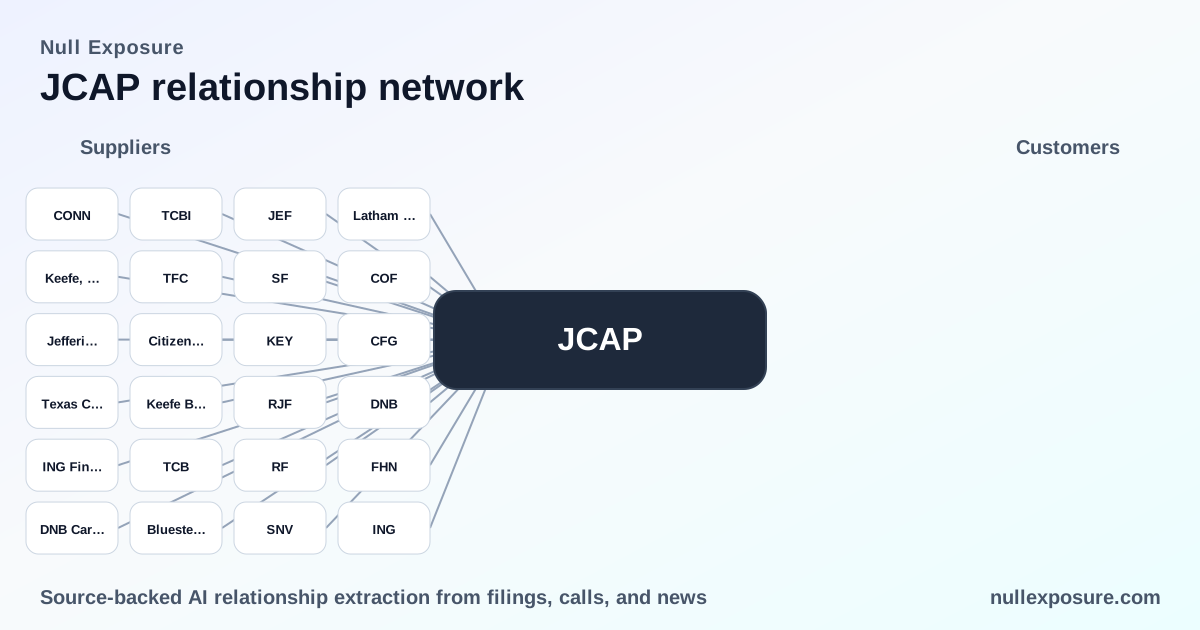
Jefferson Capital (JCAP): supplier relationships and what they signal for investors
Jefferson Capital operates as a specialized buyer and manager of consumer receivables and credit assets, monetizing through portfolio acquisitions, active collections and securitized financings while opportunistically using equity markets to manage capital and liquidity. The company generates cash by purchasing charged-off and active portfolios at discounts, extracting recovery value through analytics-driven collection operations, and then funding growth via capital markets and structured finance transactions. For a quick primer on how supplier and capital-market relationships translate to execution risk and runway, visit https://nullexposure.com/.
Why the partner list matters for a credit asset operator
A buyer of distressed consumer credit depends on three categories of outside relationships: origination/portfolio sellers, capital markets partners and underwriters, and legal/advisory counsel. The mix, depth and diversity of these partners determine access to deal flow, the cost and speed of capital, and the firmness of execution when Jefferson needs to raise equity or sell securities. Below I catalogue every relationship captured in public reporting and explain the strategic role each counterparty fills.
(If you want this formatted for diligence decks or integration planning, see https://nullexposure.com/ for tailored intelligence.)
Relationship roll call — what each partner does and why it matters
Jefferies / Jefferies LLC
Jefferies served as a joint-lead book-running manager on Jefferson Capital’s follow-on offering and was a lead underwriter on the IPO. According to Weil’s coverage of the follow-on (FY2026), Jefferies led underwriting for the $235.75 million follow-on and related repurchase activity. Source: Weil article on the follow-on offering (FY2026).
Keefe, Bruyette & Woods (A Stifel Company)
Keefe Bruyette acted as the other joint-lead bookrunner on both the IPO and subsequent follow-on offering, sharing top-tier underwriting duties with Jefferies. Source: Weil coverage of the IPO and follow-on (FY2025–FY2026).
Capital One Securities
Listed repeatedly as a book-running manager on Jefferson’s secondary offering and related transactions, Capital One Securities is part of the syndicate that provides distribution capacity and placement reach. Source: GlobeNewswire press release announcing the offering (Jan 2026).
Citizens Capital Markets / Citizens JMP
Citizens is identified as a syndicate member on both IPO-era and follow-on deals, contributing regional distribution and middle-market institutional coverage. Source: Renaissance Capital and GlobeNewswire (FY2025–FY2026).
Raymond James
Raymond James is a book-running manager on Jefferson’s secondary offering, supplying retail and institutional distribution channels that broaden order flow. Source: GlobeNewswire offering announcement (Jan 2026).
Truist Securities
Truist appears across IPO and follow-on syndicates as a joint bookrunner, adding corporate trust and regional institutional relationships to distribution. Source: Renaissance Capital and GlobeNewswire (FY2025–FY2026).
DNB Carnegie / DNB Markets
DNB is listed among the syndicate managers for the offering, indicating international or specialized capital markets participation in syndicate placement. Source: Renaissance Capital / GlobeNewswire (FY2025–FY2026).
FHN Financial Securities Corp.
FHN is named as a participating book-runner and syndicate member for the follow-on, supporting mid-cap placement and institutional relationships. Source: GlobeNewswire (Jan 2026).
ING Financial Markets LLC
ING is listed as an offering manager, suggesting debt or placement relationships that expand syndicate liquidity and lead-manager bandwidth. Source: GlobeNewswire (Jan 2026).
KeyBanc Capital Markets
KeyBanc is part of the syndicate for the offering, contributing regional capital markets distribution and investor connectivity. Source: GlobeNewswire (Jan 2026).
Regions Securities LLC
Regions appears repeatedly as a syndicate participant on IPO and follow-on transactions, supplying regional distribution and bank-channel support. Source: ConnectMoney / GlobeNewswire (FY2025–FY2026).
Synovus Securities, Inc.
Synovus is listed among the joint-book managers, indicating coverage of smaller institutional and regional accounts. Source: ConnectMoney / GlobeNewswire (FY2025–FY2026).
Texas Capital Securities / Texas Capital Bank (TCBI)
Texas Capital Securities is included in the syndicate, contributing to placement capabilities across bank and investor networks. Source: GlobeNewswire (Jan 2026).
Key underwriter counsel — Latham & Watkins LLP
Latham represented Jefferson Capital in the secondary offering, performing capital markets legal work and transaction diligence. Source: Latham & Watkins announcement regarding representation (FY2026).
Keefe, Bruyette & Woods, Inc. (legal / underwriting context)
Weil’s coverage noted that Weil advised lead underwriters including Keefe, which indicates the firm’s prominence in the underwriting group and its coordination role for execution. Source: Weil article on the $235.75 million follow-on (FY2026).
Bluestem Brands
Jefferson completed a material portfolio acquisition from Bluestem-affiliated entities, acquiring credit card receivables as part of a $302.8 million gross purchase (agreement announced Oct 24, 2025; completed Dec 2025). This is an example of JCAP’s originator/seller relationships that supply inventory. Source: Jefferson Capital press releases on the Bluestem portfolio acquisition (Nov–Dec 2025).
Conn’s
Collections activity and portfolio revenue include receipts from a Conn’s portfolio purchase, with disclosed collections of tens of millions tied to that acquisition, demonstrating Jefferson’s reliance on one-off purchases to grow recurring recovery streams. Source: Jefferson Capital quarterly results press release (Q2/Q3 2025).
Additional syndicate members and regional boutiques (summary)
Multiple regional and specialty firms — including Citizens JMP, DNB Markets, Regions Securities, Synovus Securities, FHN, and others named above — repeatedly appear as co-managers across the IPO and follow-on syndicates, providing distribution breadth and execution depth. Source: Renaissance Capital, GlobeNewswire, ConnectMoney (FY2025–FY2026).
What the relationship mix tells investors about JCAP’s operating model
-
Contracting posture: Jefferson structures short-to-medium-term, transaction-focused contracts with a broad syndicate of underwriters and regional partners rather than exclusive long-term dealer relationships; legal support is engaged on a per-transaction basis (Latham for the secondary). This indicates a transactional, capital-markets-first posture rather than vendor lock-in.
-
Concentration: Portfolio supply is sourced through discrete acquisitions (Bluestem, Conn’s), so counterparty concentration for inventory can be episodic; when large portfolios are available, Jefferson transacts directly. The underwriting syndicate is diverse, reducing single-manager concentration risk for capital raises.
-
Criticality: Capital markets partners are critical for liquidity and share repurchase or follow-on transactions; underwriter execution has direct implications for share price, dilution management and access to secondary capital.
-
Maturity: These relationships are mature in market practice (established investment banks, regional brokers and national law firms), and the pattern of repeated syndicate memberships across IPO and follow-on activity signals institutionalized execution workflows rather than ad-hoc syndication.
No explicit supplier constraints were captured in the reviewed feed; therefore there are no disclosed contract-level covenants or exclusivity provisions to attribute to specific vendors. This is a company-level signal: operational dependence is driven by execution cadence and dealflow rather than by disclosed contractual exclusivity.
Bottom line for investors and operators
- Capital-market execution is a core operational dependency for Jefferson; the company uses a diversified syndicate to scale offerings and manage liquidity.
- Portfolio acquisitions from retailers and specialty lenders are the primary supply mechanism for asset growth; these are transactional and episodic but material when announced.
- Legal and underwriting partners are standard and well-known names, reducing counterparty execution risk but leaving market and timing risk as the dominant factors.
For transaction-level diligence, model the sensitivity of liquidity to underwriter syndicate depth and the timing of portfolio rollouts. If you want help translating these relationships into a vendor-risk score or integration checklist, start here: https://nullexposure.com/.
Final call: track announced portfolio purchases and underwriting mandates as leading indicators of near-term revenue and dilution events, and use the partner roster above to map execution risk across capital-raising timelines. For more supplier-focused intelligence and tailored reports, visit https://nullexposure.com/.