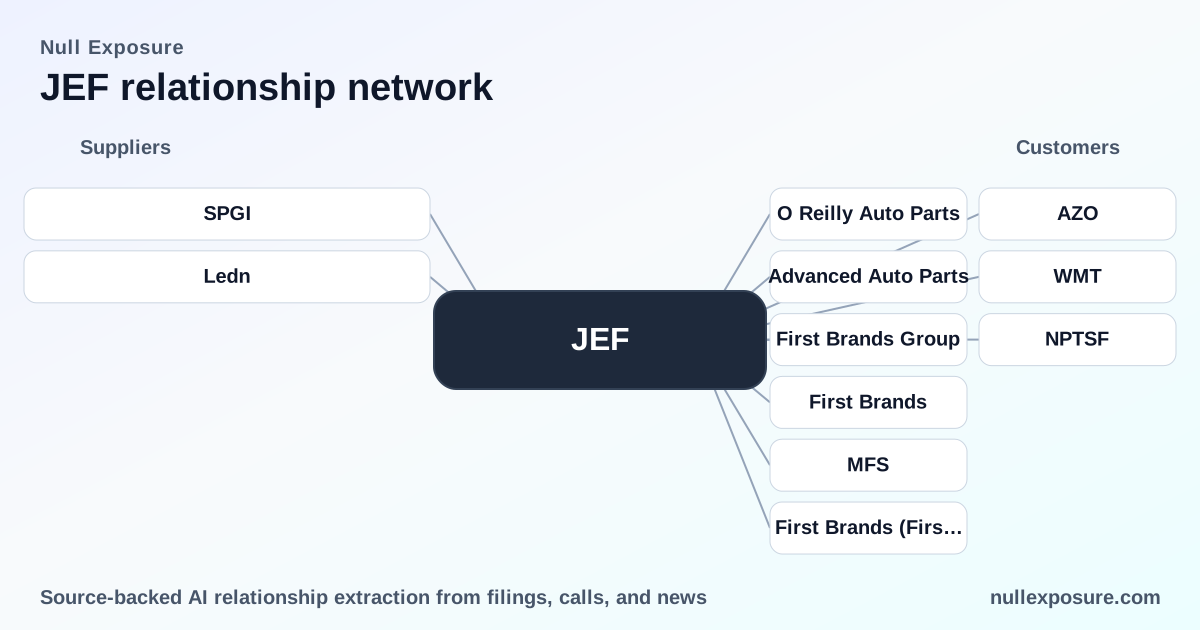
Jefferies (JEF): Supplier relationships and what they mean for investors
Jefferies Financial Group operates as a diversified capital markets and asset-management platform that monetizes through advisory and underwriting fees, trading profits and principal investment returns, and recurring asset-management fees. Revenue drivers are a mix of fee-based advisory and volatile trading/markets income, so counterparties that enable capital markets executions — ratings firms, originators and distribution partners — influence deal economics and execution risk. For a quick view of supplier exposure and to track counterparties across Jefferies’ deals, visit https://nullexposure.com/.
Why supplier links matter for a capital-markets firm
Capital-markets firms like Jefferies depend on a network of external providers that have asymmetric influence on execution and pricing. Ratings firms influence investor demand and pricing; originators and specialty lenders supply product flow; and distribution partners convert structured inventory into liquidity. Those roles directly affect deal volume and margin capture.
The constraint feed for JEF contains no flagged supplier constraints, which is itself a company-level signal: there are no documented, persistent contractual restrictions or supplier-imposed limits captured in this source. From an operational posture perspective this implies Jefferies operates with a standard contracting stance for a broker-dealer/underwriter — transaction-by-transaction engagements rather than long-term manufacturing-style supply contracts — and that supplier concentration or single-source supplier criticality are not flagged here. Contract maturity signals are likewise absent, so these supplier links should be read as transactional and market-driven rather than evidence of stable, capturable procurement relationships.
Supplier relationships identified in the record
Below I cover every relationship surfaced by the referenced feeds. Each entry is a plain-English summary with its original source.
- S&P Global Inc.: A MarketMinute article referenced S&P Global issuing a BBB- rating that was cited in coverage of a Jefferies-led bitcoin-backed asset sale, indicating Jefferies relied on an external credit opinion to support investor-facing disclosures and pricing on the offering. Source: MarketMinute on markets.financialcontent.com (Feb 11, 2026).
- Ledn: The same MarketMinute piece reported that Toronto-based lender Ledn worked with Jefferies to pool roughly 5,400 one-year loans secured by Bitcoin, a direct commercial relationship where Ledn supplied underlying collateralized loans and Jefferies structured/distributed the pooled product. Source: MarketMinute on markets.financialcontent.com (Feb 11, 2026).
How the identified relationships translate to commercial impact
These two relationships are transaction-centric but informative for different parts of Jefferies’ business model:
- S&P Global (ratings supplier) — Ratings shape market access and pricing for structured issuances; a BBB- opinion in a crypto-linked deal suggests Jefferies sought to place an institutional-quality credit wrapper on a novel collateral pool, which supports marketability and fee capture. The ratings relationship is high-impact for execution on securitizations and similar capital-markets products.
- Ledn (originator/client) — Ledn supplied the underlying loan flow used to create the asset-backed offering. That originator-to-distributor pipeline is a core route for fee generation: Jefferies earns structuring, underwriting and distribution fees, while originators provide volume that supports recurring deal flow.
These relationships are transactional and counterparty-dependent rather than long-term procurement contracts, consistent with Jefferies’ role as intermediary and principal in capital markets. The presence of a ratings firm and a crypto-lender as counterparties points to revenue opportunity but also elevated execution and reputational risk when underlying collateral is novel or volatile.
For a consolidated view of Jefferies’ counterparties across deals, subscribe and monitor updates at https://nullexposure.com/ — the platform centralizes deal-level supplier links for faster due diligence.
Risk and concentration considerations investors should weigh
- Counterparty and product risk are concentrated in the deal flow: relying on a small set of originators for novel collateral pools can amplify balance-sheet and reputational exposure if performance deviates. The Ledn relationship is an example of a single-originator flow that fed a securitization.
- Ratings dependency is material to pricing: the involvement of S&P Global as a rating provider materially influences investor demand; any change in ratings methodology or assessment standards would alter deal economics.
- Crypto-linked assets increase volatility and regulatory scrutiny: structured products backed by Bitcoin-collateral loans elevate operational and legal complexity compared with traditional ABS.
These are business-model level considerations that connect directly to Jefferies’ fee capture, market risk and franchise stability metrics (Jefferies’ FY figures show a market capitalization around $7.6B, trailing P/E ~12.9 and forward P/E ~9.2, demonstrating investor expectations that trading and underwriting revenue will sustain returns).
Practical investor takeaways and monitoring checklist
- Track which originators feed Jefferies’ securitizations — originator performance drives cash flow to bond investors and affects Jefferies’ distribution success. The Ledn example is a model to watch for repeat business or concentration.
- Monitor rating outcomes and methodologies for transactions where external credit opinions determine investor appetite; S&P’s involvement is a structural pricing lever.
- Assess exposure to novel collateral classes (crypto-backed loans) on both balance sheet and distribution inventories; these assets create asymmetric tail risk.
If you want a running log of supplier links and deal-level counterparty exposure to integrate into portfolio monitoring, check https://nullexposure.com/ for ongoing coverage and alerts.
Final recommendations: where to focus research next
- Build a short list of counterparties that repeatedly appear in Jefferies’ structured products and examine historical performance of those originators’ collateral pools.
- Evaluate Jefferies’ underwriting appetite in novel asset classes versus traditional ABS — the split will determine earnings volatility and capital requirements.
- Watch ratings agencies’ public commentary on crypto-linked securitizations for early indicators of repricing risk.
For an actionable tracker of these relationships and to receive updated supplier mappings tied to Jefferies’ transactions, visit https://nullexposure.com/.