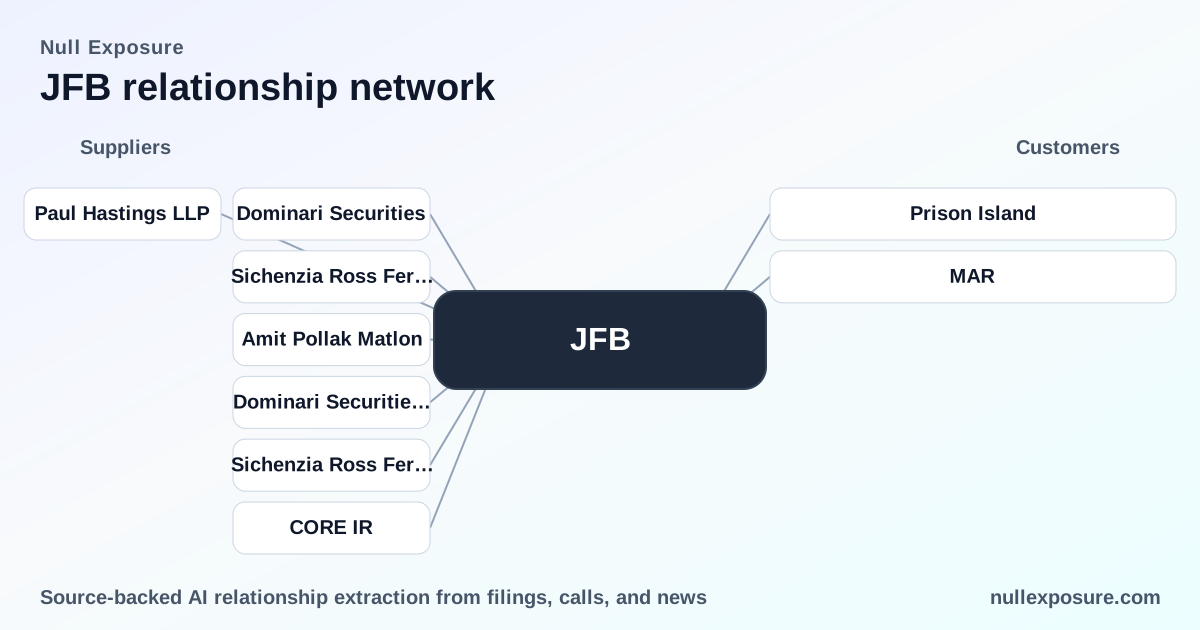
JFB Construction Holdings: Supplier and advisor map for a company turning a construction shell into a strategic issuer
JFB Construction Holdings is a publicly traded Florida-based construction and development company that historically monetizes through commercial and residential contracts and project development, while retaining a high insider ownership stake and modest institutional ownership. In early 2026 JFB has repurposed its public listing as an execution vehicle for a $1.5 billion business combination with XTEND, and is raising capital via a private placement arranged by placement agents — a shift that reorients the company’s revenue model from construction work toward transaction-driven capital markets activity and post-merger growth capture. Investors should treat JFB as a construction operator with near-term capital-markets dependencies.
Find additional supplier and counterparty intelligence at https://nullexposure.com/.
What changed this quarter: construction operator becomes deal sponsor
JFB’s core business remains construction and development — fiscal 2025 TTM revenue was roughly $21.7 million with negative reported EPS and operating margins — but the corporate narrative in early 2026 is dominated by a transformational business combination with XTEND to create an AI-driven defense robotics company. That transaction is being financed in part through an unregistered private placement and involves a set of specialist advisors: placement agents, legal counsel, investor relations, and counterparties on the deal side. News reports in February–March 2026 identify the key firms standing between JFB’s balance sheet and the intended robotics business.
A deeper supplier-and-advisor map is essential for assessing execution risk and counterparty concentration; for more detailed supplier analytics visit https://nullexposure.com/.
Operating posture and vendor model — what the constraints tell you
JFB’s operating model, based on company disclosures and the supplier-role constraint found in regulatory excerpts, presents several company-level signals:
- JFB uses subcontractors extensively to supplement an in-house workforce and to scale projects efficiently, relying on standardized agreements to manage quality, insurance, and bonding requirements.
- Those agreements impose insurance and bonding standards and require subcontractors to list JFB as additionally insured, which raises the bar for supplier qualification but also concentrates operational dependence on compliant subcontractors.
- The contracting posture is standardized and compliance-oriented, indicating mature procurement governance for construction projects but greater execution risk when the company pivots into capital markets and tech M&A activity.
These constraints should be read as firm-level operating characteristics rather than permissions tied to a single counterparty.
Who’s on the roster: counterparties and advisors you need to know
Below I cover each relationship mentioned in the available reporting; each entry is one or two plain-English sentences with a source pointer.
-
Dominari Securities
Dominari Securities is described in press coverage as the placement agent arranging an unregistered private placement for JFB related to the XTEND business combination, signaling an active role in capital formation for the transaction. See The Globe and Mail coverage of the proposed merger (March 2026): https://www.theglobeandmail.com/investing/markets/markets-news/Tipranks/281806/jfb-construction-to-merge-with-xtend-form-defense-robotics-leader/. -
Dominari Securities LLC
Multiple news items repeat that Dominari Securities LLC is serving as exclusive placement agent to JFB for the capital raise that supports the XTEND deal, underscoring placement concentration with a single boutique arranger. Pulse2 reported this detail in its coverage of the merger announcement (Feb–Mar 2026): https://pulse2.com/xtend-to-go-public-in-1-5-billion-merger-with-nasdaq-listed-jfb-construction-holdings/. -
Sichenzia Ross Ference Carmel
The law firm Sichenzia Ross Ference Carmel is acting as legal counsel to JFB in connection with the transaction, a formal role that places the firm at the center of disclosure and securities work for the deal. Pulse2 and related press releases document their engagement (Feb–Mar 2026): https://pulse2.com/xtend-to-go-public-in-1-5-billion-merger-with-nasdaq-listed-jfb-construction-holdings/. -
Sichenzia Ross Ference Carmel LLP
A parallel entry in the press release materials identifies the firm with the LLP suffix and again lists it as JFB’s counsel, reinforcing the legal advisory coverage on the JFB side of the combination. See the company press release distribution (January–March 2026): https://via.ritzau.dk/pressemeddelelse/14795761/jfb-construction-holdings?publisherId=90446&lang=en. -
Amit Pollak Matlon
Attorney Amit Pollak Matlon is named alongside Sichenzia Ross Ference Carmel as serving legal counsel to JFB, indicating a combined external legal team for securities and transaction work. This is stated in the press release distributed via Ritzau (Jan 2026): https://via.ritzau.dk/pressemeddelelse/14795761/jfb-construction-holdings?publisherId=90446&lang=en. -
Paul Hastings LLP
Paul Hastings LLP is listed among legal counsel referenced in press coverage, suggesting additional outside counsel involvement representing one or more parties to the business combination. ConstructionOwners.com and related press reports cite Paul Hastings as a legal adviser in the transaction coverage (Feb 2026): https://www.constructionowners.com/press-release/jfb-xtend-strike-1-5b-robotics-deal. -
CORE IR
CORE IR is identified repeatedly as JFB’s investor relations contact (Mike Mason), indicating a retained IR resource to manage investor communications during the merger and capital-raising phase. See company press releases and GLobenewswire distribution (Jan 2026): https://www.globenewswire.com/news-release/2026/01/22/3223694/0/en/JFB-Construction-Holdings-Announces-Commencement-of-Construction-of-Courtyard-by-Marriott-in-Melbourne-Fla.html. -
Stifel
Stifel is referenced in multiple articles as the financial advisor to XTEND (not to JFB), which places Stifel on the other side of the combination and signals professional advisory symmetry in the deal architecture. Industry reporting notes Stifel’s role in advising XTEND (February 2026): https://theaiinsider.tech/2026/02/18/jfb-and-xtend-announce-1-5b-business-combination-to-establish-ai-driven-autonomous-defense-robotics-company/. -
XTEND (counterparty target)
XTEND is the private robotics business that will combine with JFB in the reported $1.5 billion transaction; the merger is the strategic rationale for the placement agent engagement and the legal teams listed above. Transaction coverage and business combination reporting provide the timeline and valuation context (Feb 2026): https://pulse2.com/xtend-to-go-public-in-1-5-billion-merger-with-nasdaq-listed-jfb-construction-holdings/.
What this supplier and advisor footprint tells investors
- Counterparty concentration risk is real. Dominari (as exclusive placement agent) and the named law firms play outsized roles in the transaction; a failure or delay from any single lead adviser would amplify execution risk.
- Operational continuity in construction is separate from near-term capital markets risk. The constrained supplier model (standardized subcontractor contracts, insurance/bonding requirements) supports ongoing construction projects, but does not eliminate the transactional execution risk tied to the XTEND combination.
- Communications and investor-relations resources are centralized. CORE IR is the named IR contact across several press distributions, which implies coordinated disclosure control but also a single point of messaging that investors can monitor.
If you want a deeper counterparty risk profile tailored to JFB’s adviser and supplier set, explore our platform at https://nullexposure.com/.
Bottom line and investor action points
JFB is a small-cap construction operator that is actively using its quotation and corporate shell to sponsor a materially larger technology/defense combination; that pivot transforms the company’s risk profile from project execution to transaction and post-merger integration. Key near-term risks are capital-formation execution, counsel/placement concentration, and the performance of the target (XTEND). Investors should monitor placement closing updates, counsel engagement filings, and any material changes in subcontractor or bonding disclosures that could affect liquidity and delivery.
For immediate access to the supplier/advisor dossiers and ongoing monitoring, visit https://nullexposure.com/.