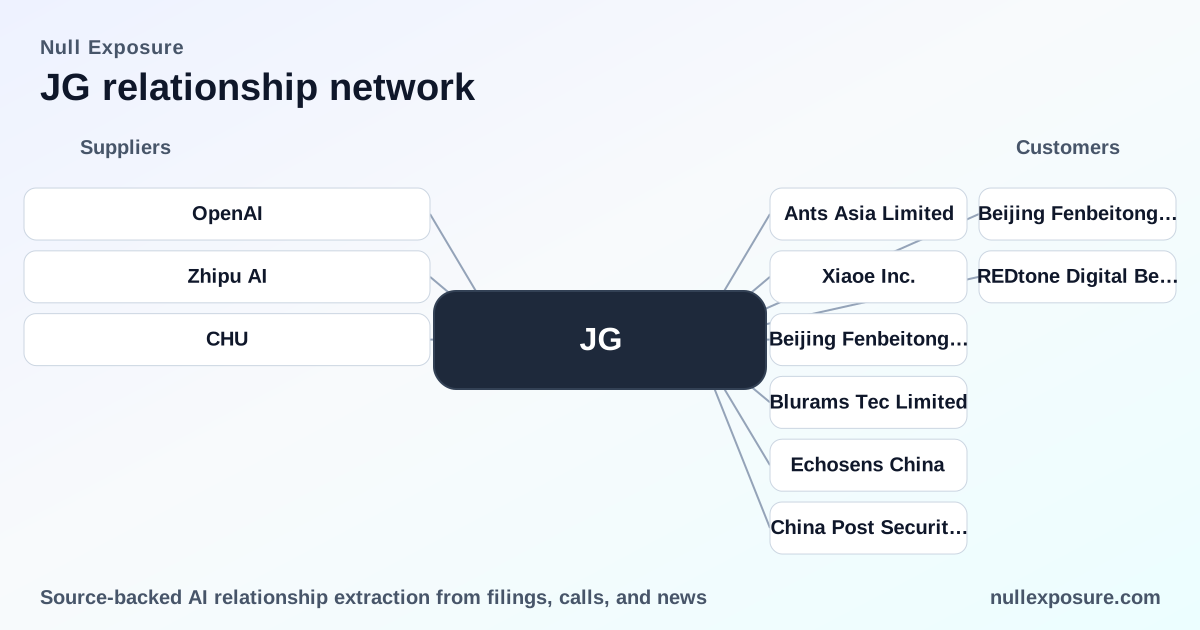
Aurora Mobile (JG) — Supplier Relationships and Strategic Implications for Investors
Aurora Mobile Limited operates as a China-based provider of mobile development and customer engagement technologies, monetizing through enterprise software licenses, platform usage fees (notably its GPTBots.ai AI agent platform and the EngageLab omni-channel suite), and paid integrations with telecom and AI vendors. Revenue is generated from platform subscriptions, value-added verification and engagement services, and AI-enabled features that command usage-based pricing, giving the company a mixed recurring/transactional revenue profile underpinned by integrations with third‑party model and gateway providers. For readers evaluating supplier risk and opportunity, this analysis breaks down each disclosed supplier relationship, explains how those ties affect Aurora’s operating posture, and highlights where investors should focus.
If you want organized exposure intelligence and supplier mapping for portfolio diligence, visit https://nullexposure.com/ for a full view of supplier footprints and risk signals.
How Aurora contracts, competes, and scales in practice
Aurora operates as a technology integrator and platform vendor rather than as an isolated component supplier. Contracting posture is vendor-agnostic and integration-focused: Aurora stitches together third-party AI models and telco gateway services into packaged solutions for enterprise customers. That posture reduces in-house R&D cost for model training but increases dependence on external providers for core capabilities and performance guarantees.
Business-model characteristics important to underwrite:
- Concentration and criticality: Aurora’s product features—voice AI on GPTBots.ai and global one-click verification through EngageLab—rely on a small number of upstream partners for models and carrier access, making those partners operationally critical to product delivery.
- Maturity and financial stance: The company shows established top-line scale (Revenue TTM ~$375M) and positive gross margins, but operating margins are slim (OperatingMarginTTM ~2.62%) and diluted EPS is negative, reflecting an operating model still investing to scale platform features and integrations.
- Commercial leverage: Integrations with global model vendors and carriers enable rapid feature expansion and addressable-market growth, but they also introduce vendor pricing and supply risk.
Supplier map: who’s in Aurora’s stack and what they deliver
Below are the supplier relationships identified in publicly available reporting and media that are relevant for underwriters and operators. Each relationship summary is concise and followed by the original reporting source.
OpenAI — audio multimodal LLM integration (FY2025)
Aurora announced that GPTBots.ai will leverage OpenAI’s native audio multimodal LLM to remove traditional ASR/TTS layers, reducing latency and improving voice interaction fluidity on its voice agent features. According to a March 10, 2026 article on Kalkine Media, this integration replaces separate ASR and TTS systems with a single multimodal model to accelerate voice workflows and reduce engineering complexity.
Source: Kalkine Media coverage, March 10, 2026 — “Aurora Mobile unveils new audio LLM capabilities on GPTBots.ai.”
Zhipu AI — GLM‑4.5 model integration (FY2025)
Aurora integrated Zhipu AI’s GLM‑4.5 as a flagship model option within GPTBots.ai to enrich Chinese-language AI agent capabilities and broaden the model portfolio available to enterprise clients. QuiverQuant reported on March 10, 2026 that GPTBots.ai fully supports GLM‑4.5 to enhance AI service experience for Aurora customers.
Source: QuiverQuant report, March 10, 2026 — “Aurora Mobile Integrates Zhipu AI’s GLM-4.5 into GPTBots.ai Platform.”
China Unicom — EngageLab verification partnership (FY2025)
EngageLab partnered with China Unicom to deliver the Smart Integrated Verification (International Edition), using China Unicom’s Open Gateway platform to power a one‑click verification ecosystem for global customers. GlobeNewswire coverage cited by Quantisnow indicates the partnership launched July 21, 2025 and targets international verification and gateway access for Aurora’s verification services.
Source: Company press release via GlobeNewswire, July 21, 2025 (reported in Quantisnow) — “EngageLab partners with China Unicom to launch Smart Integrated Verification (International Edition).”
What these relationships mean for operations and risk
Each supplier tie translates into distinct operational realities for Aurora and its customers:
- Model dependence is now explicit and diversified: Aurora uses both international (OpenAI) and domestic (Zhipu AI) LLM providers to support GPTBots.ai. This dual-sourcing reduces single-vendor risk but raises integration complexity and recurring cost exposure tied to third-party model pricing and policy changes.
- Carrier partnerships create distribution and verification scale: The China Unicom collaboration gives EngageLab direct carrier-grade access for verification services, which is material for enterprise clients requiring global authentication and reduces time-to-market for international verification products.
- Performance and commercial levers sit upstream: Because Aurora bundles third-party models and telco gateways into its offerings, service-level performance and unit economics are influenced by supplier SLAs and pricing, affecting margins and retention.
There are no explicit supplier constraint excerpts in the available public reporting for FY2025; company-level signals show Aurora is executing a multi-vendor integration strategy rather than a closed, captive supply model.
If you need supplier-level exposure analysis for M&A or counterparty diligence, check practical mapping and alerting at https://nullexposure.com/.
Implications for investors and operators
- Opportunities: Aurora’s platform approach and fast integration of leading models and carrier gateways create a pathway to upsell higher-margin AI features and verification services, supporting revenue growth and deeper enterprise engagement.
- Risks: Third‑party model pricing, API access terms, or changes in carrier gateway policies could compress margins or degrade product functionality. Geopolitical and regulatory dynamics for a China-headquartered, NASDAQ-listed company amplify vendor and compliance risk.
- Operational checklist for buyers and partners: assess SLAs for model latency and availability, validate carrier reach for target geographies, and model incremental cost of third-party model usage versus incremental revenue.
Bottom line and next steps
Aurora Mobile’s supplier posture is that of an integrator maximizing speed-to-market by leveraging best‑in‑class AI and carrier providers; this accelerates feature delivery but anchors performance and economics to a small set of external partners. Investors should value Aurora not only on top-line growth but on its ability to manage supplier costs, maintain flexible multi‑vendor options, and lock in enterprise customers through differentiated integration and verification services.
For a deeper supplier-risk briefing and to monitor supplier changes affecting JG, visit https://nullexposure.com/ to access structured supplier relationships and alerting.
If you are conducting diligence on enterprise AI stacks or carrier-dependent verification platforms, use NullExposure’s supplier mapping to translate vendor announcements into portfolio risk and opportunity signals: https://nullexposure.com/.