JHAA Supplier Review: What investors need to know about counterparties and disclosure
JHAA operates as an NYSE-listed closed-end investment vehicle that monetizes by collecting investment income and distributing it to holders through scheduled payouts; public filings and distribution notices are the primary observable signals of its commercial activity. For investors and operators evaluating supplier risk, the key question is how visible and concentrated JHAA’s external service relationships are — and whether those relationships create operational or cash-flow leverage that could affect holders. For a quick follow-up on supplier exposure and ongoing monitoring, visit https://nullexposure.com/.
The single publicly surfaced counterparty and what it tells you
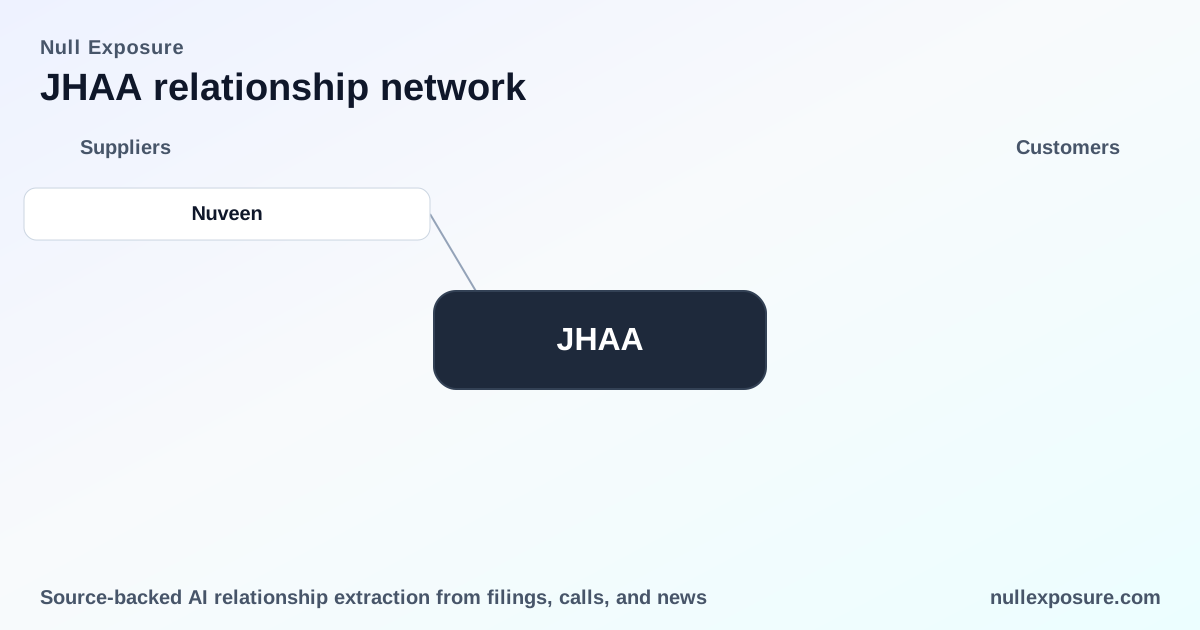
The search results identify one explicit relationship: Nuveen. According to a press release carried by The Globe and Mail covering Nuveen closed-end fund distributions (FY2023), the item lists “JHAA NYSE Nuveen Corporate Income 2023 Target Term Fund $0.0185 -$0.0065”, tying JHAA to Nuveen’s distribution notices. This is a direct, plain-English linkage between the JHAA ticker and Nuveen’s fund communications (The Globe and Mail, press release on Nuveen closed-end funds, FY2023).
- Nuveen: The press release records JHAA in the context of Nuveen’s closed-end fund distribution schedule, indicating JHAA is tied to Nuveen-managed product communications and payouts. (Source: The Globe and Mail press release, FY2023.)
This is the only relationship returned in the supplier-scope results; the record contains no additional named vendors, custodians, transfer agents, or service providers.
What the record — and the record’s absences — imply about JHAA’s operating model
With only one visible supplier linkage, investors must read both the positive signal and the silence. The positive signal is clear: JHAA surfaces in formal distribution notices tied to Nuveen-managed closed-end fund activity, which means its investor-facing cash flows and public reporting channels are integrated with Nuveen’s distribution communications.
Equally important is what the dataset omits. There are no documented third-party supplier constraints or contractual disclosures in the available results, which is itself an investor signal: either JHAA maintains a compact set of relationships that do not routinely appear in press releases, or public disclosure practices for service providers are limited. Treat that absence as a company-level characteristic rather than evidence against any specific counterparty.
Company-level operating model characteristics to factor into diligence:
- Contracting posture: Public evidence suggests vendor relationships are managed through the fund's issuer infrastructure rather than frequent public announcements; formal agreements (management, administration, custody) are likely standard but not disclosed here.
- Concentration: The observable supplier set is extremely concentrated in public records — only one named relationship surfaced — creating a possible single-point-of-visibility risk for external analysts.
- Criticality: For closed-end funds, manager and distribution channels are operationally critical; the single listed relationship to Nuveen indicates the fund’s communications and distribution mechanics flow through established fund-management channels.
- Maturity and disclosure posture: The sparse public trail implies either mature, stable vendor relationships that don’t trigger press releases, or a conservative disclosure posture that limits vendor visibility to high-level distribution notices.
For structured follow-up and continuous monitoring of counterparties, see https://nullexposure.com/ — the homepage provides tools for tracking updates and improving supplier visibility.
Risks that matter to holders and counterparties
Operational and market risks derive from how concentrated and visible supplier relationships are:
- Disclosure risk: With only Nuveen explicitly mentioned in distribution notices, investors cannot validate the broader vendor ecosystem (custodian, transfer agent, administrator) from public notices alone. Lack of documented constraints or contractual excerpts is a transparency issue for fiduciary assessment.
- Concentration risk: If critical services are concentrated with a small number of providers, service disruption or fee renegotiation could materially affect distributions. The record does not identify multiple providers; assume concentration until due diligence proves otherwise.
- Counterparty leverage: The linkage to Nuveen for distribution communications suggests the fund’s investor relations and payout mechanics are routed through Nuveen’s operational stack; that creates operational dependency that should be assessed contractually (fees, termination terms, continuity).
- Reputational and regulatory exposure: Closed-end funds trade on distribution stability; any change in the relationship noted in public communications (e.g., a revised distribution amount, manager change) will be immediately material to market pricing.
Practical next steps for investors and operations teams
Start with targeted, document-driven diligence and escalate to contractual review where warranted. Recommended actions:
- Request the fund’s current management agreement, administration agreement, and custody arrangements to identify named suppliers and termination provisions.
- Confirm the distribution mechanics and any fee-sharing arrangements with Nuveen through recent fund filings (prospectuses, annual reports).
- Monitor distribution notices and regulatory filings for changes in payout amounts, manager identity, or service-provider references.
A concise checklist:
- Obtain and review governing agreements.
- Reconcile public distribution notices against fund filings.
- Set up ongoing monitoring for distribution and manager changes.
For assistance establishing automated monitoring and alerting on supplier notices and fund disclosures, visit https://nullexposure.com/ to learn how to streamline counterparty intelligence.
Conclusion: position, priorities, and what to watch next
Key takeaway: public evidence links JHAA to Nuveen via distribution notices, but supplier visibility beyond that single linkage is limited. That combination — a clear tie to a major manager plus sparse disclosure of other vendors — is a classic indicator that investors should prioritize contractual review and monitoring rather than rely solely on press releases.
Actionable priorities for risk managers and buy-side analysts: confirm the full roster of service providers, obtain contractual terms that govern operations and termination, and institute continuous monitoring of fund communications and regulatory filings. For tools and support to operationalize that monitoring, explore https://nullexposure.com/.
This review covers every named relationship found in the supplier-scope results and frames the company-level signals investors need to complete their due diligence.